Why does urinary incontinence occur in men and how to treat pathology?
Urinary incontinence is a pathology in which a spontaneous flow of urine from the bladder is observed. There is a similar, most often, because of diseases of the urinary system. Somewhat less frequently, there is a change in the nature of the innervation of the underlying excretory structures( bladder, sphincter, urethra).Men are relatively rare with this condition, since they have a urethra many times longer than the female and urine simply does not have time to evacuate from the body.

Urinary incontinence is dangerous because in most cases it is a symptom of another, more serious disease
According to medical statistics, this pathology accounts for about 25% of all calls to a urologist. Both doctors and patients themselves are not sufficiently attentive to the described state, writing off it for banal weakening of the sphincter of the bladder due to aging of the body. This is a big mistake. This reason accounts for no more than 15% of all clinical cases. In all the rest, we have to talk about diseases. But about what, how to diagnose and cure them?
Contents of
- 1 Causes of pathological condition
- 1.1 Urologic causes
- 1.2 Other pathologies
- 2 Symptoms
- 3 Diagnostic measures
- 3.1 To which doctor should I apply?
- 3.2 Initial consultation and medical history
- 3.3 Instrumental and laboratory investigations
- 4 Treatment
- 4.1 Pharmacotherapy
- 4.2 Physiotherapy
- 4.3 Therapeutic exercise
- 4.4 Surgery
- 5 Nursing
- 6 Conclusions
Reasons pathological condition
reasons always pathological. Some of them are directly related to the pathologies of the urinary system, in other situations it is a violation of the innervation of the genitourinary structures.
Urological Causes of
-
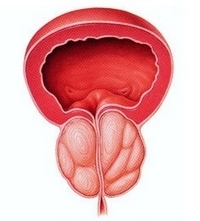
Prostatitis - inflammatory-degenerative lesion of the prostate
Prostatitis ( see details) . A common cause of urinary incontinence in men over the age of 45 years. According to statistics( European sources), prostatitis has a direct dependence on the person's age: the older the man, the higher the probability of defeat. In the age category 70+, the number of patients is approaching a hundred percent. By its nature, prostatitis is an inflammatory-infectious or degenerative degenerative disease of the prostate. It is characterized by a number of symptoms:
- Urinary incontinence due to weakening of the sphincter. It is compressed by the proliferating tissues of the glandular organ.
- Frequent false urges to empty the bladder. The organ squeezes the prostate and develops a false sense of overflow of the bladder. The reflex works.
- Erectile dysfunction. Develops due to violation of the innervation of the penis. The so-called cavernous nerves begin to die, the result is the impossibility of carrying a signal from the brain and spinal cord to the penis. Impotence persistent, treatable with difficulty.
- Pains in the area of the pubis, penis, anus, lumbar.
- Prostatic hyperplasia ( see details) .Along with prostatitis - this is the classic pathology of older men. By nature is defined as the proliferation of the prostate gland. Symptomatology is identical to prostatitis. In addition, it is characterized by nicturia: the need to visit the toilet frequently at night. This is due to the stagnation of urine in the bladder and its incomplete emptying.
- Bladder hyperactivity ( see details) .It is considered to be typically a female disease, but it's not entirely true. It often develops in young men with a weak type of nervous system. Strictly speaking, the disease does not count. This is a feature of the autonomic nervous system. Urinary incontinence in this case is imperative, that is, it can not be deliberately suppressed. The problem is relatively rare: about 1 person per 10 000 population.
- Prostateectomy .Surgery for total removal of the prostate gland. It is characterized by damage to the sphincter of the bladder. As a rule, it does not last long: the duration of the acute period of the described condition is no more than 2-3 weeks. It is considered an unpleasant side effect of the operation.
Other pathologies
In other cases, it is a question of not a urological, but a different profile. Among the typical pathologies:
-

Any damage to the spinal cord may adversely affect the urinary function of
Damage to the spinal cord and its roots .Osteochondrosis of the lumbosacral spine, herniated discs, spinal cord injuries lead to a violation of the innervation of the lower parts of the urinary tract. In addition to urinary incontinence, incontinence of stool and gases is observed. Skip this pathology is simply impossible: in addition to urinary incontinence, intense pains in the area of the affected area, irradiating to the lower abdomen, impaired motor activity are noted. Pareses and paralysis are possible.
- Sugar and diabetes insipidus. For diabetes of the sugar type, the increase in blood glucose is pathognomonic due to insufficient insulin production. In contrast to this disease, diabetes insipidus is characterized by a decrease in the production of a specific hormone-vasopressin responsible for normal kidney fluid filtration. In both cases, intense diabetes is observed. Out of the body comes more than 3 liters of fluid. Possible volumes of 15 or more liters. As a result of the severe course of diabetes, bladder hyperextension develops and the sphincter relaxes.
- Neurological diseases. Parkinson's disease, dementia, multiple sclerosis. These ailments give a typical symptomatology. If Parkinson's disease and multiple sclerosis are sometimes amenable to drug therapy, then there is nothing to be done with dementia. It remains only to use diapers for adults. Modern medicine is unable to effectively cope with the consequences of senile( age-related) destruction of cerebral structures.
- Stroke .May entail a disruption of the work of special centers of the brain. Is amenable to correction, but with difficulty.
- Effects on the bladder area of ionizing radiation .First of all, a person meets this problem during radiation therapy for prostate cancer or the bladder itself. This is a temporary effect, which takes place 2-3 weeks after the end of treatment.
- Prostate or bladder cancer.
In elderly people, almost always it is about the diseases described above, including the neurological profile. Problems with the spinal cord, diabetes, as well as hyperactivity of the bladder age "preferences" do not have.
Symptoms of
Symptoms of immediate urinary incontinence include:
- Strong urge to visit the toilet. At imperative urges it is a question of an intolerable and sharp desire to urinate.
- Urine output from the urethra. In small quantities, or in large volumes, when it comes to imperative urges.
Provoking urinary incontinence status can:
- sneezing;
- cough reflex;
- laughter;
- body position change;
- sharp physical load, including lifting weights.
Despite the fact that urine does not stay in the bladder, it does not always mean that the organ is empty. Often the opposite situation is observed: urine expires from the bladder, but the organ itself is full. This happens with prostatitis and prostatic hyperplasia in the later stages. The danger of this is the high risk of rupture of the bladder or the formation of acute renal failure.
Diagnostic measures
To which doctor should I apply?
The diagnosis of urinary incontinence is the prerogative of a urologist. It is possible and even recommended to consult a urologist-andrologist( andrologist specializes in problems of the male sexual sphere).In addition, consultations with a neurosurgeon, neurologist, and orthopedist may be required.
Initial consultation and collection of anamnesis
Primary consultation begins with an oral interview of the patient with regard to his complaints.
Next, an anamnesis is collected: the doctor specifies what diseases the person has suffered in his life. A huge diagnostic role is played by such factors as transferred venereal infections, hypothermia, the presence of diseases of the kidneys and urinary system.
The digital rectal examination of the prostate gland is mandatory. It provides an opportunity to assess the size of the organ, its structure, the presence or absence of pathological nodal inclusions and other neoplasms. This is a little unpleasant, but necessary manipulation, which, moreover, makes it possible to assess the presence of painful reactions on the part of the organ.
Instrumental and laboratory studies
Next, a series of instrumental and laboratory studies are carried out. Depending on the profile of the disease, the list can be very broad. Firstly:
- Uroflowmetry. Evaluation of the speed of urine flow. It makes it possible to reveal prostatic hyperplasia. Promotes the indirect detection of prostatitis.
- ultrasound of the urinary system. A comprehensive evaluation of all excretory structures is required. Including kidneys, bladder( to assess the presence and amount of residual urine), prostate( to confirm prostatitis, exclude its calculous form with the development of concrements).
- Study of prostate juice. The exact method of diagnosing prostatic damage.
- Spermogram.
- Study of the amount of urine( daily diuresis) according to Zimnitskiy.
- Blood tests, including venous, general urinalysis. With urological problems, a picture of inflammation is noted.
To determine other problems, additional studies are required:
- Radiography of the lumbosacral spine.
- MRI / CT scan of the brain( demonstrates foci of destruction), lumbosacral spine. Also, this survey method may be needed to verify the neoplastic process and its staging.
- Encephalograms.
Treatment
Treatment is aimed at eliminating the underlying cause of the incontinence disease. Therapy should be comprehensive with the use of medicines, physiotherapy, physiotherapy exercises.
Medical treatment
It is used for the therapy of most conditions. Depending on the type of disease, the following are shown:
-

In most cases, medication is prescribed.
Alpha-blockers. They remove the pathological spasm of the neck of the bladder, normalize the outflow of urine.
- Spasmolytics. Duplicate the pathological muscle tension.
- Analgesics. Eliminate the pain syndrome.
- Anti-inflammatory non-steroidal origin. Are appointed against inflammation of urinary and other structures.
- Inhibitors of 5-alpha reductase. They are used to stabilize the size of prostate adenoma.
Diseases of the spine are treated additionally with chondroprotectors( Structum and others) that promote the strengthening of musculoskeletal and cartilaginous structures. In exceptional cases, an operation may be required to eliminate the compression of the spinal cord and the nerve roots responsible for the corresponding nerve impulses.
Neurological diseases are treated with angioprotective agents, anticoagulants, specific drugs against Parkinson's disease and other pharmaceutical products.
Physiotherapy
Effective only with urological and orthopedic problems. Are appointed:
- ultrasound treatment;
- magnetotherapy;
- heat treatment;
- electrophoresis.
Therapeutic physical training
It is limited by Kegel exercises complex( see training of pubic-coccygeal muscle).In essence, this is the only exercise aimed at strengthening the sphincter of the bladder and the normalization of contractility of the urinary tract. It is required 100-200 times a day to strain and relax the sphincter. To understand how to perform this exercise, you should interrupt the process of urination several times. So, you can find the muscle that you should strain( see the link above for details).
Surgical intervention
An artificial sphincter may be required. Other methods of surgical intervention are applied strictly according to indications and only in extreme cases.
Taking care of patients
In case the patient suffers from pathologies of a non-urological and neurological profile, especially if the patient is recumbent, it is recommended that the following rules be observed:
- maintain constant psychological contact with a person;
- regularly ventilate the room in which the patient is located;
- buy or rent a special bed, mattress;
- to carry out preventive measures to prevent the formation of pressure sores;
- use a bedpan, polyethylene urinals for carrying;
- regularly wash the patient and prevent diaper rash;
- use diapers.
If the patient suffers from Alzheimer's disease, the family can not do anything - it is always necessary to look after the person. In all other cases it is recommended to help the patient to undergo a course of rehabilitation. The length of careful care is determined by the severity of the condition.
Conclusions
Urinary incontinence is a serious problem. An integrated approach is required in the diagnosis and treatment of this condition. A large role is given to rehabilitation after a course of therapy. In this case, the support of relatives is very important. With your own strength to fight with pathology is not necessary - you need to see a doctor. This is the only way to expect positive results.
Recommended for viewing: