The coccyx cyst. Symptoms and Treatment
 Coccyx cyst or otherwise ECX( epithelial coccygeal passage).The essence of the disease lies in the fact that with ECX strictly on the middle gluteal line at a distance of two to nine centimeters from the edge of the anus there is at least one opening. But, as a rule, there are always more than one. These ECX holes are called primary. This is the cause and the beginning of the disease. How this ill-fated hole occurs is very difficult to say.
 Experts in opinions disagree. Some consider the disease congenital, and others - acquired. The size of the holes are different. And quite dotted, and wide, resembling a funnel. Sometimes you can see a bunch of hair coming out of the hole. The disease haunts people of a young age. It almost does not occur in people who have reached the age of 45.
Causes of the disease
The causes of the disease are many. It can be a trauma of the coccyx, and influenza state, and cooling of the body. It happens that even for no apparent reason the infection can penetrate deep into the hole. In the field of coccyx and sacrum, an inflammatory process occurs. Around the primary hole appears first redness, then swelling and severe pain. This is an acute stage of the disease. The person is compelled to urgently address to the doctor. Here he learns for the first time about his illness.
Abscess should be immediately opened. Pain immediately passes, the patient is relieved. But further there is a formation of fistulas with pussy secretions. There are problems with hygiene, laundry gets dirty. The pain in the sacrococcygeal zone does not subside.
Fistulas can be closed independently. But then pus will accumulate inside, which again will exacerbate the area of the coccyx by the type of abscess.
It happens that after the opening the wound is tightened and without fistula formation. It seems that the illness is gone, but this is only an imaginary period of a successful outcome. The focus of chronic infection is preserved in the ECX and gives a repeated exacerbation. An abscess is formed, and sometimes phlegmon. In the intervals between exacerbations there is discomfort and periodic dull pain in the coccyx. This is very noticeable when sitting, there may even appear a discharge from the primary holes.
Treatment of ECD
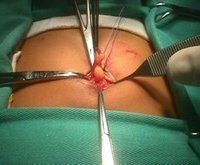
Only radical surgical intervention can cure the disease. A number of surgical interventions have already been tested. Their direct goal is to cut the pathological focus, to suture the wound in a certain way. During the operation, the coccyx cyst is removed, all primary openings and their branches. This is only the first part of the surgical intervention. It is obligatory for everyone, otherwise there will be no recovery. The second part is suturing the wound.
In a hospital, the technique of sewing the edge of the wound to the bottom is used. In outpatient clinics, open wound management techniques are used. The method has its positive side: minor pain after surgery, fast activity of the patient( although it will still be a little painful), easy tolerability and a small percentage of relapse. The disadvantage is only one - long healing of the wound, not less than 5-6 weeks. But already in the third week a person can be able-bodied.
After the operation, be under the supervision of medical personnel in the hospital, the patient must for several hours. Normalization of the general condition usually occurs in five hours. Further, the doctor conducts the final examination and changing the bandage. The patient receives recommendations on activity, care of the wound and diet. Treatment in the hospital is no longer required.
No need for pain medication. A few days later, patients already take warm baths. This accelerates the healing process of the wound and improves significantly the well-being.
After taking a bath, a fresh bandage is applied with ointment or post-ointment or levomecol. On examination to the doctor, the patient comes only once a week until the full recovery.