Daily monitoring of blood pressure
A once-measured blood pressure with a sphygmomanometer, often used in routine practice, may not accurately reflect its magnitude and is not able to give a complete picture of the dynamics occurring over a 24-hour period, which makes it difficult to diagnose hypertension and to evaluate the correctness of the selected treatment. Therefore, it is advisable to use multiple automatic measurement, i.e. Monitoring the pressure over a whole day. It will allow you to obtain the necessary information about the level of pressure fluctuations in a patient, to identify patients who experience nocturnal hypertension and abnormal pressure variability, to estimate an adequate reduction in the intake of antihypertensive medications.
Main indications for blood pressure monitoring:
- suspicion of hypertension of the White coat;
- chronicle of constitutional arterial hypotension, orthostatic arterial hypotension;
- borderline or newly diagnosed mild hypertension. The goal is to solve the problem of the need for the beginning of drug treatment;
- is a moderate or severe form of hypertension that does not respond to the prescribed course of treatment;
- assessment of prescribed therapy;
- need to obtain information regarding critical pressure fluctuations in the case of a combination with cardiac ischemia or vascular injury of the brain, as well as cardiovascular failure;
- to clarify the suspected diagnosis of hypertension in young patients with a genetic predisposition;
- obmor.
Using pressure monitoring and its benefits:
- daily monitoring of pressure more accurately reflects its level in normal life;
- the average pressure value obtained during monitoring is more closely related to lesions of target organs than clinical measurements;
- data obtained by daily monitoring of pressure before treatment, have a predictive value for detecting the development of complications in the cardiovascular system;
- regression of lesions of target organs, associated with a change in the average daily pressure value is closer than the clinical level.
Method of conducting monitoring during the day
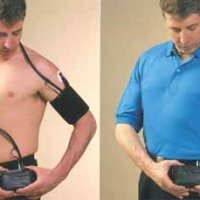
Daily monitoring of the pressure is intended to attach a special device to the patient's belt. This device quickly measures blood pressure and fixes the rhythm of the pulse during the prescribed time order. Such control is carried out one day or two.
Do not worry about the possibility of discomfort. This device is used in a certain period of time, it weighs little, works without noise, does not delimit the movements of the patient. The cuff is specially fixed on the wrist and is designed for any girth, even on the child's arm.
All measurements that are required are carried out automatically. Measurements are made through a specific time interval. If necessary, the doctor is able to receive data about the patient's health at any time.
All the indicators that are collected are recorded in a diary in which not only the daily indication of the pressure in the numerical equivalent is reflected, but also the actions performed by the patient at a certain time. It records the time of waking up in the morning, the time in transit, the relaxed state of rest during rest hours, the intake of food, medicine, beverages containing caffeine, active loads, etc.
Strictly recorded emergence of anxiety symptoms bordering on pathology - pain in the region of the heart and head, dizziness, darkening in the eyes.
The patient should behave properly during monitoring to achieve a good result, even with minimal amounts of erroneous measurement.
When monitoring, the following rules should be observed:
- when the pressure is measured, the hand with the air mantle must be pulled and relaxed;
- exclude the intensity of exercise and exercise on the day when monitoring is performed;
- if the pressure changes when walking, you should stop and lower your hand down, wait for the measurement to end;
- the patient is forbidden to look at the device with readings in order not to provoke an alarm that leads to incorrect results and leveling of the main advantages of SMAD;
- at night the patient needs to sleep, and not think about how the registrar works, otherwise the dimensions of the night study will not be reliable;
- when monitoring is carried out, the patient should fill in the diary in detail, where it is necessary to reflect all his actions, as well as the state of health.