
When it is required to build up the dental bone tissue during the implantation of teeth, the features of this procedure, the pros and cons
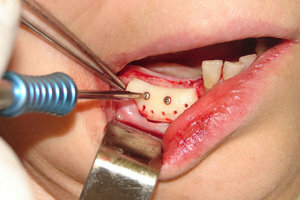 The cases of bone tissue atrophy or their deficiency are quite common problems in modern dentistry, especially if dental implants are needed.At the same time, doctors are forced to look for non-standard solutions to the current situation or resort to the procedure of increasing bone dental tissue.
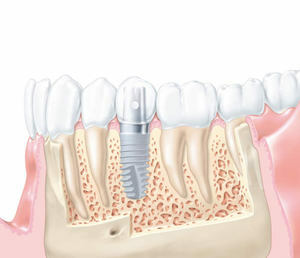 In a situation where a decrease in the volume of bone tissues of the maxillofacial region is detected, there is a high risk of damage to the maxillary sinuses when implanting the teeth.The design of the tooth implant is longer than the jawbone, which leads to rupture of the maxillary sinuses and infection with their infection, which can cause sinusitis.There are several options to solve the problem:
- installation of dental implants without the procedure of increasing the jawbone;
- sinus lifting.
It should be noted that if the problem is caused by bone atrophy in the lower jaw area, the implantation of the tooth can damage the mandibular nerve.To solve the problems associated with a lack of volume of the jaw tissue on the lower jaw, the following methods are used:
- implantation of the tooth in the anterior jaw area, which is possible only in the case of a full jaw adentium;
- Implant implantation of the tooth in close proximity to nerve endings;
- change in the location of nerve endings;
- enlargement of the jawbone during implantation of the tooth.What is the purpose of bone grafting?
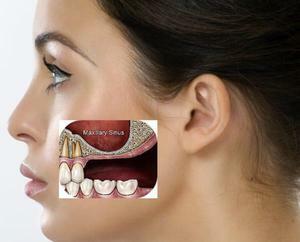 In the case of implantation of titanium structures( dental implants), a sufficient amount of jaw bone is necessary.From this, the will directly depend on the stability of the and the life of the implants.If the doctor decides to perform implantation of the teeth without the build-up of bone tissue, then this is only possible if there is a ten-millimeter-high jawbone.
In its turn, insufficient jaw bone volume is a direct indication for its growth.In this case, deficiency of the jaw is determined by the doctor individually depending on the implantation indications:
- in the case of implantation of the teeth in the anterior jaw area to fix the removable prosthesis, bone plastic is not performed;
- if it is necessary to install an immovable prosthesis, and the jawbone is not enough, then the buildup of bone tissue with the implantation of teeth is mandatory.
An increase in bone volume may also be required by with uncompensated bone atrophy , which leads to the following problems:
- abnormal displacement;
- distortion facial expressions;
- impaired chewing function;
- distortion of the facial contours.
It should be noted that in the case of atrophic changes in the jaw bones of , bone buildup is an indispensable procedure for , used both for treatment and prevention.
Materials used to build up bone tissue
uses special bone grafts , which requires the presence of certain materials, in the process of restoring lost volumes of jawbone .
-
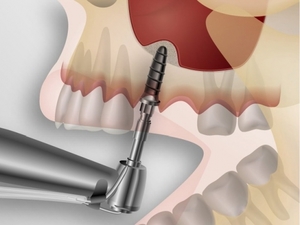 bone material of the patient's tooth - autografts.The patient will be taken part of the bone from the jaw area on the chin.At the same time, such natural grafts are not rejected by the patient's body;The donor bone tissue of the tooth is allografts
 - .Any person can act as a donor.However, the cadaver bone is most often used.Before starting to build up the bone tissue, the graft is treated by special technology to prevent complications in the future;
- bone tissue of cattle - xenografts.Such a transplant is considered the most affordable.However, the xenograft takes too long to survive;
- an artificial material for the build-up of bone tissue - alloplant.In most cases, bioceramics are used as artificial grafts.
Basic ways of increasing jaw bone
It is worth noting that progress does not stand still and in the modern dentistry there are various ways to restore bone tissue before implantation of teeth.Recently, the following methods of bone augmentation have been used before implantation of the teeth:
- block jaw transplant;
- Regeneration of the jawbone;
- procedure of sinus-lifting;
- of the plastic of the jaw bones.
Above are the most common ways of increasing the jawbone, some of which you want to consider in more detail.
How is guided bone regeneration performed?
In the case of directed regeneration, the bone material is replenished in the form of membranes that have a significant degree of compatibility at the biological level and ensure the formation of jaw bones.
- For the manufacture of membranes of this kind, collagen fibers are used.
- This material can be both absorbable and not.
- Once the membrane is implanted, the wound surface is sutured.
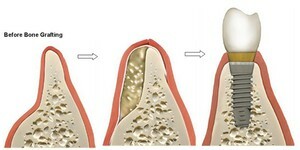 Bone plastic is not used as often as the previous method.In this case, the technology of such augmentation of the jaw bones implies the use of a transplant.
The meaning of such an operation is the insertion of bone tissue taken directly from the patient, and the implanted part of the graft is secured with titanium screws.
After approximately 6 months fixing screws remove and implants are implanted in the following sequence:
- a gash cut is performed;
- with a special tool cleavage and expansion of the bone tissue;
- in the resulting cavity is placed osteoplastic material;
- graft is fixed with screws from titanium;
- all intermediate flaws are filled with special crumb;
- a special membrane is applied.
Implant implants after the bone tissue is completed in this way, probably not earlier than 6 months.
Sinus lifting before implantation of teeth
The main purpose of sinus lifting is to increase the volume of bone tissue by lifting the maxillary sinuses.In this case, this procedure is assigned in the following cases:
- if the patient does not have pathologies on the operated site;
- no risks of various kinds of complications.
In this case, such an operation is contraindicated if any of the following health problems are found in patients:
- multiple septa in the maxillary sinus;
- persistent cold;
- disease polyp;
- sinusitis;
- any problems with bone tissue;
- is a sick heavy smoker.
It should be noted immediately that there are several ways to perform the procedure of sinus-lifting:
- open surgery;
- closed surgery.
Under the open procedure of sinus-lifting is a fairly complex surgical intervention.At the same time, is considered to be the main indication for its carrying out bone disease in the lateral sections of the maxillary region.
- A dentist makes a small hole in the outer part of the sinus, without damage to the mucosa.
- After that, the mucous tissue of the sinus is raised to the desired height.
- The voids are filled with materials used for building up.
- The exfoliated part of the bone and mucosa is placed in place and stitched.
The procedure for closed sine lifting is used with insignificant insufficiency of maxillary tissues not more than 2 mm.
- First cut the bed under the implant - form the hole of the desired length.
- With the help of a special dental instrument, the doctor uses the tapping method to move the necessary part of the bone towards the maxillary sinus, thereby raising the periosteal flap.
- Through the hole, deep into the bed, osteoplastic material is implanted, and only after that the implant is directly installed.
Positive and negative sides of the sine-lifting
Like any surgical procedure, sinus lifting has a number of advantages and disadvantages.At the same time, the following features are worth considering:
- recovery of the required bone volume;
- with the closed method of jaw bone building, the patient is inflicted with minimal number of injuries;
- obtaining artificial teeth according to their parameters is not inferior to living analogues.
It is worth noting that with unsuccessful surgical intervention there are serious consequences:
- injuries of the maxillary sinus, which may lead to a permanent cold in the future;
- sinking the transplant deeper into the maxillary sinuses, which will lead to the need for its removal;
- development of various kinds of inflammatory processes in the maxillary sinuses.
Negative qualities of the procedure can also be attributed to a severe postoperative period, which takes a long time.In addition to this the patient is obliged to adhere to the rules of behavior of during postoperative recovery, for example, one can not sneeze or cough at full strength, since artificial bone can fall out.


