The main types of prostheses used in prosthetics of the teeth, the features of removable, non-removable and conditionally removable dentures
 To date, prosthetic services are considered one of the most popular in modern dentistry.Such dental services are designed to restore the structure, as well as the chewing functions of the teeth, which for whatever reason have been completely or partially lost.In this case, the procedure for restoring the teeth is due not only to the medical or physiological components, but also to the aesthetic side.
I just want to note that dentures are dental devices that allow you to restore the appearance and chewing functions of damaged teeth.Even considering that to artificial teeth will have to get used to and they do not completely replace real analogs, modern methods of prosthetics allow creating artificial designs that look natural and do not cause discomfort to the patient.At the same time, there are the following types of orthodontic systems:
- permanent fixed structures;
- permanent detachable structures;
- permanent implants.
Features of fixed prosthetics and types of prosthesis
Non-removable dental structures are used to replenish the dentition in the presence of healthy teeth that act as a base.Prosthetics of this kind
is recommended for the destruction of one or two teeth caries , and to give the latter a new shape or color.In this case, there are certain features of such orthodontic systems.-
 The construction of artificial teeth is created on an ongoing basis.It is impossible to remove such structures independently without damage to the latter.
 - The load from chewing food when using such prostheses lies entirely on the supporting teeth of on which the orthodontic construction is attached.In such a situation, the distribution of loads along the gums is not realized, unlike the removable dental systems.
I would like to note the following types of non-removable artificial teeth:
- crown made of metal;
- ceramic crown;
- combined crown made of cermet;
- bridge systems;
- prosthetic insert;
- dental veneer.
Next, let's look at some types of fixed orthodontic structures in more detail.
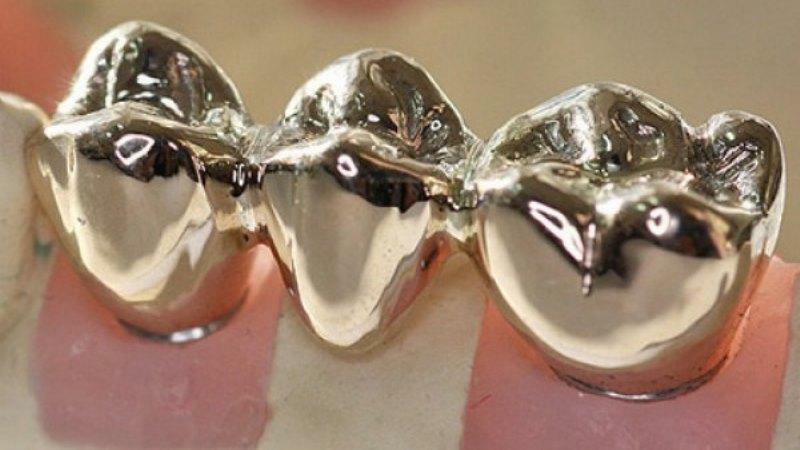
Bridged structure - consists of crowns, which are rigidly fastened to each other in one tooth row.As a support for the prosthesis, adjacent lateral teeth protrude, which are pre-sharpened in order to secure the prosthesis qualitatively.I want to note that the filling of the dentition is entrusted to the medial construction of the prosthesis, but this is possible with the loss of not more than a pair of teeth.However, despite this bridge-like prosthesis has several advantages:
- is such a prosthesis, it is convenient to operate without causing discomfort in the patient, and is also close to the anatomical structure of the living tooth;
- tooth structure does not fly during chewing or while talking;
- fixed prosthesis is attractive in aesthetic terms;
- patients are accustomed to foreign material as soon as possible.
In this case, there is a certain classification of orthodontic systems:
- for the material used in the manufacture;
- for fastening design;
- for structural features - integral or composite;
- effect on the alveolar ridge;
- on the design of the support on the teeth.
It's worth mentioning about veneers with which the shape and shade of the front teeth is restored or changed.This technology has the main purpose - aesthetic correction of teeth.Therefore, they are most often used in cosmetological purposes or at the request of the patient.Although there is an alternative to veneers - this is a cermet crown mounted on the teeth in the front row.
Features of removable prosthetics and a variety of prosthesis
 If several teeth are missing in succession or if a defect of the whole dentition is detected for a long time, removable orthodontic systems are used.More often such prosthetics is prescribed to pensioners , since in old age, many citizens have many missing teeth.
In some situations, removable dentures are used for prosthetics of teeth without grinding a healthy lateral tooth.The main disadvantage of such artificial teeth is the need for daily removal of the structure for hygienic treatment.In this case, there are certain constructive elements of the removable prosthesis.
- The basis of the prosthesis.It is made of plastic, nylon material or a combination of several components.
- Artificial tooth, mounted on the base.Made from plastic or in some cases from porcelain.
- System for fixing the prosthesis in the oral cavity.It is made in the form of a clasp or micro-lock that does not provide high-quality fastening of the artificial teeth, so that they do not fly off during chewing food or talking.
It should be noted that such prosthesis designs occupy a significant volume in the oral cavity, which is caused by the presence of a dimensional basis of the dental structure.In this case, removable prosthesis designs are divided into several types, due to the following parameters:
- by volume occupied by the base in the oral cavity;
- on the materials used in the manufacture of removable dentures;
- for chewing loads, which are transferred to the gum by the prosthesis;
- on methods of fixation of orthodontic structures.
Acrylic and nylon prosthetic structures
In the manufacture of acrylic type of dental structures use a special plastic.In this case, such prosthetics is considered the most common and is used with complete loss of teeth.According to the design, this prosthesis resembles the natural dentition of and does not require special attention in the care.
The main advantage of  for acrylic prosthesis is the ease of installation and maintenance.Very often such systems are used as temporary dental structures for the time of manufacture of a permanent, unbroken orthodontic system.The only but significant deficiency of the acrylic prosthesis is the plastic , which can cause the patient to be allergic.
Nylon prosthesis for manufacturing and use is almost identical to acrylic analogues.However, they have a significant advantage - they do not need to be rented for the night.That is, they are hypoallergenic.But making a nylon denture will cost its owner quite expensive.
Use of clasp prosthetics
 Clasp dentures imply the use of a metal base in the form of an arc, which is a support.Such designs are used with partial damage to the dentition.In this case, both clamping and locking fastening systems are used to fix them.This is the most progressive prosthetic construction, which is adapted to the biological and physiological parameters of the oral cavity.
A clasp prosthesis is somewhat more expensive than a nylon or plastic counterpart because of the laboriousness in manufacturing, and also the use of expensive material.But at the same time, 90% of patients are quite happy with such prostheses, as they are easy to install, unpretentious in care, they quickly get used to and they do not occupy additional volume in the oral cavity, and they do not need to be removed at night.
Use as implant prostheses
 This type of prosthesis involves fixing artificial teeth with special pins( implants) that are implanted in the bone tissue of the patient's jaws.Implants are an exact copy of the anatomical roots of living teeth, on the basis of which artificial teeth are constructed.At the same time, after a certain time, the implant fuses with the bony jaw tissue , which ensures its maximum reliability and stability.I want to note that the implant itself is made in the image of a screw.To produce implant prostheses, bioinert material is used, which does not cause allergies and is not torn off with bone tissue.
Prosthetics with non-removable implants
 This prosthesis is used if the patient has lost no more than one maximum of two teeth.An implant of titanium, which is directly implanted in the gum, fixes a ceramic or cermet crown.The process itself involves several stages - implantation into the jaw of the pin and fixation of the abutment on it, on which the crown is mounted.
In the case of significant defects in the dentition or complete absence of the latter, a number of implants are being installed, which are the basis for fixing the bridge prosthesis from ceramics or cermets.
It is worth noting that the modern implant prosthesis can last up to 25 years on average.Even in the event of breakage of the crown or bridge with the manufacture of duplicates, problems usually do not arise.In this situation only a duplicate of the prosthesis is made, the implant remains undamaged.It should also be noted that the main indications for the use of implant prosthesis are the following:
- loss of one dental unit if there are full teeth in the neighborhood;
- loss of lateral teeth for chewing food;
- no supporting teeth for fixing the bridge;
- impossibility of installing a removable prosthesis.
Conditionally removable dentures: the main features of
 Such prosthetics can be considered an alternative to complete removable dental structures, which have a number of certain disadvantages caused by the lack of end supports.Such designs may loosen and fly off during chewing or while talking.The implant in this case acts as a lateral end fixation of the prosthesis, but the design can be easily removed.
This prosthetics is carried out in several stages, the first of which implants are implanted in the bone tissue of the jaw.After that, the attachment is mounted in the attachment, which is a small head of metal, shaped like a ball protruding beyond the edges of the mucous membrane.In such prostheses, fixators are installed, due to which the orthodontic construction is attached.
Dental systems of this kind have rigid fixation, do not fly off during meals or during conversation, and also absorbed the advantages of both removable and permanent structures.Thus the patient without special problems can independently remove such prosthetic system for carrying out of prophylaxis.