Pathological abrasion of teeth: treatment, photo
The age-related wear of teeth is a natural process associated with the active use of the oral cavity for crushing and chewing products, including solid.Sometimes the increased abrasion of the teeth is diagnosed in people under the age of 40, which indicates pathological changes in the tissues of the tooth and the need for effective treatment.
In the article we will consider what affects premature destruction of dental tissues, what symptomatology is accompanied by this process and how to get rid of the problem.
The nature of the ailment and its causes

Teeth erosion
With normal bite, the outer wear of the lower teeth and the inner side of the lower teeth wear out faster in the upper parts.The chewing surface of molars regularly receives a load in the process of food intake, which comes to the erasure of natural tubercles.
Let's see what causes it.
- The uneven load of on adjacent and other teeth after the amputation of the dentition element, the installation of prosthesis or braces.For example, if root molars were removed, then the entire load is distributed to the fangs and incisors.
- Increased wear of teeth with abnormal occlusion or pathologies of the jaw structure, including congenital ones.For example, in the case of a direct bite, the cutting and lateral edges of the front teeth quickly deteriorate.
- Bruxism is a disease in which a person unconsciously grinds his teeth in a dream, destroying the enamel.
- Occupational pathology. Some professions( confectioner, chemist, plant worker, etc.) oblige the patient to be in dysfunctional working conditions, when the particles of the substances used in the production settle on the skin and the surface of the teeth, among others.Such components and compounds can destroy the enamel several times faster than is inherent in nature, and wear occurs evenly.
- Insufficient hardness of tooth tissue .In the case of diseases such as hypoplasia, erosion of the enamel, wedge-shaped defect and fluorosis, there is a pathology - a thin enamel and insufficient hardness of the bone tissue, which leads to accelerated deformation of the tooth.
- Systemic diseases. Disorders of metabolism, endocrine system( thyroid, pituitary, etc.), some specific diseases( Steynton-Capdepone syndrome) reduce the durability of dental tissue.This is due to a violation of structural resistance of the tissue.
- Poorly matched diet .The predominance in the menu of solid foods( apple, carrots, seeds, nuts, etc.), as well as carbonated sweet water, confectionery and flour products, acidic foods and beverages leads to a deterioration in the health of the teeth, reducing their hardness.
- Bad habits of .The use of alcohol and smoking negatively affects the enamel and bone tissue, destroying it ahead of time.Also, bad habits include retention in the oral cavity of foreign objects( caps of pens and pencils, toothpicks, nails, etc.).You can not avoid chipping and chipping on the enamel if you open the cans with your teeth or use them for other unnatural purposes.

Pathological abrasion of teeth
- Drug consumption .Some aggressive drugs( for example, based on hydrochloric acid) lead to the destruction of the upper layer of enamel.
- Severe physical activity. Athletes and even loaders are often noted abnormal abrasion of teeth( photo above), which is associated with tight jaw closure during lifting weights.
Symptoms of pathology
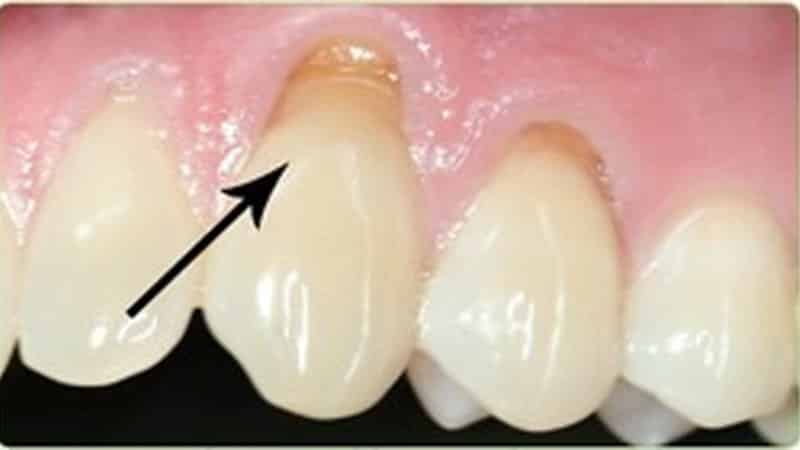
The clinical picture is characterized by the accelerated erasure of the upper layer of the tooth( enamel) with the transition to soft tissues( dentin).
The initial stage is also characterized by increased sensitivity of the enamel to temperature, chemical and mechanical factors.Acute pain can be caused by warmed or chilled food and drinks, too sharp, sour, sweet or salty foods.Also, tenderness is observed when you touch the tooth, during regular oral hygiene.
When the dentin is exposed and the appearance of a substitute substance, the sensitivity may decrease for a while, while the wear increases several times.
The progression of the disease results in a rapid shortening of the molar length, which leads to a visual change in facial expressions and facial symmetry.Patients note the omission of the corners of the lips, problems and discomfort in the temporomandibular joint.In some cases, hearing deterioration, pain in the area of the tongue is possible.
During this period there is a change in the occlusion, which leads to inconvenience during biting and chewing food.In some cases, malfunctioning can even affect the digestive system.
In the process of erasing fissures and irregularities are smoothed, making the enamel surface smoother and smoother.This allows you to partially get rid of the early caries, lying on the bottom of such grooves.

Pathological abrasion of the teeth of the upper jaw
In the case of increased wear of the incisors, the process sooner or later reaches the neck of the tooth, and through the defects in the dentin you can see the tooth cavity.
Deep bite is characterized by damage to the surface of the lower and upper incisors.
If the ailment has begun after tooth extraction, then adjacent teeth are erased, as well as fangs and incisors.
When pathology is diagnosed in workers of production of chemical compounds, metal structures, as well as confectionery products, there is uniform damage to the enamel, an equally smooth surface of the teeth, and a lack of deep fissures.The surface in this case is not a normal glossy, but a matte shade without plaque and stone.
In some cases, naked smoothed dentin is noted.If the patient works in an acid plant, the molars can wear down to the neck.Thus the person feels a rough surface of a tooth, morbidity, a dyscomfort during chewing.
Diagnosis and treatment of ailment
Treatment of pathological abrasion of teeth will depend on the type of pathology, the initial causes and the stage of the disease.
Before proceeding with therapy, the dentist conducts a thorough diagnosis of and helps to eliminate the problem that caused increased wear.After this, a restorative treatment is appointed, which allows restoring the teeth, restoring the aesthetics of the series.
Diagnosis involves the collection of anamnesis, analysis of subjective complaints of the patient, determining the cause of erasure.The dentist performs a visual examination of the oral cavity and the dentition, taking into account the changes in the bite, the symmetry of the face.
It also establishes the nature and degree of occlusion, notes visual symptoms, determines the hardness and resistance of tissues, the degree of erasure of enamel and dentin.

Treatment for increased dental abrasion is performed by dentists
It is necessary to assess the condition of root canals, pulp cavity by means of electrodontodiagnostics and x-rays, orthopantomography.
Using computer programs, the dentist examines the model of the jaw, determines the shape, depth and extent of tooth damage, occlusal relationships of the upper and lower rows.
In the later stages, the study of the functioning of the jawbone and masticatory muscles is required, using the x-ray, the tomography of the TMJ, electromyography, etc.
At the first stage, the causes of erasing are eliminated, for which it is necessary to heal systemic and dental diseases, to put a normal bite, to change prostheses or implants, to abandon bad habits, to change ration or even work place, to restore the removed teeth in the form of crowns, etc.
At the same time, the administration of auxiliary preparations , food additives and vitamin-mineral complexes, allowing to restore the balance of substances in the body, ensure the normal intake of calcium, mineral salts, fluoride and other microelements useful for the teeth is prescribed.
Further, hyperesthesia of the dentition is eliminated by remineralization.The patient continues to take vitamin-mineral complexes, attends physiotherapy procedures( electrophoresis).Applications based on fluorine-containing drugs are carried out.
Sharp edges, chips and defects of the enamel are then ground smooth and safe for soft tissue surfaces.

Kapa with bruxism
Defects and omissions in the dentition are corrected by means of prosthetics, implants.
For the treatment of bruxism, individual nightcaps are prescribed to remove the wear of the enamel during a night scraping.
The final stage is the restoration of the natural shape of the teeth( crowns, cutting edges, etc.) with filling composites, inserts, veneers, artificial crowns, lumineers or artistic restoration.
If you noted the symptoms in the article, noticed a decrease in the length of the tooth or chipped on the surface of the enamel, then make an appointment with the dentist to exclude the increased abrasion of the teeth.Also do not forget to take necessary for the health of the dentition trace elements and vitamins, purified water with a normal level of fluoride.