
Wilson-Konovalov's disease
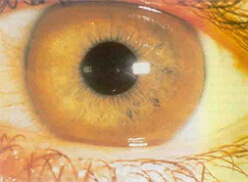 Wilson's disease( Wilson-Konovalov's disease) is a disease that has a hereditary pathology that affects the liver and central nervous system as a result of disturbances in the metabolic processes of copper in the body. The rim of the yellow-brown color, formed with Wilson's disease on the iris of the eyes, indicates serious pathological changes.
Wilson-Konovalov's disease is considered a rather rare genetic anomaly, in which copper can not accelerate the work of vital enzymes, affect hemopoiesis and endocrine glands, and also participate in the formation of hemoglobin. Therefore, in the body there are some deviations associated with the accumulation of copper in the cells of the liver and the central nervous system.
Wilson-Konovalov disease causes
Wilson's disease is inherited by an autosomal recessive type, with the disease occurring in the same ratio among men and women. Recently, cases of diagnosing this pathology began to increase. In general, the prevalence of Wilson's disease in different countries is 1: 30,000, with a frequency of one percent heterozygous carrier. Marriages between close relatives increase this incidence rate, which is especially observed in the regions where they are welcomed.
Wilson-Konovalov disease develops as a result of the genetic defect of the gene, which is localized on the thirteenth chromosome and is responsible for the intracellular transport of copper, which underlies the cause of this disease.
Initially, gene expression should occur in the placenta, kidney and liver, but as a result of various pathological disorders, bile excretion with copper decreases, so it gradually accumulates in the hepatocytes.
Entering with food in the body of copper( 2-5 mg), first absorbed into the intestine, then into the liver, then binds to ceruloplasmin( protein containing copper and present in blood plasma), moves in the blood serum, gets into some organs and excretesWith bile. However, with Wilson's disease, the component of copper excretion 0.2-0.4 mg per day, when the norm is 2 mg, leads to an excess accumulation of metal in the body. This decrease in excretion is due to the anomalies of the hepatocerebral dystrophy gene. As a result of the disruption of the delivery of copper to the special Golgi apparatus, which includes it in ceruloplasmin, and subsequent isolation by bile into the bile, copper begins to deposit in the hematopoietic organs, such as the cornea, liver, kidneys, brain. When deposited in the liver, secondary inhibition of the synthesis of ceruloplasmin occurs. As a result, hepatocytes undergo necrosis and develop chronic hepatitis, hemolytic anemia, cirrhosis and subsequently liver cancer.
Wilson-Konovalov's disease
symptoms The clinical picture of Wilson-Konovalov's disease is represented by several forms of manifestation: hepatic, neurological, psychiatric, cardiovascular, musculoskeletal, gastrointestinal and dermatological.
At the very beginning of liver damage, non-specific fatty degeneration develops, necrotic changes in hepatocytes in a small amount, periportal fibrosis. Then, chronic hepatitis progresses with high activity, which is accompanied by jaundice, increased levels of aminotransferosis and hypergammaglobulinemia.
If Wilson-Konovalov's disease continues to develop, patients are diagnosed with liver cirrhosis, which is characterized by hypertension in the portal vessels and a lack of liver cells.
A rare manifestation of Wilson-Kovnavalov's disease is fulminant liver failure. It is more often detected in adolescence and young age. The signs on which it is possible to differentiate it with viral hepatitis of the fulminant type is a small but increased activity of transaminases, in which ACT activity predominates, low values have alkaline phosphatase and albumin, but a high amount of total bilirubin and copper, as well as hemoglobinuria.
A frequent symptom of Wilson-Konovalov's disease is hemolytic anemia, which is formed as a result of a huge release of copper from the liver. Sometimes the liver is affected by the abdominal form of Kerr, and this leads to early liver failure. With a constant presence in the blood above the prescribed rate of copper and its deposition in other organs, the kidneys, erythrocytes, brain, cornea of the eyes and skeleton are affected.
Neurological manifestations of Wilson-Konovalov's disease are characterized by extrapyramidal, cerebellar and pseudobulbor disorders, as well as convulsive seizures.
The first, rigidly-arrhythmic hyperkinetic or early form of Wilson's disease, manifests itself in the form of general rigidity, nonrhythmic hyperkinesis, which are athetoid and torsionally spastic. Muscles located on the trunk, limbs, as well as those involved in the processes of talking and swallowing embrace rigidity. In such patients, dysarthria, amyema and dysphagia are observed. People with this form of Wilson's disease become constrained in movements, and their gait resembles bouncing. Sometimes patients freeze in an uncomfortable position. This is explained by paroxysmal contraction of the muscles, which often becomes the cause of complete immobility.
The regimen-arigmohyperkinetic form of Wilson's disease basically begins with seven years and proceeds to fifteen. Disorders of visceral nature manifest somewhat earlier - with 3-5 years of symptoms of liver pathology, which are noted before the beginning of neurological signs.
Another, flexor-extensor form of Wilson-Konovalov's disease is manifested by the tremor of the hands or the whole body. The intensification of jitters is usually associated with excitement or purposeful actions. In some patients, moderate tremor is observed only on one side. All patients are prone to muscle dystonia. During the trembling-reged form, there is a decreased intelligence, difficulty speech and hypomia.
Extrapyramidal pathology is characterized by mono and hemiparesis, which is diagnosed with hepatocerebral dystrophy of extrapyramidal-cortical form. Its difference from other manifestations of Wilson-Konovalov's disease lies in the large defeat of the cerebral cortex. The clinic of such a disorder manifests itself in epileptic attacks, especially of Jacksonian character, and in severe defeats of the intellect. But, despite this, there are clinical cases when neurologic symptoms are not observed, which indicates a positive course of Wilson-Konovalov's disease.
Mental disturbance in hepatocerebral dystrophy is characterized by emotional psychosis, changes in behavior and cognitive activity.
Intravascular hemolysis is noted in 15% of patients with Wilson's disease, which passes with temporary manifestations and self-extinctions. But it is preceded by liver damage over many years. Simultaneously with hemolysis, acute liver failure sometimes occurs. In this case, free copper strongly influences erythrocytes and hemoglobin.
Renal damage in Wilson's disease occurs as a partial or complete Fanconi syndrome, nephrolithiasis and reduced glomerular filtration. And this is the cause of peripheral edema, microhematuria and proteinuria. In this case, very often found in the urine of valine, threonine, phenylalanine and tyrosine.
With the deposition of copper in the lens, in the form of the Kaiser-Fleischer ring, cataracts appear.
From the SSS side, arrhythmia and cardiomyopathy are noted. When the muscles and skeleton are affected, arthralgia, osteomalacia, arthropathy and osteoporosis are diagnosed.
Gastrointestinal manifestations of Wilson's disease are characterized by cholelithiasis, pancreatitis, and dermatological manifestations - purpura of vessels, increased skin pigmentation and blue holes at the base of the nail.
Wilson-Konovalov's disease treatment of
The main therapy for Wilson's disease is associated with the removal of excess copper in order to prevent its toxic effects on the whole organism in the future.
To begin with, diet No. 5 is prescribed, rich in proteins, but with limited copper content in foods.
The main treatment for Wilson-Konovalov's disease is aimed at using drugs that will bind copper, and remove it from the body.
For the beginning prescribe British antilyuizit - 1,25-2,5 mg / kg, intramuscular injection twice a day, up to 20 days and a break, too, in 20 days. Or, inject this drug according to another scheme: 200-300 mg several months two times a day, until a positive effect is achieved. Unitol 5% - in / m 5-10 ml every other day, course - 25-30 injections, with repetition in three months. D-penicillamine is prescribed from 0.3 to 4 g per day, which will depend on the severity of the Wilson-Konovalov disease and the excretion of copper in the urine. This drug improves the excretion of toxic copper from the body. Dosage is established annually and changes after monitoring liver biopsy.
At the beginning of treatment for Wilson's disease, after 2-3 weeks, neurologic symptoms may increase, and the functional state of the liver may become worse, and then change to improvement after a few months or even weeks.
Sometimes, chronic hepatitis and cirrhosis of the liver disappear completely, after intensive therapy with this drug, which is determined by biopsy analyzes.
Indications for liver transplantation are fulminant hepatic insufficiency, as well as its progression in chronic hepatitis and cirrhosis, if ineffective drug therapy.
The consequence of Wilson-Konovalov's disease, as a rule, is the disability of patients. However, with appropriate therapy, at the first stages of the disease, you can achieve positive results. But the late stages are the absolute development of complications in which treatment of Wilson's disease no longer has a significant effect. As a result, there is a fatal outcome at a young age from cirrhosis of the liver or hepatic insufficiency of the fulminant type.