Adenoma of the prostate: symptoms, treatment and prognosis
Prostate adenoma is a benign neoplasm of the glandular organ tissues. In urological practice, it is customary to talk about adenoma not as a neoplasm, but as a nodular proliferation( hyperplasia) of glandular cells as a result of the influence of a number of external and internal factors. Therefore, it is more correct to call prostate adenoma benign prostatic hyperplasia( BPH) .
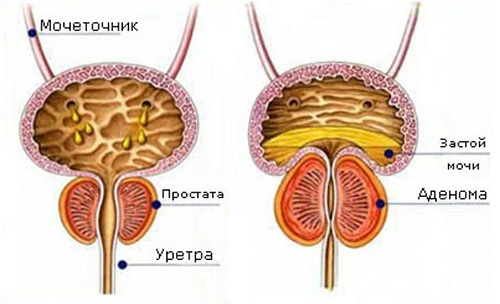
Prostate adenoma, or benign prostatic hyperplasia
Hyperplasia takes a worthy place in the structure of androgenic pathologies. In general, the disease occurs in older men: if in young age it is about 3-5% of cases, then after 40 the number increases to 50%, and after 70 years and does in all crosses over 75%.What do you need to know about the described pathology?
Content
- 1 Definition
- 2 Causes BPH development
- 3 Pathogenesis
- 4 Symptoms
- 5 Diagnostics
- 6 Treatment
- 6.1 Pharmacotherapy
- 6.2 Surgery
- 6.3 Treatment folk remedies
- 6.4 Diet
- 7 Complications
- 8 Preventive measures
Definition
Adenoma of the prostate( alsoBenign prostatic hyperplasia) is a neoplastic process, as a result of which active division occursGlandular cells of the organ being described with the formation of a well-delimited round-shaped node. The disease is benign. Nodal neoplasms are not prone to malignancy( acquiring the properties of a malignant tumor).
Causes of development of prostate adenoma
Until the end of the cause of the disease is not clear. However, despite this, we can talk about the factors predisposing to the formation of pathology:
- Age. There is a direct relationship between years and the probability of becoming a victim of prostatic hyperplasia. The older the patient, the higher the risk of getting sick. Over time, the prostate stops working as before, a change in the level of hormones, bad habits, all this accumulates for a long time and, as a result, results in a pathological proliferation of glandular tissues of the organ.
- Hormonal imbalance. Excess testosterone leads to increased libido and activation of sexual function. Frequent sexual acts, nocturnal pollutions( outside sexual acts) and other reproductive factors entail an increased synthesis of seminal fluid and secretion of the prostate. At some point, iron loses the ability to satisfy the body's need for secrecy. The prostate responds by the growth of its own tissues for a more intensive synthesis of the necessary substance.
- Frequent sexual acts ( the immediate cause is described above).
- Irregular sexual activity. Paradoxically, it also affects the work of the prostate, causing it to hyperplasia.
- Influence of viral and infectious agents on the prostate gland. Especially when it comes to human papillomavirus( HPV).HPV causes excessive proliferative activity, contributing to cell division.
- The presence of inflammation in the prostate gland( prostatitis). acts as a trigger( provoking factor).
There are other factors, the role of which, however, is not clear for certain: there are too few studies and sources.
- Smoking. According to one theory, nicotine and tobacco cause stenosis of the main vessels feeding the tissues of the organ. As a result, ischemia occurs, an acute shortage of blood leads to the proliferation of the prostate gland.
- Postponed venereal infections.
- Weighed down by heredity. The role of the genetic factor is also unknown. However, some studies indicate a direct relationship between hereditary heredity and the risk of developing prostate adenoma. If the genus was a man who suffered from hyperplasia, with a probability of 25%, the offspring would suffer. Fortunately, not inherited disease, but only the characteristics of the reproductive system, including predisposition to neoplastic processes.
- Diabetes mellitus. Causes atherosclerosis of the vessels feeding the pelvic organs( more about diabetes mellitus type 2).
- Belonging to the Negroid race. For reasons that have not been fully clarified, Negroids suffer from prostate adenoma almost twice as often as white patients.
- Malnutrition and obesity. Affects lipid metabolism. Metabolic disorders, in turn, lead to a decrease in the synthesis of male sex hormones. The reproductive system comes into disharmony.
Pathogenesis of
Men's sex hormones, androgens, play a primary role in prostatic hyperplasia. It has been established that in patients with adenoma of the prostate gland the concentration of dihydrotestosterone exceeds the norm by at least 3-5 times. Both dihydrotestosterone and other substances( including female specific hormones) have a stimulating role on the glandular tissue. At a certain point in time, iron simply can not cope with the function assigned to it due to overload. The only way to satisfy the induced need is to increase the amount of synthesizing tissue. This is how nodal neoplasms are formed, known as prostate adenoma. Similar processes occur in the pituitary gland, the thyroid gland.
Read more: Influence of androgens on the prostate
Symptomatic
The clinical picture of the disease is extremely diverse. Specific manifestations depend on the stage of the pathological process, the general condition of the patient, the presence of concomitant diseases, etc. Depending on the severity of the clinical picture, three stages of the adenoma are distinguished:
- Compensation stage. Manifestations occur when the bladder is emptied.
- Stage of subcompensation. Micturition is severely impaired. After visiting the toilet in the bladder remains a significant amount of urine.
- The stage of decompensation. Total bladder dysfunction.

If any of these symptoms persist, consult a doctor immediately!
At the moment, this classification is recognized by most urologists as obsolete, but it remains relevant and is used in diagnostic practice.
Symptoms include:
- A feeling of inadequate emptying of the bladder even after going to the toilet. This is due, first, the pressure of nodal proliferation on the walls of the bladder, and secondly, the incomplete release of urine.
- Low urine pressure. As with prostatitis, the process of urination is disrupted. The jet is weak or may weaken during the process itself.
- Isolation of urine in small portions( dropwise) after the end of the process of urination.
- The need to make an effort to urinate. The muscles of the abdominal press enter the case.
- Frequent urge to empty the bladder( so-called pollakiuria).It shows up day and night.
- Imperative urge to empty the bladder. Characterized by the urgency, impossibility to restrain.
- Oliguria. Decrease in daily diuresis. It is observed in the advanced stages. It is explained by incomplete emptying of the body.
Diagnostics
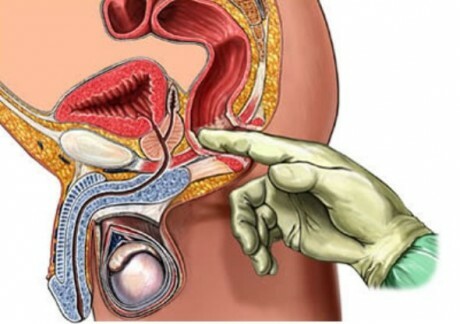
Diagnostic measures should be performed only by the treating specialist( urologist or urologist andrologist).The examination begins with the collection of anamnesis and oral questioning of the patient for complaints. rectal finger examination of the prostate is very informative. This uncomfortable manipulation for the patient makes it possible to evaluate the structure and size of the prostate. Without it, simply can not do. However, to establish only the fact of nodal proliferation of the prostate gland is not enough. To verify the diagnosis and differential diagnosis, a series of instrumental studies is shown:
- Ultrasound examination of the prostate .It is necessary to assess the presence of neoplasms, their size, shape, structure. It also makes it possible to determine the calcifications in the structure of the nodes.
- TRUS( a kind of ultrasound study) ( more info here) . It is considered more informative, because it gives detailed information about the state of the prostate gland.
- CT / MRI. The most informative study( especially with contrast), which makes it possible to distinguish malignant process from benign. Due to its high cost and low availability, it is rarely appointed.
- Cystography. Contrast minimally invasive bladder examination. It allows to determine deformations in the area of the urinary tract.
- Cystomanometry. The method necessary to measure pressure inside the bladder. Identifies problems with urination.
- Detection of residual urine. It is carried out by means of ultrasound examination immediately after emptying the bladder.
- Uroflometry. Required to evaluate the characteristics of the urine stream.
For the purposes of diagnosis, a simple questionnaire is offered to the patient. Each question suggests a one-syllable answer, "Yes" or "No".And the degree of positive or negative value is ranked on a scale from 0 to 5. Questions are standard:
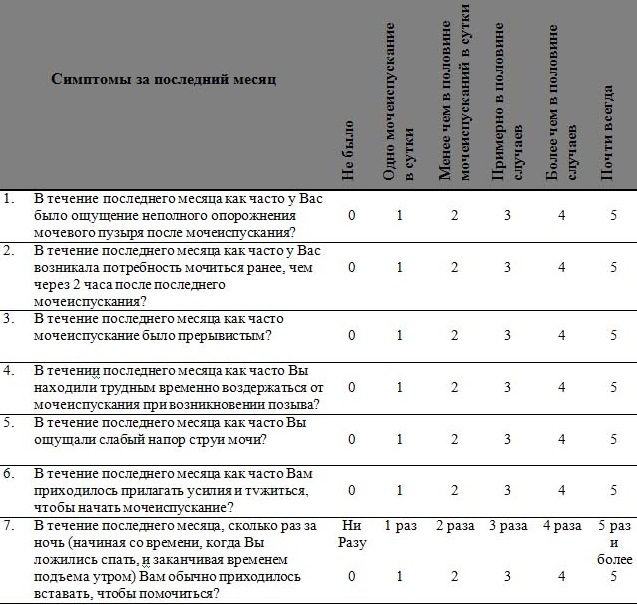
Value over 7 points in favor of the current process. The questionnaire is necessary for assessing the subjective feelings of the patient and should be evaluated only in conjunction with objective research data.
Treatment
Therapy is symptomatic. In most cases, observation in the dynamics with simultaneous administration of drugs is shown. Surgical intervention is indicated only if the process is difficult.
Read on: The tactics of treating prostate adenoma depending on the stage
Medication
The reception of alpha-adrenergic blockers is indicated. They lead to a decrease in the tone of the smooth muscle of the muscles of the urinary system and, as a result, a decrease in resistance during the passage of urine. Trade names:
- Terazosin;
- Prazosin;
- Doxazosin;
- Alfuzosin.
The dosage is determined by the doctor, based on the stage of the disease. The course of treatment is long and is about six months. The therapeutic effect is achieved by 3-4 months of use of drugs. In the absence of a clinically significant effect, a change in the tactics of treatment is shown.
5 alpha-reductase inhibitors have also proven successful. These drugs normalize the hormonal background, eliminating the immediate cause of hyperplasia. Stabilize the size of the prostate gland and reduce the adenoma in size. The main drawback of these medicines is in their side effects( they are heavy, like all hormonal drugs).
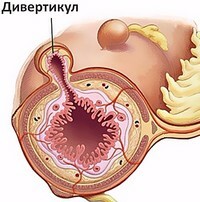
The presence of a bladder diverticulum is an indication for an
prompt intervention. In the absence of a therapeutic effect or if there is a significant deterioration in urination that threatens the health or life of the patient, surgery is necessary. The list of absolute indications is considered to be exhaustive:
- urinary retention;
- recurrent urinary tract infection;
- hematuria( blood in the urine) caused by the adenoma;
- kidney failure;
- urolithiasis;
- presence of a large size diverticulum.
Surgical treatment
The tactical of surgical treatment is determined by the doctor. In previous years preference was given to open surgery with the formation of a cut and direct access to the prostate gland. At the moment less radical, endoscopic methods of intervention are practiced. Among the techniques:
- Stent implantation. It is necessary for normal drainage of the bladder. It is considered a temporary measure.
- Dilation( expansion) of the urinary tract by mechanical means.
There is a whole group of endoscopic methods:
- Thermodestruction. It presupposes the destruction of the affected prostate tissue by high temperature.
- Microwave thermotherapy.
- Laser exposure( vaporization or coagulation).
- Electrointestion of the prostate. Less radical method, not involving even partial resection of tissues.
- Electropolarization of prostate tissue.
- Classical endoscopic( transurethral) surgical intervention with removal of adenoma.
At the moment, open operations do not resort.
Read more: Operations with prostate adenoma: types, pros and cons
Treatment with folk remedies
Used only as a palliative measure designed to alleviate the condition of the patient. Phytotherapy can be a great help in therapy. The most effective recipes:
- Beespine. It helps to reduce swelling and inflammation. To prepare the preparation, take 2 tablespoons of raw material, pour half a liter of water. Boil for 2 hours. Take a tablespoon twice a day.
- Flaxseed oil. Take 2 tablespoons a day.
- Fresh onions. Eat on the bulb a day.
- Tea from the seeds of cumin.
- Treatment with salt of prostatic adenoma( Professor Okulov).Controversial, but relatively safe method of treatment. Pour a teaspoon of salt without a slide 100 ml of warm water. Soak bandage or gauze with salt solution. Squeeze the fabric. Apply it to the crotch in the form of a bandage. Leave for a few hours. Reduces painful sensations.
Diet
It is important to eat foods high in zinc:
- Mushrooms.
- Seafood.
- Eggs.
- Red meat.
- Herring.
- Peas.
- Bran.
- Nuts.
- Grech.
- Sesame.
- By-products.
There are no hard bans. It is also important to consume more foods rich in selenium. This is:
- Sea kale.
- Sesame.
- Brazil nut.
- Pistachio.
- Bean cultures.
- Olive oil.
- Shrimps.
Read on: Nutrition for prostate cancer
Complications
- Acute urinary retention. A condition that can lead to rupture of the bladder or acute kidney failure.
- Hematuria( appearance of blood in the urine).
- Formation of stones in the bladder.
- Inflammatory processes of excretory system.
Prevention measures
- Rationalization of physical activity( see Morning exercise for male health).
- Healthy Eating.
- Regular sexual life( no frills).
- Normalization of body weight.
- Wearing loose underwear.
Hyperplasia( adenoma) of the prostate gland is a disease requiring increased attention. In most cases, the process can be reversed or stopped by conservative methods. However, in extreme cases, surgical treatment is required. The patient must be attentive to his own state of health. At the first suspicions it is not necessary to delay with visit to the urologist. So a man can keep his health.
Recommended for viewing: