What is a biopsy of the prostate?
The results of the biopsy of the prostate: what is the procedure and how to decipher analyzes

Immunohistochemistry (IHC) - modern and accurate diagnostic method to detect cancer in its early stages. It is based on the treatment of tissue sections with labeled antibodies to detect the substance, in this case it is an antigen. After a biopsy was taken of the prostate, decoding results influences the prognosis and treatment strategy.
IHC assigned with suspected prostate tumor. If there is cancer, immunohistochemistry reveals the nature of the primary tumor, its spread and to predict.
The method
What is immunohistochemistry, and for what it is appointed? In the body at any foreign substance vyrabatyvayutsyaspetsificheskie antibodies that prevent the spread of a pathological process.
Tumor cells secrete specific proteins, which serve as antigens. They have the ability to bind to antibodies.
In this reaction, based histochemical method.
For this purpose, fluorescent dyes, electron-dense particles, enzymes. The resulting complex has the property of fluorescence, that is, it creates a glow. If the biopsy to detect such a change, it is likely we can talk about the presence of cancer cells.
Histochemistry possibilities:
- sets nozoologichesky primary view formation;
- to determine the prevalence of the process;
- It identifies the type of tumor metastasis of unknown primary site;
- evaluates the effectiveness of the treatment, determines the sensitivity of cells to chemotherapeutic drugs as well as radiation therapy;
- step determines malignancy and prognosis of the disease;
- reveals proliferation, ie the rate of tumor growth.
Immunohistochemistry is considered a more reliable method of diagnosis than conventional histological examination. However, in many cases it is required histology, therefore optimally combine both types of analyzes.
In the immunohistochemical studies can determine the presence of specific hormones and their receptors, specific enzymes, antibodies, cell particles.
Stages of IHC
The study consists izsleduyuschih steps:
- Fence sample by biopsy, for the study will need a piece of suspicious sites and surrounding tissues. The material can be obtained during surgery.
- Fixation, degreasing.
- Pouring paraffin, during this operation form histological blocks. Later they postupayutna eternal storage, therefore, the study can be repeated at any time if necessary.
- Mikrotomirovanie - is to get the thinnest slices of the sample. Later their technician is placed on a special histological glass.
- Coating immunohistochemical preparations containing a predetermined concentration of the antibody. There is a small histochemical panel, it includes species of antibody 5, and a large panel (the number of markers is six to ten). What exactly antibody will be processed sample depends on the type of the intended tumor.
- Microscopy material conclusion transcript analysis.
Indications for prostate IHC
IHC analysis is given after a number of other studies. PSA results are preliminarily estimated, digital rectal examination, prostate ultrasound data.
Indications for IHC as follows:
- When rectal palpation of the prostate gland seal portions are found, knobby surface.
- The structural changes in the prostate ultrasound (Study conducted through the rectum, or the abdominal wall).
- Analysis of PSA (prostate-specific antigen - tumor marker) exceeds the allowable value. Increase in PSA may indicate how about cancer and the banality of prostatitis.
- The results of prostate biopsy showed morphological changes.
- It is necessary to accurately determine the type of tumor, its prevalence, disease stage.
- Evaluation of reaction cells for use of chemotherapeutic drugs and radiotherapy.
IHC is assigned at the slightest suspicion of malignant transformation of prostate cancer.
Not everyone has a tumor formation in nature. For example, the cancer may mimic other diseases: benign increase in prostate (BPH), acute and chronic inflammation, prostate adenosis.
used histological and histochemical analyzes, the IHC is used as an additional method for the differential diagnosis.
Prostate biopsy zhelezyprotivopokazano, if available:
- Acute infectious disease.
- Severe cardiac and pulmonary pathology, liver and kidney failure.
- Inflammation of the prostate gland in the acute phase.
- Exacerbation of diseases of the rectum - haemorrhoids, proctitis.
- Hereditary disorders of the hemostatic system (hemophilia). A biopsy in this case may lead to bleeding, which is almost impossible to stop.
Survey Preparation
Preparation involves the following steps:
- A week before the biopsy of the prostate sleduetisklyuchit drugs that affect blood clotting (Aspirin, Warfarin, Cardiomagnyl, heparins). Although most of these resources and do not cause complications, but in order to avoid bleeding is better to cancel them.
- 3 days before the study excluded anti-inflammatory drugs (ibuprofen, diclofenac). These drugs work the same way as antiplatelet agents and anticoagulants, meaning they can provoke bleeding.
- Come on an empty stomach biopsy is necessary.
- The night before and the morning is enema in case scheduled a biopsy through the rectum. When the fence material through the perineum, bowel cleansing is required.
If the patient is taking natural supplements (vitamins, herbal extracts, dietary supplements), they are also recommended for a time to eliminate.
Within a few days before the biopsy of the prostate observed besshlakovaya diet with exception of coarse fibrous foods and foods that cause flatulence. Upotreblyatv can not eat wheat and barley porridge, cabbage, fresh berries, fruits, whole milk, brown bread, soda, alcohol.
Daily diet is an easy soup to a low-fat broth, boiled meat, biscuits, crackers, eggs. Admitted buckwheat and rice porridge, sweet foods (jelly honey), fruit, and tea.
How is a biopsy for IHC?
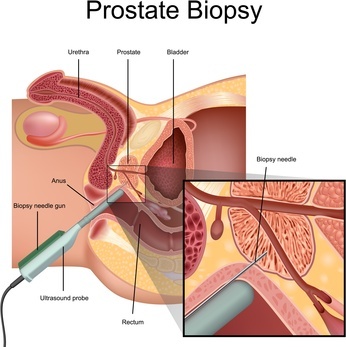
Most often, the biopsy delaetsyatransrektalnym way, ie through the rectum. After a local anesthetic is injected into the intestine ultrasound sensor device, which is attached to the gun with the biopsy needle.
During the rapid puncture needle goes through the prostate gland and takes a piece of tissue, called a column. When transrectal biopsy taken from 12 to 30 bars, at the crotch of their number reaches 50.
The larger pieces of tissue was taken from the patient, the better the result of the study.
Prostate biopsy is no more than 30 minutes, he prick lasts a few seconds.
Subsequently the sample is placed in a plastic container and delivered to histochemical laboratory. Here, it is stored permanently in the form of paraffin blocks. The results of prostate biopsies in the future lie in the laboratory archive.
Any intervention in patients alarming: how much it hurts? Talk about the severe pain can not be, rather, the manipulation causes a little discomfort.
Anesthesia reduces discomfort. However, the important role played by the psychological state of the person. The alarm will be removed sedatives appointed to manipulation.
Possible complications of biopsy
Discomfort in the rectum after a biopsy - a common phenomenon. Acute pain does not arise, but the slight discomfort appears. It will pass in a few days. Sometimes a patient is prescribed painkillers and sedative medications to relieve symptoms.
One of the complications of prostate biopsy is an acute proctitis. The disease is characterized by severe pain in the perineum near the anus, fever, urinary disorder. At the slightest suspicion of an inflammation of the rectum require hospitalization in proctology department.
In rare cases, after a biopsy of the prostate develop infections of the genitourinary system: urethritis, cystitis, orchitis. The fact that E.coli bacteria penetrate from the rectum to the urinary tract and cause inflammation there.
This happens in case of violation of the recommendations, for example, on the eve of the patient did enema.
To prevent infectious complications of patients were prescribed antibiotics. They are taken for 2-3 days before the procedure and within 5-7 days after it.
After prostate biopsy appears blood selection as hematuria, haemospermia, anal bleeding. Small bleeding may be doctors, it disappears in 3-4 days. If symptoms persist for a long time, developed massive bleeding, fever, require emergency medical care.
How is the analysis?
A study conducted in pathology laboratories. The doctor doing the analysis, must pass special training for IHC. IHC analysis results vydayutsyacherez 7 days (if used small panel), or after 15 days (when extensive research).
The conclusion indicates a set of markers that were used in the analysis, the presence of marker expression, decoding the type of tumor.
The doctor determines which antibodies it has an affinity for the tissues. He describes the morphological structure of the sample, the presence of degenerated cells, wherever possible.
See also:How is the transcript of semen
If the detected tissue tropism for a certain type of markers, it is mandatory to mention the doctor.
deciphering analysis
biopsiiprostaty results may include the following:
- acute inflammation;
- chronic inflammation of the prostate;
- hyperplastic tissue and benign nature;
- sclerosing adenosis;
- adenocarcinoma, indicating the number of modified cells, their germination in healthy tissue.
A source: https://prostatu.guru/diagnostika/kak-rasshifrovyvayutsya-rezultaty-biopsii-predstatelnoj-zhelezy.html
What is a biopsy of the prostate gland, as it prepared and how it is spent?
 12.01.2018
A biopsy of the prostate gland - is one of the most popular and informative diagnostic methods for prostate disease in men.
This procedure is carried out spot diagnosis of major diseases: adenoma, prostatitis and cancer. A biopsy can not only detect the presence of disease, but also to identify their current stage and the presence of complications.
Conducting technique requires ambulatory patient's stay.
What is it?
Prostate biopsy tissue sampling implies the need of the body enzymes. Using the resulting material is carried out a histological study. The procedure used to detect prostate tissues in any foci of inflammatory reaction, adenomas or cancer.
By means of a biopsy manage to achieve such objectives:
- specify the presence of cancer or BPH, using histological examination. After biopsy confirmed or refuted by the disease;
- determination of tumor stage or propagation of the inflammatory response;
- revealing the true nature of the build-up.
Due to staging tumors manage to adopt appropriate and the most appropriate treatment.
Earlier research was carried out with the control by means of rectal probing. Today, a biopsy is performed under the supervision of a special transrectal ultrasound, which leads to greater information content and accuracy of the technique.
Biopsy - is informative and accurate type of diagnosis to help determine the nature of the tumor process
testimony
Preparing for the detection of prostate biopsy requires tangible indications for diagnostic activities and exclusion of contraindications.
The procedure was first held at:
- increasing the concentration of prostate-specific antigen (PSA) in a patient's bloodstream. Status indicates prostate lesions and adenoma development, prostatitis or cancer;
- detected during rectal examination any foci with uncharacteristic structure of tissues. Indications may make the sealing point, uneven and irregular body shape as well as enlargement of the prostate;
- transrectal ultrasound in the presence of foci of reduced conductivity, since it indicates the state and development of tissue pathology disorders;
- clear need refinement stage of the disease, if the prostate cancer has been previously confirmed through resection or transvesical prostatectomy.
Retesting is necessary in the preparation of the negative findings from the previous procedure, and there are other indications, evidence of pathology.
Prostate biopsy is currently carried out in all patients with suspected cancer
Indicators for secondary biopsy are:
- subsequent increase in the amount of PSA;
- elevated levels of PSA does not change for a long time;
- achievement PSA density above 15%;
- free PSA is less than 10% relative to the total level;
- detection during the previous procedure severe stage of prostatic intraepithelial neoplasia;
- during previous studies used a small amount of collected material.
Contraindications
For some patients, a biopsy is contraindicated procedure. To diagnose or confirm the diagnosis in their states to use alternative measures.
Among the key contraindications:
- the patient is in a serious physical or mental condition;
- the presence of disease of an infectious nature;
- rejection as blood coagulability associated with;
- use of anticoagulants or antiplatelet agents;
- recurrence of prostate regardless of the flow;
- inflammation affecting the rectum;
- hemorrhoidal veins;
- discharge of blood from the rectum;
- the presence of feces in the intestine.
The main contraindications for prostate biopsy associated with general exhaustion of the patient, presence of inflammatory processes of infectious
Training
Preparing for a biopsy of the prostate gland requires a number of recommendations:
- when referring specialist must provide the results of preliminary tests. Keyword research is the analysis of urine, blood and urine crop flora;
- for 2-7 days before the examination must be completed or temporarily discontinue use of medications that affect blood clotting. Commonly used blood-thinning drugs, on which is to give - "Aspirin", "Heparin", etc .;.
- 3-5 days before the procedure is recommended to be excluded from the use of drugs with anti-inflammatory action, "diclofenac", "Ibuprofen", etc .;.
- is required before the procedure shown purgation of fecal debris and by enema;
- 2-4 hours prior to use diagnostic techniques assigned the use of antibiotics as a preventive measures against complications of infectious nature. The use of antibiotics is regulated by a doctor, usually appointed for 7-10 days in order to maintain the health of the person;
Preparation for prostate biopsy is conducted in several stages
- if the patient has an intolerance to any medicines, you need to pre-announce the information your doctor or specialist who will conduct the study;
- the doctor is required to transmit data on the presence of disease in the chronic form, especially the cardiovascular system;
- it is recommended to stop the evening meal, in the morning allowed a light breakfast;
- a brief consultation with a specialist about the technique of the biopsy. The more a procedure is required to eliminate the fear of patients who experience fear of severe pain.
Before the procedure, the physician often does not introduce pain medication as biopsy causes a minimal amount of pain. At the request of additional indications or patient anesthesia may be used, but should take into account the risk of complications. General anesthetics are not assigned at all, it is permissible to use only drugs with a local effect.
How it is?
In modern medicine, biopsy of the prostate, is 3 kinds, and how the survey is conducted in a particular case depends on the evidence.
Fence tissues was performed using a biopsy gun in a manner different small traumatic
Known and common methods of biopsy:
- transrectal. It involves the introduction of the device through the anal passage into the rectum. To control using transrectal palpation can be used rarely;
- transurektalnaya technique can be applied during uretroskopicheskogo survey;
- perineal biopsy needle to enter uses crotch disposed between sexual organ and anus.
By the method of performing a biopsy of the prostate transrectal type is further divided into 3 groups:
- sextant type. Preferably used for the primary diagnostic procedure in chronic inflammation, cancer or adenoma. During a biopsy for collecting used six different sites. The patient is placed on the left side and leg presses to the sternum. The method is effective by obtaining data from the areas that could be not visible during the passage of ultrasound. Its main drawback is the lack of material from peripheral tissues, thus diagnosis does not cover them. That is, there is a risk of incorrect results;
Samples are labeled and sent for further histological and cytological examination
- extended biopsy. In conducting the survey used sampling tissue of the prostate sections 8-18. The technique provides a holistic view of the body of the state. In medicine, this technique is ranked as more informative surveys, which often prefer the previous version. Samples for research are not only centers of alleged pathology, but also evenly gather around the body and the periphery. Acceptance is indicated for use in the disputed detecting PSA and prostate enlargement;
- Saturation form suggests that the material is obtained from 24 points. Among all the listed forms saturation biopsy is the most accurate, it provides accurate setting of the diagnosis.
complications
According to the diagnostic end, some patients encounter complications. Among the frequent violations of the release:
- the presence of blood inclusions in the urine;
- difficult urination;
- detecting sperm particles in urine;
- pain in the anus;
- discharge of blood from the rectum;
- occurrence or recurrence of acute prostatitis form;
- increase in body temperature;
- acute inflammatory response by the testes and appendages;
- severe urinary retention;
- sepsis;
- fainting during the procedure.
There is a possibility of complications after prostate puncture
In the majority of cases, the negative effects does not occur after the biopsy. Even with the development of complications often they are easy to remove. Immediately after the procedure the patient can return to the familiar life, if there are no adverse reactions. In the case of a pending occurrence of complications you should immediately consult a specialist.
See also:What tests for men shall be the presence of infection in the genital organs
after the biopsy,
In some cases, after a proper analysis is necessary to supplement the information of diagnosis.
For advanced and correct picture of the prostate condition is assigned to CT, MRI, lymph node biopsy, radioisotope examination and blood for PSA analysis.
As treatment, the doctor has the right to appoint an additional biopsies and blood tests to monitor the condition of the body and assess the effectiveness of treatment.
Price
In Russia, the cost of the procedure at the level of 5-6 thousand rubles, the price varies depending on the clinic and the region. The most expensive procedure is different in Moscow and St. Petersburg (5800-6200 rubles). By Region pricing is slightly smaller in Yekaterinburg is 4000-4500 rubles, but more often in the areas of about 5,000 rubles.
Reviews
About prostate biopsy patients responses are different, but mostly their meaning is similar:
Nikita, 38 years old:
"Of course, this procedure is useful but unpleasant. Two years previously had to undergo a biopsy result was negative. Severe pain during the procedure did not feel, suffer more from psychological experiences. "
By prostate biopsy effects are rare, but there are also such ratings
Valery, 49 years old:
"I had to go to the doctor because of fears of prostatitis. Expert appointed biopsy, which revealed no abnormalities. After the event began long separation of blood from the rectum. After treatment in a clinic has been established hemorrhoids. The disease is a contraindication, which ignored the doctor. "
Mikhail, 53 years old:
"Unpleasant sensations during the procedure could not shake, then there was blood in the urine. I asked the doctor, he appointed a drug for blood clotting gain with a lot of side effects, which have fortunately gone. "
A source: https://prostatoff.ru/prostatit/biopsiya-predstatelnoj-zhelezy
A biopsy of the prostate gland - what is it in simple terms, how is the procedure and how to prepare for it

Prostate biopsy - the most reliable diagnostic method if you want to exclude oncologic pathology. Biopsy - minimally invasive intervention in the process of which is made of tissue sampling for cytology.
What is a biopsy of the prostate gland
Multifocal needle biopsy - a mandatory procedure for confirmation of the diagnosis of tumor of the prostate tumor. The reason for the procedure is positive answer to one of the signs of neoplasm.
Triad criteria:
- Detection increase in size of the prostate and the presence of nodules in the tissue;
- Changing the echogenic body structure transrectal ultrasonography (TRUS);
- Increase or change the dynamics of Prostate specific antigen (PSA). In a normal PSA level - 2-4 ng / ml.
The degree of abnormality of these parameters defines the biopsy procedure and the number of sampling points for the material.
Histological studies reliably indicates the prevalence of pathological process and the pathological changes in the body.
Indications for biopsy:
- Detection sealing zones or digital rectal ultrasound;
- Increased specific antigens above age norms (up to 49 years - 2.5 ng / ml, 50-59 - 3.5 ng / ml, 60-69 - 4.5 ng / ml, over 70 - 6,5 ng / ml);
- Increased prostate specific antigen in the dynamics;
- Changing the ratio of free and total PSA (fPSA reduction of less than 15% - a dangerous prognostic indicator);
- The presence of atypical cells in previous assays (for determination of dynamics of the disease);
- For the control conducted by the treatment.
Useful: Increased testosterone in women
Preparation for biopsy
Prior to the collection of material for cytological study of the patient for several days must comply with certain conditions. Some medications are able to distort the result of the analysis, and cause a number of undesirable consequences.
Recommendations during the preparatory period:
Preparing for a biopsy of the prostate gland begins a few days before analysis.
- It is necessary during the week to refrain from taking drugs that affect blood coagulation system (Aspirin, Heparin and other anticoagulants);
- Within 3 days not to use anti-inflammatory drugs, because they reduce the actual zone of reactive reactions in the prostate;
- Refuse Hour antimicrobials broad spectrum of action;
- On the eve should do a cleansing enema as biopsy sampling is performed transrectal.
How to do a biopsy of the prostate gland
After the appointment to analyze nurse conducts mandatory briefing held as a prostate biopsy. Extremely it is important to comply with the procedure of preparation prior to the study.
Immediately before the procedure, the physician performs the puncture processing painkillers are usually used with anesthetic cream. After the disappearance of the pain and tactile sensitivity start to the fence of material for study.
Puncture necessarily performed under ultrasound guidance. To apply this sensor with the rectal nozzle. Ultrasound monitoring allows to visually monitor that contained the modified tissue biopsy (taken from areas with abnormal echogenicity).
The first day after the procedure is necessary to refrain from significant physical exertion. Puncture needle with which produce fence material for research, thick enough and traumatize small vessels.
Physical activity stimulates increased blood flow, which may lead to local capillary hemorrhages. To prevent infection of the intestinal mucosa at the puncture site impose a sterile swab.
Depending on the localization of suspicious lesions in the prostate tissue doctor can use several techniques to access authority.
Access methods for taking a biopsy sample:
According to the method of access:
- Blind biopsy;
- transurethral;
- transrectal;
- transperitoneally;
According to the scope of prostate tissue:
- Classic access;
- Sextant access;
- Advanced access;
- Carbonated access;
Blind biopsy was performed without hardware control. Before taking the material a physician palpated estimated prostate localization and spent 4-6 fencing material. Such a method has low productivity and is not currently used.
Transurethral method consists in carrying out a probe to serve as a channel to prostate through urethra and bladder) The simplest procedure is transrectal access. It is the least traumatic and painful.
When difficulty of access via direct Kishu organic diseases - pronounced hemorrhoids, anal stenosis, resorted to the transperitoneal approach, the second name of the method - fusion biopsy.
In this case, a puncture is made as a local anesthetic in the perineum.
When fusion to control biopsy tissue sampling column except ultrasonograph can use magnetic resonance, such as a fence material in the rear body wall.
Sektantny access used in diffuse changes or multiple foci. During this procedure, tissue sampling produce from different parts of the body, carrying up to 8 fences.
If necessary, a larger portion of sample resort to biopsy sampling extended tactics, when readings have to perform sampling of tissues from 18 different sites.
The most clear picture carbonated provides a process performed when the fence material and 24 points evenly distributed over the volume of the prostate. Such method allows to diagnose diffuse forms of cancer.
The evaluation of prognostic factors in this case is carried out using a Gleason score. The principle of evaluation is built on a summation of the balls based on the degree of differentiation of cells in smears histologically.
The more poorly differentiated cells, prone to rapid growth and division, the above estimated value and the worse the prognosis.
The initial volume of biopsy sampling is calculated based on the results of preliminary examinations - volume changes with ultrasound of the prostate, the degree of hypertrophy of the body, the level of prostate-specific antigen (PSA).
| The number of points for taking biopsy | The PSA level, ng / ml | |
| < 20 | >20 | |
| prostate volume, cm3 | 50 | 18 |
Contraindications to study
- Anticoagulation, which can not be undone (postinfarction state);
- Congenital abnormality of blood coagulation system (hemophilia, a coagulopathy);
- Rectal bleeding, abscess or proctitis (transrectal access if necessary);
- Acute inflammation of the prostate tissue;
- Private patient reluctance to biopsy.
Useful: The patch of damp corns COSMOS
Effects
A biopsy refers to a class of minimally invasive surgical procedures. As with any surgery, during a biopsy may be intraoperative (during the procedure) and post-operative complications and consequences.
Intraoperative complications:
- Intraoperative hemorrhage with hematoma formation and without (at wound puncture needle large vessel);
- An anaphylactic reaction (intolerance anesthetic);
- Loss of consciousness.
See also:Features of the sowing tank men
Postoperative complications:
- Later bleeding;
- Hematuria (blood in the urine, and if damaged vessel wall through perforations prostate);
- Hematospermia (detection of blood in the semen);
- Acute prostatitis (bacterial infection when skidding of the large intestine);
- Rectal bleeding (the large vessels is damaged intestinal mucosa);
- Dysuria (voiding during smazmaticheskoy obturation prostate lumen);
- Orchiepididymitis phenomena (inflammation of the testicles when descending infection).
A source: https://plannt.ru/biopsiya-predstatelnoy-zhelezy
How to carry out a biopsy of the prostate gland
 How is the procedure
Very often, through a series of examinations, medical researchers insist on the passage of the men of this analysis, as the biopsy.
Prostate biopsy - this is one of the modern methods of research, which involves the collection of cellular tissue, which, according to the preliminary diagnosis urologist, are considered suspicious, to confirm it or else refute.
For example, when in a male suggest oncologic tumor or adenoma in the prostate, a biopsy is prescribed mandatory.
There is a special biopsy needle, which looks like a long, thin rod called a biopsy of the prostate adenoma to collect such cellular tissue.
Using such needles experts take the affected segments of prostatic tissue.
Carry out a prostate biopsy procedure using three methods:
- Method transrectal prostate biopsy - biopsy needle passes through the rectum wall;
- Method transurethral prostatic biopsy - biopsy needle extends through the passageway for urination;
- cherezpromezhnostny - biopsy needle extends inwardly between the anal ring and follicle.
This kind of analytical studies of the body are carried out by doctors males in this case:
- when plasma is increased prostate specific antigen (PSA), i.e. cancer marker newly formed tumors in prostate
when he grows very rapidly; - when any are detected in the prostate gland seal at manualnyh studies;
- increased the size of the prostate gland, when studied in the US.
What is a biopsy of the prostate gland
A study of the prostate is itself an invasive diagnostic manipulative work. But, since such analysis is accompanied by a large-scale capture of risk and an increased level of trauma, by biopsy analysis allowed to use in patients who have this contraindications.
We list the main indications:
When doing the procedure
- phenomenon when the doctor suspects the occurrence of cancer cells in the prostate gland (if necessary histologically confirmed diagnoses to determine);
- the need to establish the degree of development of processes of oncology;
- choice of tactics of treatment of cancers and the monitoring of its passage;
- differentiation of diagnostic processes of prostatic adenoma and cancers;
- a situation where other methods of differential diagnosis can not be carried out and the results of analysis are needed.
The results of prostate biopsy can not be used to cure the disease, but only with its help medical specialist can choose appropriate tactics therapeutic measures for cancer and other diseases of inflammation of the prostate.
There are some cases in which a man is contraindicated biopsy:
Contraindications to the age
- individual male who is over 81 years;
- critical condition in men;
- a phenomenon in which there are associated diseases that aggravate the health status of patients;
- acute viral infection or bacterial infection is in the form of any localization;
- plasma coagulation disease processes.
There are a few specific contraindications to spend transrectal biopsy, among them, such as an acute disease and a direct portion of the intestinal pathology, in which narrows anus. In these diseases the indications for biopsy there, but spend it in other ways.
Identify the types of biopsies
Transrectal method of taking the sampling cell is the most common. The fact that it is so often used, is associated with the fact that the procedure is painless and is accompanied minimal risks that may develop complications and educated in the field of internal injuries authorities.
How to make a man a prostate biopsy? When carried transrectal method of taking tissue from the prostate gland, rectum used as a place through which to access the desired intake assay cells.
Medical researchers often use the word "puncture" to the study of the prostate gland.
If in a male there is at least one of the contraindications to the use of transrectal method of research, some alternative methods are used:
diagnostic measures
- carbonated method of collecting cells of the prostate. Such are used in cases where clinical and laboratory studies confirm the formation of cancer cells in the prostate, but other methods biopsy did not confirm the results.
Such an analysis is taken from the rectum or else using transperineal access;
- transurethral biopsy method. It is performed by a cystoscope, is inserted through the channels for urination.
In carrying out the patient make general anesthesia, and it is the reason that men age 80 years can not use this method;
- the method of the sextant. This method assumes that the person must take a minimum of six different areas of glandular tissue.
Therefore, this method is not the most truthful.
method of aspiration. Considered to be the "old" method, so today it is carried out only in teaching hospitals, which are not equipped with ultrasound machines.
Through aspiration biopsy, the doctor uses access via the rectum, ie, rectal access. Among the shortcomings can be identified painful and inaccurate results. The reason is the absence of ultrasonic testing.
Furthermore knowledge organismic patient conditions and characteristics of its pathogenesis, this technique is directly related to the size of the prostate and prostate-specific antigen in the plasma.
How to prepare for prostate biopsy
Preparation for prostate biopsy involves the full readiness of the patient for the procedure. In order to properly prepare for the procedure, you must pass a complex therapeutic interventions to prevent the development of complications at the end of the taking cells for analysis.
In order to prepare for prostate biopsy gave a positive result in the end, you need to follow these rules:
preliminaries
you need to stop taking medicines that affect the clotting properties of the plasma. These medications have a components such as non-steroidal anti-inflammatory agent and an anticoagulant. Termination should be no later than one week before the procedure;
- the patient should start receiving antibacterial medication in order to proactively influence the possibility of infection. Drink tablets for three days in order to carry out a biopsy of the prostate without consequences;
- in the evening and for two or three hours before the man put enema procedure to be applied to cleanse your colon of stool, as it prevents access to the prostate gland;
- directly not to use the food before the procedure.
Before the procedure, the patient has to prepare mentally, then it is examined for the presence of comorbidity, which is a clear contraindication to carry out this event. Anesthesiologists determine the types of possible types of anesthesia and reveal a tendency to allergens on the components of anesthesia.
The course of the biopsy
The situation for the procedure
Analysis of prostate biopsy - How are you? For a start before the procedure, men need to set the location of the body, which is the most comfortable during the biopsy.
If access to the necessary cell passes through the rectum, the patient should lie on his right side, pulling the knees to the chest. You can put him on his back with his head down and lifted the lower half of the body.
In the method of sampling urethral prostate cells is placed on a man's back, and the lower part is raised on special supports.
How is a biopsy? Man administered anesthesia, then examined the histology using ultrasound, using a special hinge extracting samples of prostate tissue. Cell materials were placed in a saline solution and sent for histology. In the laboratory analysis and decoding occurs output an accurate result. Fence cell tissues can be made from 30 to 40 minutes.
A source: http://prostamed.ru/diagnostika/provedenie-biopsii-predstatelnoj-zhelezy.html