Lyell's syndrome: causes, symptoms. treatment, diagnosis, prognosis
Content
- What is Lyell's Syndrome?
- Causes of Lyell's syndrome
- Lyell's syndrome symptoms
- Diagnostics
- Treatment for Lyell's syndrome
- Lyell's syndrome prognosis
What Lyell's syndrome?
Lyell's syndrome (toxic epidermal necrolysis (TEN), epidermonecrolysis) is an acute severe bullous skin diseasecharacterized by extensive areas of necrosis (necrosis) of the skin, accompanied by a systemic toxic state.
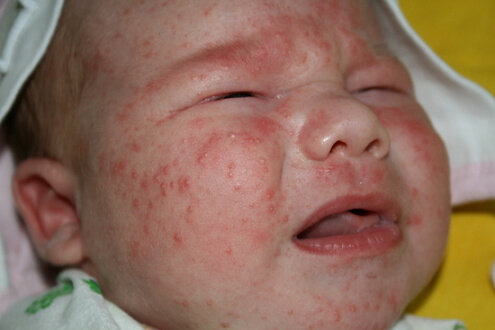
The syndrome can occur in all age groups. Most In children, TEN develops in the form of blisters with erythematous spots and plaques, which within a few hours turn into extensive areas of skin necrosis with pronounced epidermolysis. Few in children, the lesions begin with exposure of the oral mucosa, followed by large areas skin necrosis, but with intermediate areas of normal skin (in more detail these signs can be seen in the photo below).
The disease is also accompanied by severe rash, skin tenderness, erythema, malaise, and fever. The rash quickly drains over large areas of the skin and forms large, flaccid blisters. Widespread involvement of mucous membranes is possible. Due to the vast area of eroded skin, a large amount of body fluid is lost with subsequent disturbances in water-electrolyte metabolism.
A number of drugs have been indicted as causal agents, including pyrazolones, hydantoin derivatives, sulfonamides and barbiturates. Other factors cited as etiological factors in Lyell's syndrome are microorganisms, food and other elements that have an antigenic effect.
The annual incidence of TEN is 1 in 1,000,000.
Causes Lyell's syndrome

The leading role in the development of the syndrome is assigned to drugs, among which the first place are occupied by sulfa drugs, then antibiotics (40%) - penicillins, tetracyclines, erythromycin and etc.; anticonvulsants (11%) - phentoin, carbamazepine, phenobarbital, etc.; anti-inflammatory drugs (5-10%) - butadion, amidopyrine, salicylates, analgesics; anti-tuberculosis drugs - isoniazid. However, the occurrence of Lyell's syndrome is also possible as a result of other groups of drugs - vitamins, pyrogenal, X-ray contrast agents, tetanus toxoid, etc.
The timing of the development of TEN from the moment of the start of taking the drug that caused it, as a rule, ranges from several hours (even 1 hour) to 6-7 days, and sometimes even later. Of great importance is a hereditary predisposition to allergies due to a genetic defect in the detoxification system of medicinal metabolites, as a result of which drug metabolites can bind epidermal protein and trigger an immune response leading to immunoallergic reactions. In this case, the development of a graft-versus-host reaction is assumed. Found also a frequent association of Lyell's syndrome with antigens HLA-A2, A29, B12, Dr7. Patients have a history of various allergic reactions to medications.
It is assumed that the basis of the pathogenesis of TEN there is a hyperergic reaction such as the Schwarzman-Sanarelli phenomenon, leading to violent proteolytic processes in the skin and mucous membranes, accompanied by a syndrome of endogenous intoxication. The latter is manifested by a violation of protein metabolism, discoordination of proteolysis and accumulation in liquid media. the body of medium-molecular uremic and other proteins against the background of a decrease in the function of natural detoxifying systems organism. Added to this are violations of the water-salt balance. An increase in this status is fatal and therefore requires emergency therapy. Death occurs in 25–75% of cases of Lyell's syndrome.
Read also:Quincke's edema: symptoms and treatment
Lyell's syndrome symptoms

Mostly children and adults of young and middle age are ill. The disease usually develops acutely, quickly bringing the patient (within a few hours or 1-3 days) in a serious and extremely serious condition.
Body temperature suddenly rises to 39-40 ° С, on the skin torso, extremities, face there is an abundant disseminated rash in the form of a deep red color of edematous spots, which, "spreading", form confluent lesions.
After a few hours (up to 48 hours) on inflamed skin multiple bubbles of various sizes (up to the size of the palm) are formed with a thin, flabby, easily ruptured cover, exposing extensive painful, easily bleeding erosions.
Soon, all skin looks scalded (resembling a 2nd degree burn). She is diffusely hyperemic, painful; the epidermis easily moves when touched, symptoms occur "soaked laundry» (the epidermis under the finger shifts, slips and shrinks), symptoms "gloves», «socks» (the epidermis exfoliates, keeping the shape of the fingers, feet).
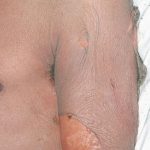


On the mucous membranes of the oral cavity, lips, there are extensive multiple erosive areas, painful, bleeding easily, on the lips they are covered with hemorrhagic crusts and cracks, making it difficult to take food. The process may involve the mucous membranes of the pharynx, larynx, trachea, bronchi, digestive tract, urethra, bladder. Often the mucous membrane of the genitals is affected, as well as the eyes with the development of erosive blepharoconjunctivitis, iridocyclitis.
Histologically, the process on the skin and mucous membranes is characterized by necrosis of the epidermis with the formation of subepidermal and intraepidermal blisters and a complete loss of the structure of all layers of the epidermis. The contents of the blisters are sterile. The dermis is edematous, the infiltration around the vessels and glands is small and consists of lymphocytes with an admixture of neutrophils and plasma cells. The capillary epithelium is swollen.
The general condition of the patient rapidly worsens to a degree of extreme severity, manifested by high fever, headaches, prostration, drowsiness, symptoms of dehydration:
- excruciating thirst;
- decreased secretion of the glands of the digestive tract;
- thickening of the blood, leading to circulatory disorders and kidney function.
Clinical symptoms of intoxication in the form of hair loss, nail plates. The occurrence of multisystem damage (liver, lungs by the type of pneumonia, noted in 30% of cases, kidneys up to acute tubular necrosis) is possible.
The serious condition of the patient, in addition to severe dehydration (dehydration) and disturbances in the water-electrolyte balance, manifests itself mainly endogenous intoxication syndrome, which is caused by impaired protein metabolism and discoordination of proteolysis.
In this regard, the accumulation of medium molecular weight oligopeptides (SM) occurs in the body fluids, which is 2–4 times higher than the norm. They are made up of the so-called uremic fractions of proteins with a molecular weight of 500–5000 D, as well as with an even higher molecular weight - 10 000–30 000 D. In the blood, there is a sharp increase in the leukocyte index of intoxication (LII). These indicators together reflect the severity of endogenous intoxication, and they can be used to monitor the effectiveness of the therapy.
Read also:Allergen test (allergy tests): what is it, how is it done, methods, indications
Diagnostics
In laboratory studies, leukocytosis was noted with a decrease in the relative number of lymphocytes (cytotoxic effect on T-lymphocytes), left shift of the formula with the appearance of toxic forms neutrophils; accelerated ESR; absence of eosinophils; LII is sharply increased; a change in the fibrinolytic activity of plasma is expressed due to the powerful activation of the proteolytic systems (high content of plasmin, plasminogen activators and a decrease in the content of inhibitors plasminogen); the proteinogram is characterized by a decrease in the total amount of protein, mainly due to albumin, while the content of globulins is increased; accumulation of SM is sharply expressed; the biochemical analysis noted the accumulation of bilirubin, urea, nitrogen, an increase in the activity of alanine aminotransferase.
In urine tests, microalbuminuria, proteinuria, and hematuria are noted.
The course of the process without treatment is steadily progressing, the development of pulmonary edema, acute tubular renal necrosis, pyelonephritis, pneumonia, septicemia due to secondary infection, septic shock with fatal the outcome. More often complications develop at 2–3 weeks of the disease. In modern conditions, when correcting water and electrolyte balance, protein metabolism, corticosteroid and antibiotic therapy, mortality is 20-30%.
The danger of death increases sharply with late diagnosis, irrational therapy, and also with necrolysis of 70% of the skin.
The diagnosis of Lyell's syndrome is based on history, clinical presentation, and laboratory findings.
To establish the role of a particular drug in the development of the process, immunological tests can be used, and in particular the blast transformation reaction, indicating an increase in the mitotic activity of sensitized lymphocytes of the patient with the formation of blast forms (lymphoblasts) in the presence of an allergen (suspected medicinal substance).
Differential diagnosis carried out with a bullous form of exudative erythema multiforme, pemphigus and other types of toxidermia.
Treatment for Lyell's syndrome
Early hospitalization of patients in the intensive care unit is necessary to combat the syndrome of endogenous intoxication and disorders of homeostasis, to maintain water, electrolyte, protein balance and activity of vital organs. The complex of treatment includes:
- Extracorporeal hemosorption: effective and pathogenetically grounded means of early complex therapy, which is best to carry out in the first 2 days of the disease (carrying out 2-3 sessions of hemosorption then interrupts the development process). By the 3-5th day, endotoxicosis is much more pronounced, and it will take 5-6 hemosorption sessions with a short intersorption interval.
- Plasmapheresis, in the mechanism of action of which, along with detoxification (removal of endogenous toxins, allergens, immune complexes, sensitized lymphocytes) normalization of the immune status sick. Spend 2-3 sessions, which allows (in combination with other means) to stop the process.
- Maintaining water, electrolyte and protein balance due to the introduction of intravenous drip up to 2 liters (sometimes 3-3.5 liters), on average 60-80 ml / kg per day, liquids: based on dextran (polyglucin, reopolyglucin, reogluman, rondex, rheomacrodex, polyfer); polyvinylpyrrolidone (hemodesis, neohemodesis, gluconeodesis, enterodesis); saline solutions (isotonic NaCl solution, Ringer-Locke solution with 5% glucose, etc.); plasma (native or fresh frozen), albumin, etc.
- Proteolysis inhibitors (kontrikal, etc.) - 10,000 units (up to 200,000 units) per day.
- Corticosteroids parenterally at the rate of 2-3 mg / kg body weight, on average 120-150 mg in terms of prednisolone, but in in cases of insufficient provision of the therapeutic complex, the dose of hormones can be increased to 300 mg and more. The high dose is kept until the process stabilizes and the endogenous intoxication syndrome is removed (7-10 days), then the dose is intensively reduced, transferring the patient to tablet forms.
- Hepato- and nephroprotectors (cocarboxylase, essential, riboxin, adenosine triphosphoric acid (ATP), vitamins C, B vitamins, E).
- Antibiotics, preferably cephalosporins, better than the 3rd generation: in particular, claforan (syn. cefotaxime), kefzol (syn cefazolin), seporin (synonym - cephaloridin) or aminoglycosides (gentamicin, kanamycin, amikacin, etc.) - within 7-14 days. Exclude the use of penicillin, ampicillin.
- Trace elements: CaCl2, panangin for hypokalemia, potassium chloride, lasix (for hyperkalemia).
- Heparin (100,000 IU per 1 kg / day), heart drugs, anabolic hormones.
- Cardiovascular monitoring. Care is extremely important: a warm room with bactericidal lamps, a warming frame is desirable, as for a burn patient; drinking plenty of fluids (rose hips), liquid food, sterile linen and dressings.
- Hyperbaric oxygenation (5-7 procedures) accelerates the healing of erosion.
- Outwardly: aerosols with corticosteroids and epithelializing, bactericidal agents (oxycort, oxycyclosol, etc.), aqueous solutions of aniline dyes methylene blue, gentian violet; ointments 5-10% dermatol, xeroform, solcoseryl, diprogent, elokom, celestoderm V for erosive and ulcerative areas, etc.
- On the mucous membranes of the oral cavity prescribe rinsing with infusions of medicinal herbs (chamomile, sage, etc.), lubrication with egg white to accelerate the epithelialization of erosion.
Read also:Allergy to latex
Lyell's syndrome is a serious illness with a high mortality rate, in which systemic treatment is extremely important, as well as careful skin therapy.
Forecast for Lyell's syndrome
The prognosis largely depends on the degree of damage, the presence of infectious complications, the timeliness and volume of medical care provided. The average death rate is 25-30%, in severe cases, these numbers can reach 65-70%.