Allergy to crustaceans (shrimp, crayfish, crabs ..) symptoms, treatment
Content
- Who are crustaceans?
- What is crustacean allergy?
- Symptoms
- How do crustacean allergy symptoms manifest?
- Treatment
- Treatment and prevention of crustacean allergy
- Diagnostics
- Can crustacean allergies be diagnosed?
Who are crustaceans?
Crustaceans - these are invertebrates of the underwater type of sea or fresh and salt water. These invertebrates, together with molluscs and fish, are included in a whole list of "seafood".
Crustaceans are: crayfish, king prawns, tiger prawns, etc. types of shrimp, crabs, lobsters, scampi, shrimp, arachnid crabs and all kinds of others. crabs.
Crustaceans are considered expensive and delicious food; despite their high cost, due to their taste, they are one of the best-selling seafood in the world.
From a nutritional point of view, crustaceans are included in the first group of staple foods. They have a moderate energy reserve, contain proteins of high biological value, B vitamins and mineral macronutrients (calcium, phosphorus, sodium, etc.). They are also rich in astaxanthin (an antioxidant provitamin A), cholesterol, omega-3 polyunsaturated fats (eicosapentaenoic acid and docosahexaenoic acid) and important trace minerals such as iodine, zinc and Selena.
Although they are nutritious, crustaceans have very high allergic force; therefore, like shellfish, they should be eliminated from children's diets and replaced with hypoallergenic fish such as cod.
What is crustacean allergy?
Allergy is an immunomodulated side reaction (release of certain immunoglobulins) against one or more well-defined peptide sequences. When food allergies, then symptoms (of varying severity) appear after eating food containing these amino acid sequences; depending on the case, these symptoms can occur almost immediately or many hours later (after the digestion of food you are allergic to).
Shrimp and crab allergies are one of the most common and frequent allergies in the world. She is also one of the most dangerous and has an absolute record for the number of hospitalizations. It manifests itself more often in adulthood than in juvenile (youth).
Read also:Quincke's edema: symptoms and treatment
Crustacean allergy is NOT synonymous with fish and shellfish allergy. That is, theoretically, those who suffer from allergic reactions to crustaceans can safely eat fish with bones (bream, anchovies, tuna, etc.), cuttlefish, octopus, snails, mussels, clams, oysters, scallops, sea truffles and etc. On the other hand, before consuming these products for crustacean allergies, you need to consult with an allergist and go through a series of diagnostic procedures to know for sure.
Note: Although statistically, crustacean allergy is more often definitive, it is not precisely known. It depends a lot on the case, so there are no known methods for determining its duration.
Symptoms
How do crustacean allergy symptoms manifest?
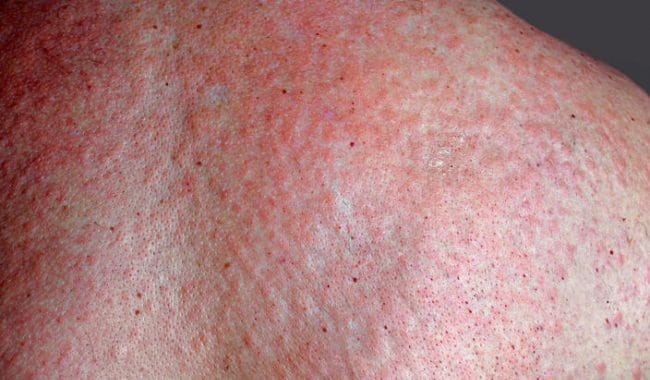
The most common symptoms of shrimp and crab allergy are:
- vomit;
- stomach cramps;
- stomach upset;
- diarrhea;
- spreads throughout the body hives (cm. Photo);
- labored breathing (dyspnea);
- wheezing when inhaling and exhaling;
- cough;
- swelling of the throat and trouble swallowing;
- swelling of the tongue and / or lips;
- bradycardia;
- pallor;
- dizziness and / or confusion.
Treatment
Treatment and prevention of crustacean allergy
Below we briefly summarize the points needed to treat and prevent this allergy:
- The first fundamental and inalienable rule of any allergy is avoid foodsthat cause a symptomatic reaction; among them are:
- Crustaceans.
- Products that contain derivatives thereof; always look carefully at food labels. It is recommended that you pay close attention to foods such as surimi, various fish snacks, etc. It is very important, especially when eating outside the home, to communicate with the kitchen staff.
In the previous section, we pointed out that crustacean allergy is a form of adverse reaction distinct from fish and shellfish allergy. However, especially in the foodservice industry, cross-contamination caused by mixing different products is not uncommon.
Let's take a trivial example: if a restaurant's menu offers Fritto Misto, then the different ingredients are probably already blended. When ordering Fritto Misto without Shrimp, there is a high probability that the kitchen operator will simply remove the shrimp after cooking. Or if the same oil used to prepare your dish is rich in leftovers from pre-cooked shrimp. As a result, a very sensitive allergy sufferer is likely to face a more or less severe symptomatic reaction.
- Some symptoms can be controlled by taking antihistamines and corticosteroid drugs. However, ONLY with mild allergic reactions.
- Suspecting the occurrence of "potentially" severe allergic reactions, especially anaphylactic shock (potentially fatal condition), it is important to always have on hand self-injecting epinephrine preparations (adrenaline). It is also important that these drugs:
- Introduced quickly, as soon as the first symptoms appear; remember that a severe allergic reaction is much more dangerous than the potential side effects of epinephrine (anxiety, anxiety, dizziness; seldom tachycardia of the heart, arterial hypertension and pulmonary edema).
- Were not overdue.
- Available in at least two doses; the second can be a spare and come in handy if the first breaks down or if the reaction is very serious.
- In addition, if children have an allergic reaction to crustaceans in the absence of their parents, it is important that adults present at mealtimes were informed and trained (e.g. school teachers, nannies, etc.) etc.).
Note: It is important that the allergist writes a prescription that states the emergency treatment with the type of medication used and the dosage, depending on the symptoms.
Diagnostics
Can crustacean allergies be diagnosed?
For a variety of reasons, diagnosing crustacean allergy can also be very difficult:
- If the crustacean allergy is severe, the subject may be admitted to the hospital unbeknownst to and unable to communicate with the medical staff, slowing down the diagnosis.
- Symptoms can be subjective and very different among people; Let's also not forget that allergic reactions to crustaceans can affect the skin, respiratory tract, gastrointestinal tract and / or cardiovascular system.
- Symptoms may change from time to time, between episodes of the same person.
- As we have already said, in some cases, allergy symptoms can appear even when eating suitable food, which, nevertheless, has come into contact with crustaceans.
- Cases of allergic reaction after inhalation of vapors / vapors from cooking crayfish are not very common.
Read also:Allergy to alcohol: causes, symptoms and treatment
If you suspect food allergies it is important to consult with an allergist who can make a diagnosis, prescribe special research and advise patients on how to cope with any symptoms of accidental intake food.
The allergist's diagnostic process begins with a detailed study of the medical history and symptoms of a hypothetical cancer allergy; for example, it will be necessary to report “what was eaten and in what quantities”, “how long it took for symptoms to appear”, “what symptoms appeared” and “how long they lasted”.
The allergist will then order a blood test (ImmunoCAP test) and / or perform a skin test himself to check for the presence of food specific immunoglobulin E (IgE).

Allergy tests (Prik test) - one of the skin allergy tests is performed on an outpatient basis and shows results within 15-30 minutes. They are done by dripping a drop of liquid containing the allergen onto the patient's forearm or back, piercing the skin with a small sterile probe (causing the liquid to penetrate the skin). These tests, which are not particularly painful but rather annoying, are considered positive. when the skin that comes in contact with the allergen turns red and swells (like a bite insect).
Blood tests are less sensitive than skin tests and show the amount of IgE antibodies to specific allergenic foods. Results are usually available after one or two weeks and are reported numerically for contextualization within a specific range.
As a reminder, there are cases where allergy skin tests are positive but do not cause symptoms when the food in question is taken. In addition, it should be noted that the amount of IgE tested by a blood test is not necessarily proportional to the severity of symptoms.
If both of these diagnostic tools give unclear results, the allergist may resort to conducting an accurate diagnosis for an accurate diagnosis. food test in which (under strict medical supervision) the patient consumes a large amount of potentially allergenic food.