Stomach or pancreas hurts: how to determine the cause
Since childhood, many are familiar with the phrase "stomach ache". By itself, as we understand, the stomach cannot hurt - the cause of discomfort always lies in a violation that occurs in one of the abdominal organs. Soreness in the abdomen is characterized by multifaceted symptoms and can signal various ailments. Accordingly, the treatment tactics in each case will be different.
In this text, we will look at how to determine the stomach or pancreas hurts. This is important in order to take the first measures in time before going to the doctor. The correct diagnosis is confidence in the effectiveness of actions aimed at combating the disease!

Stomach or pancreas hurts: how to determine
Content
-
1 Stomach or pancreas hurts: how to determine
- 1.1 Video - Digestive disorders, pain in the stomach and pancreas
- 1.2 Symptoms of stomach diseases
- 1.3 Symptoms of diseases of the pancreas
- 2 Diagnosis of the disease
- 3 Summarizing
Stomach or pancreas hurts: how to determine
The pancreas is an irreplaceable organ, the functions of which no other part of the digestive tract can take on. The pancreas produces enzymes that are essential for the digestion of food, as well as insulin hormone, which is responsible for the regulation of glucose in tissues. Dysfunction of the pancreas is dangerous by a serious deterioration in the quality of human life - it is not just an unpleasant symptomatology in a particular organ, it is a general wilting and weakening of the body.

Pancreatic pathologies are considered more dangerous than stomach diseases
Why is it so important to determine what exactly is given by pain in the abdomen - stomach or pancreas? The fact is that common stomach diseases, for example, gastritis of various etiologies, are not life-threatening for the patient. If irreparable damage occurs in the pancreas, the patient's condition can be very serious, even fatal. The second danger lies in the fact that diseases affecting the pancreas can progress in very short time intervals. For example, pancreatic necrosis can develop in less than one day and lead to the death of a person.
The pancreas is the closest "neighbor" of the stomach, it is located directly below it and through the duct supplies pancreatic a secret that allows the food bolus to be properly and well digested in order to prepare for further evacuation from organism. At this moment, the absorption of nutrients also occurs, without which a person is not able to be considered healthy and active. Therefore, pain symptoms transmitted by either the stomach or the pancreas are often confused. Due to the close proximity of organs, it is difficult to determine what exactly is out of order. Let's consider the most striking symptoms that allow us to detect a problem.
Video - Digestive disorders, pain in the stomach and pancreas
Symptoms of stomach diseases
The stomach is located in the upper abdomen, below the diaphragm. Since the organ is a kind of bag with soft contours, most of it is located on the left under the ribs, and another part is in the epigastrium, in the middle of the abdomen. It is believed that the stomach is able to accommodate several liters of food and drinks, so its size changes depending on the state of the person - hunger or satiety.

Stomach location
Accordingly, soreness in the stomach is primarily associated with food intake or lack thereof. Three types of stomach discomfort can be distinguished:
- Hungry pain - occurs when there is a prolonged absence of food. This is a "sucking" pulling soreness. In a healthy person, it can occur against a background of more than ten hours of hunger. If a similar symptom occurs during the day or in the morning, before breakfast, a peptic ulcer can be assumed.
- Early pain after eating - occurs half an hour after a meal. The soreness lasts quite a long time until the food bolt has passed the first digestive stage. Pain may indicate inflammation in the esophagus or stomach, polyps.
- Late pain after eating - occurs two to three hours after eating. The pain syndrome usually begins moderately, builds up gradually, and subsides after using the toilet. This is a signal of possible gastritis, most often with excess acid formation.
There are also stomach pains associated with eating specific foods. Fried and spicy foods, alcohol, cocoa and caffeine can provoke pain. People who prefer to drink a cup of Americano on an empty stomach instead of breakfast feel especially acute discomfort - the organ responds with aching pain almost immediately. If a person not only drinks coffee, but also adds a cigarette to the process, soreness and an unpleasant feeling in the stomach will haunt him until the moment of a normal balanced meal.

Caffeine can cause stomach pain
Soreness associated with high acidity of the stomach can be distinguished. This happens when the level of hydrochloric acid rises in the gastric secretion. Most often, errors in the diet are to blame, and the symptoms are manifested by a burning sensation in the epigastric region, moderate pain, heartburn, and pain in the abdomen on an empty stomach.
The characteristic pain that occurs with an upset stomach is acute twisting spasms that last intermittently. A person who ate something wrong will feel soreness for several hours, usually pain symptoms do not last long - followed by diarrhea, less often vomiting.

Vomiting and diarrhea can be symptoms of an upset stomach
Table 1. How does your stomach hurt?
| Why does it hurt? | Characteristics of pain symptom |
|---|---|
| Gastritis | Dull pain that worsens from diet errors. The stomach seems to be bursting from the inside. On palpation above the navel, soreness is more pronounced. |
| Ulcer | Severe epigastric pain, reaching painful shock. More often spread on an empty stomach or after a hearty meal. The stomach is seized with spasms that can last almost without interruption. Pain can radiate to the spine, penetrating the entire body. |
| Oncology | The stomach hurts almost constantly, regardless of food intake or pain medications. The pain differentiates from aching, moderate, to severe, bright flashes. |
| Polyps | Sharp cramping pains, usually occurring right in the process of eating. The pain is localized under the ribs, radiating to the lower abdomen. |
| Increased acidity | Burning, or as they are also called, burning pains in the stomach closer to the epigastrium. Soreness is characteristic on an empty stomach and a couple of hours after eating. Bad taste in the mouth. |
| Disorder | Acute pain, spasms, can develop at any time in a few minutes. The soreness can be quite severe, driving the person into cold sweats. It is accompanied by diarrhea. |
Symptoms of diseases of the pancreas
The most common ailment affecting the pancreas is pancreatitis. It occurs due to an overabundance of digestive enzymes and / or duct dysfunction, which prevents the enzymes from being released into the stomach. This process is self-destructive for the pancreas, since enzymes simply digest the walls of the organ itself instead of food. If the pancreas becomes inflamed, digestive enzymes attack its own tissues, destroying them.
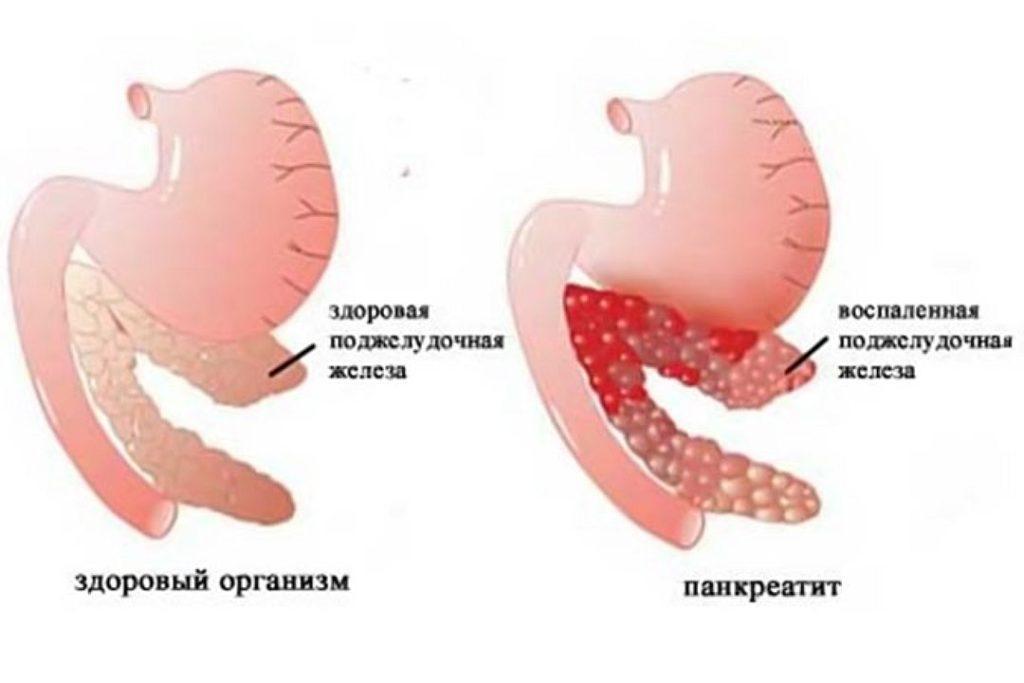
Inflammation of the pancreas with pancreatitis
There are two forms of pancreatitis: acute and chronic. The acute form occurs suddenly, bringing with it unexpected and very painful symptoms. This form of the disease is characterized by severe girdle pain, radiating to the left side, scapula, or even the collarbone. The person is feverish, nauseous, he can hardly find a position in which the pain syndrome subsides. The chronic form of pancreatitis is a calmer condition, but lasting for a long time. For several weeks or even months, if the patient does not seek help, he is worried about aching pains below the sternum, radiating to the back. Due to the constant lack of digestive enzymes, the pain intensifies some time after eating, bothers at night. When drinking alcohol, heavy fatty foods, the soreness will manifest itself sharply, subsequently returning to the "usual" moderate discomfort.

Causes of Acute Pancreatitis
Severe, boring pain that cannot be tolerated can occur with injury or damage pancreas, as well as when a gallstone enters the duct through which the pancreatic juice. In such a situation, a person is under the influence of a painful shock, is unable to move and most often takes a half-sitting position, pressing his knees to his stomach.
Another terrible form of pancreatitis is pancreatic necrosis. This is a destructive form, a terrible high risk of death. With pancreatic necrosis, the walls of the pancreas are destroyed, and in addition to necrotizing the organ itself, a high dose of toxins is released into the body due to dying tissue. Pancreatic necrosis occurs due to severe trauma, the simultaneous use of a large dose of alcohol or drugs, and can also develop in the process of a meal, when a person combines incompatible foods or wholeheartedly eats fat, spicy, sweet.

Pancreatic necrosis symptoms
Table 2. How does the pancreas hurt?
| Why does it hurt? | Characteristics of pain symptom |
|---|---|
| Acute pancreatitis | Unbearable pain in the middle of the abdomen, leaving the "belt" in the lower back and above. Rapid heartbeat, panic, fever. |
| Chronic pancreatitis | Moderate pain in the left hypochondrium, extending to the back. It is aggravated by a violation of the diet, becoming as strong as in acute pancreatitis. The patient is tormented by stool disorders, flatulence, spasms. |
| Abscess (formation of a purulent cavity) | Severe girdle pain that persists for several days. Low-grade fever, signs of intoxication, lethargy. |
| Cysts, neoplasms | Constant moderate pain, which turns into acute, short-term pain several times a day. Loss of weight, appetite, tension in the upper left abdomen. |
| Pancreatic necrosis | Sharp, sharp pain in the abdomen, which encircles the body on the left, radiates to the side and scapula. It is accompanied by fever, vomiting, fever, depression of consciousness, delirium. |
Diagnosis of the disease
Even an experienced doctor is not always able to determine what hurts a person - the stomach or the pancreas. The fact is that the symptoms of diseases of these organs are often difficult to differentiate, they are very similar. Ailments that affect both the pancreas and the stomach can manifest themselves with high fever, nausea, upset stools, and loss of appetite. In addition, each patient feels pain individually: for some, a spasm can be unbearable, for someone it is practically not felt, does not interfere with life.

Even a doctor can not always immediately determine the stomach or pancreas hurts.
In the event that moderate pains pursue a person for more than a couple of days, he needs to make an appointment with a therapist or immediately a gastroenterologist. If the pain is acute, persistent, it cannot be tolerated. It is recommended to call the "Ambulance" brigade so that doctors can examine and decide on the need for hospitalization.
In any case, whether on an outpatient basis or on admission to a hospital, the patient must undergo a series of studies aimed at identifying the diagnosis. As a rule, both with suspicion of a stomach disease and with symptoms characteristic of pancreatic pathology, approximately the same diagnostic methods are prescribed.

Listen to your doctor and go through all the prescribed tests and procedures
The patient must undergo blood tests, if necessary, urine and coprogram. Next, you need to visit the ultrasound office in order to examine the abdominal organs in real time, detect violations of the contours of the pancreas or stomach, changes in tissues and mucous membranes. Ultrasound diagnostics will allow to identify an unhealthy organ; to clarify the diagnosis, the following can be prescribed:
- Computed tomography or MPT.
- Endoscopic and laparoscopic examinations.
- Analyzes for tumor markers.
- X-ray diagnostics with contrast.
- Studies of gastric or pancreatic juice and the like.
Summarizing
The structure of the digestive tract is such that the stomach and pancreas are located in close proximity. Even from the names it becomes clear that these organs are practically parts of each other, and it is quite logical that the normal functioning of one of them is impossible without the other.
A person trying to figure out what his stomach or pancreas hurts, can be guided by the information set out above. But do not forget that the course of the disease and its pain symptoms in different people proceed in their own way. Therefore, there is no need to engage in self-diagnosis, it is better to entrust this to the specialists of a medical institution.

Do not self-medicate, but consult a specialist