Angina pectoris: what is this disease and how to treat it, symptoms, first aid
Content
- What is angina pectoris?
- Causes
- Stages of development and progression of the disease
- Symptoms
- Different forms of angina pectoris
- Complications
- Prerequisites for a heart attack
- Diagnostics and treatment
- Relief of an attack
What is angina pectoris?
Ischemic disease is a set of signs, angina pectoris (angina pectoris) is one of such forms.
The presence of plaques on blood vessels, the deposition of cholesterol on the walls of blood vessels, leads to a decrease in the level of oxygen in the blood, which in in turn, causes oxygen starvation and causes acute pain in the area of the heart muscle, which is also called the chest toad.
What is it and how to overcome this disease and will be discussed in the article. We will take a closer look at the main symptoms and treatment.
Causes
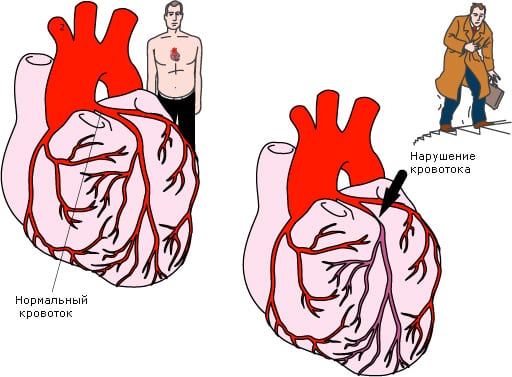
An attack of angina pectoris begins suddenly and does not stop until an ambulance is called.
There are many reasons for the attack, it can be caused by abundant nutrition, overeating, obesity, anxiety, temperature changes, stress, alcohol consumption on an empty stomach and smoking.
According to the statistics of the health center, the causes of angina pectoris are:
- smoking - quit smoking, smoking constricts blood vessels (tubular organs);
- do not overeat, high cholesterol levels are a sure sign of beginning changes in blood vessels;
- quit smoking, take steps to lower blood pressure, reduce increased blood cholesterol. Start by exercising. Diabetes exacerbates the course of the disease.
Ischemic heart disease (coronary heart disease) and angina pectoris, as its special case, begins with a narrowing of the blood vessels. Blood nourishes the heart muscle weaker, a feeling of general weakness of the body begins, the formation of plaques on the walls of the tubular organ, stress and constant overwork aggravate the situation.
An unpleasant painful sensation arises from the fact that starving pain receptors react to a lack of oxygen with impulses.
This condition is called a seizure. Tubular organs lose elasticity, pain intensification begins to arise from normal stress. This condition is not corrected, it is called chronic heart failure.
Stages of development and progression of the disease
It all starts with the on-duty state of tension, doctors call this condition angina pectoris, the patient is increasingly resorting to pills for heart pains, the person's relatives are obliged to measure him pressure.
A feeling of heaviness in the chest is a sign that medical help is needed. The condition will not let go, as they say among the people, one cannot expect from angina pectoris that it will pass on its own himself, this disease is insidious, an attack overtakes a person on the staircase, at work, in transport.
Symptoms
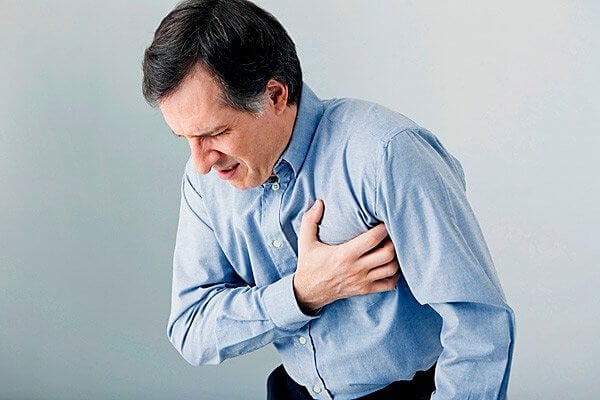
An attack is a classic symptom, it is perceived by the patient as an ordinary heartache, the person lies down and does not move, any attempt to do something causes pain.
The burning sensation in the region of the heart does not stop by itself, the heaviness on the soul is not easy to remove, you need to open the window, lay the person down and put a wet bandage on his head.
Read also:Arterial hypertension
With such pain, it is hard to breathe, a person tries to reduce activity in principle, since any movement causes unpleasant painful sensations under the scapula.
If relatives have a nitroglycerin tablet, then it should be placed under the tongue. It happens that a seizure goes away on its own, but this is more the exception to the rule than the rule.
Summing up, we can safely say that the main symptoms of angina pectoris are pain, which has the following characteristic features:
- she is a seizure-figurative;
- by nature - oppressive, squeezing;
- localized in the upper or middle part of the sternum;
- pain radiates to the left upper limb of a person, that is, to the hands;
- discomfort grows slowly, but quickly stops after taking nitroglycerin or eliminating the cause that caused it.
Pain can be provoked by:
- brisk walking, climbing stairs, carrying any heavy objects;
- increased blood pressure (hypertension);
- cold;
- severe overeating;
- emotional distress or stress.
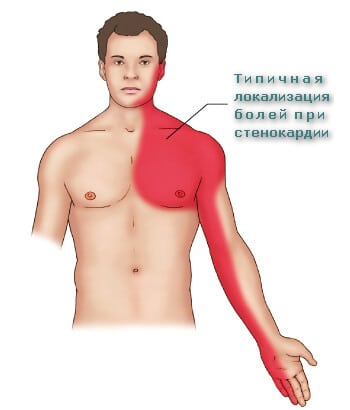
Angina pectoris begins with burning pain in the chest, suffering accompanied by sweating, vomiting.
The feeling is as if a soldering iron is being heated inside a person, and the pain, pulsating, over time covers the entire abdominal cavity.
The inability to raise the left arm and leg should alert the patient's family, breathing becomes jerky and frequent.
Different forms of angina pectoris
Cardiologists distinguish different forms of this ailment, among them:
- stable (exertional angina) - the moment of amplification occurs under stress on the heart muscles, during running and work;
- variant - spasm of the arteries of the heart.
Both are harbingers of a heart attack.
Complications
Coronary heart disease and angina pectoris, as its special case, have common features. Chronic heart failure is a clear consequence of fatigue. With the disease, the legs swell, shortness of breath and heaviness in the chest appear.
Changes in pressure are natural, wear and tear of the heart muscle is directly proportional to the increase in pressure. The end point is a heart attack, but it can occur from scratch.
Prerequisites for a heart attack
Spasm of arteries (tubular organs that feed the heart), atherosclerosis, plaques, the result of a clot getting stuck in the coronary arteries. In any case, the result is the same - heart attack, heart loses the ability to work adequately.
Also, each attack will entail such serious illnesses as:
- arrhythmia;
- tachycardia;
- ventricular block;
- heart failure;
- shock;
- inflammation of the heart;
- blood clots.
Being an eyewitness of such a condition, immediately call an ambulance and provide assistance to the patient, create conditions of rest.
Diagnostics and treatment

The doctor is responsible for helping the patient, hospitalization is recommended for examination and therapy.
Read also:Spasm of cerebral vessels: causes, symptoms and treatment
Before treating a disease, a person needs to undergo a series of examinations. When diagnosing the patient is prescribed:
- ECG,
- take blood tests
- take general urine analysis.
The diagnosis is made based on these tests. The doctor prescribes strong pain relievers as well as oxygen therapy.
Immediate procedures and measures to remove the consequences of a blood clot, the appointment of thrombolytics, angioplasty (vasodilation, a plastic can is used).
Today's popular coronary artery bypass grafting (bypass grafting from English translates as bypass, bypass) corrects the problem of blood supply to the vessels of the heart, after the operation it is shown rehabilitation.
First of all, patients need a tonometer. You can choose a tonometer of a budget category, it will allow you to control blood pressure and keep a diary of hypertensive patients.
The pressure is measured using a special cuff, while the condition of the person must be taken into account, otherwise frequent shaking and measurements can weaken and exhaust the patient. You cannot quit taking medications:
Nitrates (nitroglycerin) are given to the patient to reduce the frequency and severity of seizures. Their action usually lasts 10-14 hours, It is usually a tablet and a spray, the forms of such drugs may differ, some of them are taken 4 times a day, with a feeling of heaviness in the chest or with chronic conditions.
Remember! An attack of angina pectoris is a serious condition, you can not drag the patient from place to place, the interval between taking medications that remove amplification should be five to ten minutes. If this does not help, this is a direct indication for hospitalization.
Nitrates help to remove the effect, not the cause, unfortunately, in acute attacks, only hospitalization helps, although at discharge the patient is prescribed beta-blockers and calcium antagonists. Doctors often prescribe acetylsalicylic acid, it reduces the risk of blood clots, helps to eliminate the consequences of complications on the heart in the form myocardial infarction.
Each person has their own pace of life - remember this!
Do not be complex, do not be equal to healthy young people. There is no need to set new records, do not listen to stupid people who will begin to shame you and your capabilities. Angina pectoris is subject to disability, which means that the body's capabilities should be considered limited.
An active lifestyle can and should be led, especially before heavy loads of a forced nature (saving your life, swimming, fleeing from danger) you will still have to face. Drink a nitroglycerin drug before vigorous activity, it will save!
Healthy lifestyle on 70 percent controls the course of the disease better than any doctor, as the British said, if you want to be healthy, do not smoke and eat an apple every day. Diabetes and diseases of the gastrointestinal tract greatly complicate the course of the disease, however, to achieve significant weakening is possible even in the presence of these diseases, the main thing is to consult a doctor on time and monitor the pressure and food.
Relief of an attack

If a person is overtaken by angina pectoris, first aid is urgently needed. The following will help to interrupt the disease:
- Everyone is hearing nitroglycerin, it is considered a panacea for heart disease, although aspirin can be used just as well. Yes, it has been proven to be toxic, but what to do? Validol is ineffective; after taking aspirin, it is necessary to take a horizontal position and stay in a room with fresh air.
- Patients are shown a relaxing massage, it helps to quickly move away from an acute attack, sometimes patients do self-massage for themselves, you need to massage the areas of the face and neck close to the heart, that is, on the left sides. Hand massage is also effective, especially if the attack lasts a long time.
- Vascular spasm affects the head the brain, there is a strong pain in the head, the pain reliever is taken according to the testimony of the doctor, usually it is analgin, if the pulse exceeds 120 beats, it is necessary to drink anaprilin.
- If aspirin is in powder form, it is poured into a glass, filled with warm water (not cold, cold intensifies the spasm). Severe vasoconstriction, in which pallor and cold sweat are observed, indicate a decrease in pressure, in which case nitroglycerin should not be drunk.
- The relief of an attack at rest and in irritation is different, did the attack overtake lying down? Raise the person so that the legs are below the head, inversely proportional to the position when fainting.
The role of smoking during the course of the disease is significant - by itself, nicotinic acid dilates blood vessels, however, during smoking, the vessels narrow. The mystery lies in the metabolism of cells, nicotine and tar are poisons that clog the tubular organs, and nicotinic acid, separately, is a PP vitamin that has a positive effect on the body.
Of the substances that cause pleasure, namely, harmful fats, psychoactive substances and alcohol, there is not a single substance that has a positive effect on health. Resign yourself to the idea that whatever is pleasant is harmful.
Read also:Vein thrombosis of the lower extremities: causes, symptoms and treatment
If there is a desire to restore the work of the heart muscle and the state of the blood vessels, you need to begin to cleanse the body of toxins and toxins, if the wrong diet and an abundance of bad habits, even the most intelligent and talented doctor will not help a person, if he is not lucky, even the surgeon will not be able to save a life. It all depends on the patient.