
Myopia: what is it, causes, symptoms, treatment, complications
Content
- What is myopia?
- How common is myopia?
- Myopia symptoms
- When does myopia occur?
- Severe myopia
- Causes of myopia
- Genetic factor
- Environmental factors
- Diseases that cause blurred vision
- Diagnostics
- Myopia treatment
- Glasses and contact lenses
- Laser treatment
- On-site laser keratomileusis (LASIK)
- Photorefractive keratectomy (PRK)
- Lens implantation surgery
- Phakic Lens Implant Insertion
- Replacing a natural lens with an artificial one
- Complications of myopia
- Complications of surgery
What is myopia?
Nearsightedness (myopia) is a vision problem that makes distant objects appear blurry while close objects can still be seen clearly.
This is because the light beams are focused in front of the retina (inside the back of the eye) and not directly on the retina.
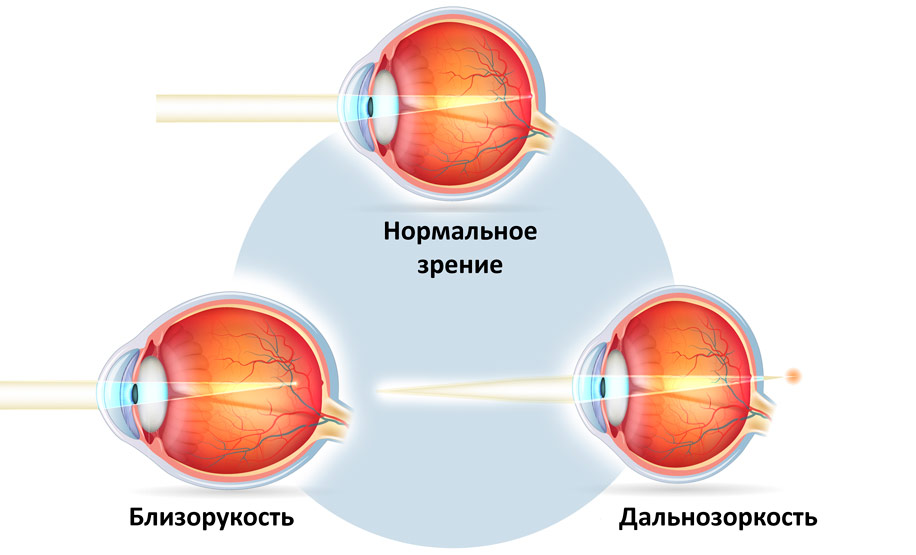
Myopia is caused when the eye is too long from front to back, or the cornea (the front of the eye) is curved too abruptly. The result is a mismatch between the length of the eye and its focusing power.
The degree of myopia is determined by the focusing force of the lens, which is measured in diopters (diopters):
- myopia mild - from 0.5 to 3.0 diopters;
- myopia medium - from 3.0 to 6.0 diopters;
- myopia high degree - 6.0 diopters and above.
Myopia can usually be corrected with glasses or contact lenses. Surgery to correct myopia is also available, although most people pay for it privately (see the Treatment section for more information).
How common is myopia?
In the world, at least 30% of people suffer from myopia, and about 5% of them suffer from high myopia.
Myopia symptoms
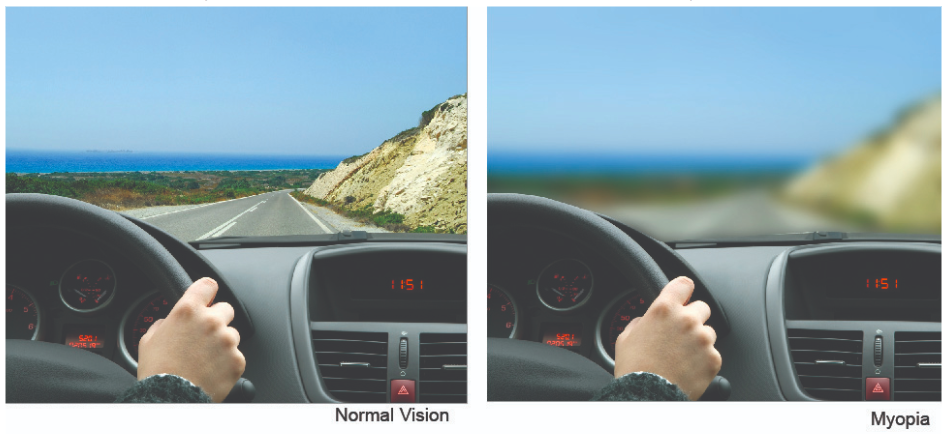
The main symptom of myopia is distant objects that appear blurry, while close objects are still clearly visible (see illustration). Photo). Other symptoms may include headache and eye strain.
When does myopia occur?
Myopia usually appears during puberty, but can appear at any age from early childhood to 25 years.
Usually, the degree of myopia increases with age, because the eyeball grows with the growth of the child. In most cases, myopia stops when the person stops growing.
In older people, myopia may be the earliest sign that it is beginning to form. cataract (clouding of the lens of the eye).
Some children who develop myopia may not at first realize that their vision is impaired. They may be able to read books and do “close work” well, but they may find it difficult to see distant objects, such as a blackboard in a classroom. They often think that this is "normal" and do not tell anyone about it.
Read also:Astigmatism
All this can be checked at school. If not, parents should take a referral to an ophthalmologist (ophthalmologist) to check the child's vision.
Severe myopia
Myopia that begins in early childhood often gets worse in adulthood and can become very severe. Known as high-grade myopia, this condition can create problems later in life due to associated changes in the back of the eye.
There is a small risk of decreased vision, which in some cases can be serious because the enlarged eyeball stretches the retina, thereby damaging it.
Causes of myopia

Myopia tends to run in families, although a variety of factors are thought to be responsible for myopia.
A person's genetic makeup and the environment in which they grow are believed to be associated with the development of myopia.
Blurred vision can also be a symptom of other health problems.
Genetic factor
The probability of developing myopia in children is approximately 30% if one parent has myopia, and 55% if both.
Environmental factors
People who spend a lot of time reading, working at a computer, or doing other work where need to look closely, temporary myopia may develop (when vision returns after rest eye). In addition, they may be more prone to developing permanent myopia.
Some people develop "night myopia" - blurred remote vision that occurs only at night. This is because blue colors make the eyes artificially short-sighted during the day, and a slight degree of myopia becomes more noticeable at night.
Diseases that cause blurred vision
- Blurred vision, as with myopia in patients diabetes mellitus could be a sign diabetic retinopathy (damage to the tiny blood vessels that feed the retina).
- Myopia can be a sign of developing cataracts (a cloudy spot in the lens).
Diagnostics
Myopia is usually diagnosed by an ophthalmologist (ophthalmologist) after an eye exam. The ophthalmologist will use a letter or symbol chart to record the level of vision and see if the lenses can return the person to normal vision.
Read also:Pterygium
Children can get their vision tested at school. If not, parents should also see an ophthalmologist.
Children should have their vision checked at least every two years.
Myopia treatment
Glasses and contact lenses
Myopia can usually be corrected with glasses or contact lenses. They negate the increased curvature of the cornea or the increased length of the eye so that distant objects no longer appear blurry.
Laser treatment
Laser surgery involves reshaping the cornea so that the eye is correctly focused. It is usually suitable for the treatment of mild myopia.
Most people pay for laser treatment privately.
Current evidence suggests that laser surgery to correct myopia is safe and effective in patients who have been appropriately selected.
However, as with any surgery, there are potential complications that you need to be aware of (see. (See Complications section below). The two available procedures are described below.
On-site laser keratomileusis (LASIK)
A small flap is made in the cornea and a tiny piece of tissue is removed with a laser. This is usually an outpatient procedure that takes about 15 minutes per eye. Vision may be blurry or blurry for several days after surgery.
Photorefractive keratectomy (PRK)
A laser is used to remove tissue from the cornea and reshape it. Treatment may be painful for up to 48 hours after. It can only be used to treat less severe myopia.
Lens implantation surgery
In lens implantation surgery, contact lenses are implanted in the eye to correct severe myopia (high degree of myopia). It is sometimes referred to as an intraocular lens insert or corneal implant placement.
There are two main methods of lens implantation surgery:
- Placement of the actual implant - the contact lens is permanently inserted into the eye without removing the natural lens ("phakic" means that the eye contains a natural lens)
- Replacing a natural lens with an artificial onesometimes called refractive lens replacement.
Phakic Lens Implant Insertion
This procedure is usually done for people aged 25-45 who are not suitable for laser surgery, or for people who have difficulty wearing glasses, for example, due to a disability or professional requirements.
Read also:Abrasions and scratches on the cornea of the eye
It is the preferred method for younger patients (up to 45 years of age) as it preserves natural vision when reading without assistance.
The procedure is performed under local anesthesia, and the person can go home the same day. At the beginning of the procedure, the pupil is dilated with eye drops, and then a phakia lens implant is inserted into the eye through a small incision in the cornea (the front of the eye).
Depending on the design, the actual lens is attached to the iris membrane (the colored part of the eye), located at an angle between the cornea and the iris or above the surface natural lens.
The second eye is usually treated about a week after the first.
The National Institute for Health and Clinical Excellence (NICE) has published lens implantation guide (PDF, 58kb) in February 2009. He concluded that there is strong evidence for short-term safety and efficacy, but there is an increased risk of developing cataracts, corneal damage, or retinal damage. There is no long-term data on this.
Therefore, it is important to speak with your doctor about this procedure and understand the risks involved.
Replacing a natural lens with an artificial one
This procedure is essentially the same as cataract surgery. The natural lens of the eye is replaced with an artificial one, which corrects myopia.
Replacing a refractive lens is usually a one-day procedure performed under general or local anesthesia. The operation is not painful. The second eye is usually treated about 7 days after the first.
Complications of myopia
If you have severe myopia (high-grade myopathy), you are more likely to have serious visual complications later in life, such as retinal detachment, glaucoma and cataract.
Complications of surgery
Complications of myopia surgery may include:
- clouding of the cornea (although this tends to improve rapidly);
- glare around bright lights;
- overcorrection (leading to hyperopia) or undercorrection;
- corneal infection;
- increased pressure in the eye (glaucoma);
- puncture of the cornea or eyeball;
- retinal detachment (when the mucous membrane separates from the back of the eye), which requires urgent surgical treatment to prevent permanent loss of vision.