
Nystagmus: what is it, causes, symptoms, treatment, prognosis
Content
- What is Nystagmus?
- Signs and symptoms of nystagmus
- Causes of nystagmus
- Hereditary diseases
- Central nervous system (CNS) disorders
- Birth trauma
- Causes of nystagmus in babies under 1 year old (newborns)
- Typology of nystagmus
- Diagnostics
- Treatment of nystagmus
- Forecasts
- conclusions
- Related Videos
What is Nystagmus?
Uncontrolled eye twitching, which resembles the movement of a pendulum, is called nystagmus, a condition sometimes diagnosed in children.
The natural, physiological form refers to the norm: it is spontaneously formed while tracking moving objects, as well as after exposure to drugs used to correct epilepsy and sleep disorders. Physiological nystagmus quickly disappears, while the pathological form always persists.
ICD-10 code refers to the name H55, which includes visual impairment.
Nystagmus is treated by an ophthalmologist, an otoneurologist (a specialist specializing in disorders of the vestibular apparatus), as well as a therapist, neurologist and pediatrician.
Signs and symptoms of nystagmus
Violations of the visual apparatus are associated not only with the inability to concentrate on one point, but also with the appearance of visual impairment - myopia or hyperopia. Clarity of vision is not always impaired immediately - in the early stages, visual deterioration is sometimes absent, although most patients suffer from the fact that they see the world as blurry.
The incessant vibrational movements create discomfort, so the child tries to reduce the discomfort by making atypical gestures and adopting unusual body positions.
External signs:
- "Moving" eyes (you can see this in the video below);
- a distant look;
- unnatural head position;
- restless behavior;
- frequent head turns to the side (or tilts);
- increased vomiting (sometimes);
- decreasing muscle tone.
Irritation of the visual receptors leads to nervous tension, so children with this disease are more often capricious and fall asleep worse. Clinical signs are more pronounced during fatigue, nervous excitement, and a sharp shift of the eyes from one object to another.
Fact.With nystagmus, the gaze is not able to project onto objects - it rushes beyond it. Impaired perception of the picture leads to tension in the brain and visual apparatus. The result is the formation of a visual defect.
Studying the condition of the child, parents primarily pay attention to the work of the vestibular apparatus if they want to identify nystagmus.
Read also:Astigmatism
Vestibular signs of a painful phenomenon:
- impaired body coordination;
- dizziness;
- unsteadiness of gait.
Without treatment, the intensity of the symptoms increases: the movement of the eyeballs is accelerated, gait worsens, vision is weakened.
Causes of nystagmus
Pathology develops during life or appears before birth. Summarizing the factors of influence, doctors note that most of the internal influences are associated with disorders that injure the organs, blood vessels and tissues of the head.
Hereditary diseases
When diagnosing nystagmus of the congenital (hereditary) type, the presence of this disease in relatives is revealed. Congenital severe myopia (below –5 diopters) also increases the risk of rhythmic eye fluctuations. Retinal injuries are similarly a risk factor.
Another dangerous hereditary disease is albinism, which is manifested by the absence of skin pigmentation. This disorder increases the likelihood of having a child with visual impairments.
A warning. If one of the parents is diagnosed with congenital nystagmus, then the probability of its transmission to offspring is 50%. There are no preventive measures.
Central nervous system (CNS) disorders
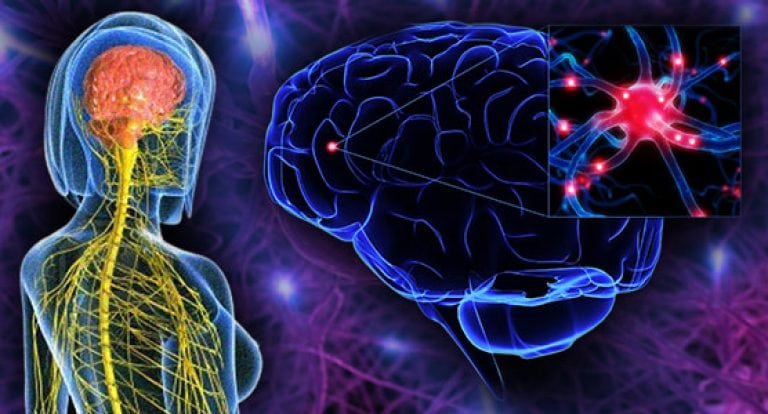
Nervous system pathologies are the reasons leading to incorrect transmission of impulses to various organs.
Vision is regulated by the central nervous system, so the damaged system negatively affects the child's ability to see.
Diseases of the central nervous system:
- multiple sclerosis;
- brain tumor;
- stroke;
- infectious otitis;
- meningitis (inflammation of the soft membranes of the brain and spinal cord);
- Meniere's disease;
- encephalitis (inflammation of the brain).
Often, the disease occurs with damage to the brain bridge, as well as impaired work of the pituitary gland.
Fact. Nystagmus is a consequence, a secondary disease formed under the influence of other diseases.
Birth trauma
Difficult childbirth often ends with injuries that damage mainly the head and the organs located in it.
Causes of nystagmus at birth:
- damage to the visual organs;
- severe compression of the head (traumatic brain injury);
- damage to the spinal cord and spine;
- internal hemorrhages in the trunk and head;
- damage to the facial nerve.
It is also dangerous for a child to pass through the birth canal affected by an infection. Contacting with it, the skin - if damaged - serves as a source of penetration of a dangerous agent into the blood.
Causes of nystagmus in babies under 1 year old (newborns)
Visual impairment is easy to identify before the age of 1 year, but not in the first month. Not having developed the ability to fix the gaze on objects (due to the weakness of the visual apparatus), the baby at this age demonstrates constant movement of the eyeballs - physiological nystagmus.
Read also:Hyperopic astigmatism
This feature should be taken as a disease only if "shifting eyes" are preserved after one month of age. Doctors manage to accurately diagnose nystagmus in newborns at the age of 3 months.
Typology of nystagmus
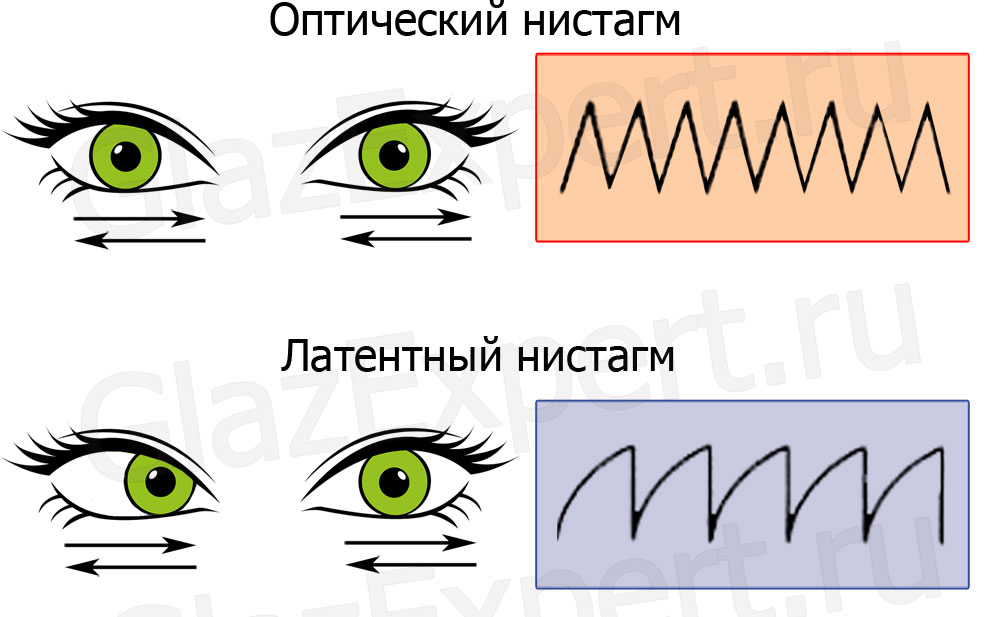
Oculomotor pathology has different manifestations that can be grouped.
-
On the side of defeat - the disease develops when the semicircular canals associated with the inner ear are damaged. Depending on the localization of the lesion, the nature of the manifestation of the disease in children also changes:
- left-sided variety (the patient throws his head in sharp jerks to the left side, and also moves his pupils in the same direction);
- right-sided (head and eye movements are shifted to the right).
Often these forms develop after purulent ear diseases. Labyrinth nystagmus is characterized by rapid movement of the pupil - often the head - towards the affected organ. After the jerk, there is a smooth return to the starting position.
-
Towards oculomotor movements:
- horizontal. The most common form in which the eye moves exclusively to the right and left and exclusively straight;
- vertical. The eyes move up and down. Always smooth and in sync;
- diagonal. Pupils move at an angle (usually towards the bridge of the nose);
- rotatory. The fourth form in its manifestations resembles the diagonal type, but the trajectory is characteristic of the horizontal type of the disease;
- dissociated. Oscillations are asymmetric - each eyeball moves in different directions. The opposite form is associated, in which synchronous eye movement is observed;
- monocular. Only one visual organ is affected by nystagmus.
Fact.In most babies, horizontal nystagmus disappears by 6 months of age, when the visual apparatus becomes stronger.
Classification by the intensity of eye tremors:
- jerky nystagmus. The trajectory is unstable - combined with sharp jerks in one direction and a slow return to the other;
- pendulum (swinging). Oscillations of the eyes are identical - the amplitude of movements is always unchanged (similar to oscillations of a pendulum);
- mixed. The third type combines the features of the two forms described above.
Attention. Exceeding the angle of eye movement with an amplitude of more than 15 degrees is a large-caliber nystagmus. If the swing range is in the range from 5 to 15 degrees, then a medium-caliber shape is diagnosed, up to 5 - a small-caliber shape.
Diagnostics
If you think you or your child may have symptoms of nystagmus, see your doctor. A doctor (ophthalmologist) will examine your eyes and test your visual acuity.
Read also:Color blindness test with numbers, Rabkin table
Diagnosis will depend on the type of nystagmus, your age, and what your doctor thinks is the root cause.
Treatment of nystagmus
Treatment for nystagmus depends on whether the condition is congenital or acquired. The actual nystagmus cannot be cured, but some remedies and procedures can still help you:
- glasses, contact lenses and aids for the visually impaired: they will not cure the disease, but will help to improve visual acuity, which, as a result, will slow down the movement of the eyes;
- surgery: Very rarely surgery is needed to reposition the muscles that move the eyes. Unfortunately, surgery also does not cure nystagmus.
Forecasts
In newborns, the pathological defect develops rapidly, but with the use of corrective agents, doctors are able to stop the progression in time. During this period, additional diagnosis is possible. myopia, astigmatism or hyperopia.
Early treatment is mandatory: the older the child, the less the effect of therapy. An unpleasant feature remains the fact confirmed by doctors: if nystagmus disappears (the ability to fix a gaze is established), then visual acuity does not spontaneously recover.
Advice. Treatment of nystagmus is also aimed at eliminating myopia, which becomes the cause of the disease and a factor that slows down the child's recovery.
conclusions
What we learned about childhood nystagmus from the article:
- pathological wobble of the eyes cannot be suppressed by willpower;
- nystagmus is characterized by increased variability of oculomotor movements;
- the pathological form cannot be detected in infants up to 1 month;
- medical statistics indicate the likelihood of the disappearance of the disease in children under 1 year old;
- geneticists identify increased risks of transmission of the disease from parents.
Non-stop wobbling of the pupils is an ophthalmic disease that can be corrected, but often not completely cured. The goals of therapy are to reduce the amplitude of oculomotor movements and achieve a value that does not cause discomfort in the child.