Diphtheria in children, symptoms and treatment, prevention, photo
Diphtheria is an infectious disease most commonly diagnosed in children and adolescents. In the case of lining and enveloping the throat with a fibrous film, an inflammatory process begins to develop. Babies become hysterical, whiny, have difficulty breathing, swallowing.
The reason for the development of diphtheria is damage to the mucous membrane of any part of the larynx with corynebacterium (diphtheria bacillus), leading to the covering of the tongue, throat, larynx, nasal cavity with a fibrous impenetrable film. Bacteria are quickly spread with the outflow of blood, they begin to emit a large amount of exotoxins. The body is experiencing severe poisoning. In case of failure to provide timely honey. help complications in children in the form of toxic shock, nephrosis, polyneuritis, myocarditis up to death are inevitable.
Content
- Infection routes
- Classification and forms
- How does it manifest?
- What other symptoms are there?
- Diagnostics
- Treatment methods
- Diet
- Prophylaxis
- Related Videos
Infection routes
The main causative agent of diphtheria is the diphtheria bacillus, which tolerates low temperatures well and even drying, remaining on clothes, objects, toys. Only boiling for 1 minute or disinfection with chlorine - 10 minutes leads to death.
The main route of transmission of diphtheria is airborne. The source of infection can be:
- saliva;
- discharge from the nasal cavity;
- contaminated items, toys that children like to put in their mouths
- a person is a carrier of bacteria, but after 9-10 days from the moment of infection, i.e. after the incubation period of corynebacterium.
Even when the test is performed, the analysis may appear negative, although this does not mean that no infection has occurred. The diphtheria bacillus is not detected as long as it is in a latent, dormant state. Only when certain favorable conditions appear, in particular unstable immunity, does it begin to rapidly activate to manifest itself.
The most susceptible to the disease are children aged 3-7 years. Babies, while breastfeeding, acquire passive immunity from the mother and even if they become infected, the bacteria will probably not manifest themselves in any way. Older children develop stable immunity. But adolescents during puberty are again at risk, when the immune system, as well as the hormonal background, begin to experience some kind of imbalance.

Diphtheria bacillus, when ingested, produces hyaluronidases (toxins), which quickly penetrate into epithelial cells. As a result:
- vasodilation and increased permeability;
- severe intoxication of the body;
- epithelial cell necrosis;
- slowing down blood flow;
- sweating of exudate;
- covering the mucous membrane of the larynx with a fibrous film;
- manifestations of local foci of inflammation in the palate, pharyngeal cavity pharynx.
Exotoxins have a toxic effect on the entire body as a whole, and a child can become a carrier of bacteria throughout his life.
Attention! Diphtheria in children is not a viral disease, which many people are mistaken about. The inflammation is caused exclusively by bacteria that can get into the mouth even with contaminated water, food and the treatment of this disease is special, although the symptoms are very similar to angina, acute respiratory infections, flu with a stuffy nose, throat.
Classification and forms
Depending on the location of the infection in the throat, the following forms of diphtheria are distinguished:
- localized when bacteria are introduced exclusively in one limited place;
- common when corynebacteria spreads outside the tonsils;
- hemorrhagic, characterized by damage to the hematopoietic system as a whole, the appearance of hemorrhagic rashes on the body and hemorrhage in the gastrointestinal mucosa;
- toxic, as the most dangerous with a rapid course, leading to tissue edema, and against the background of complications - paralysis of the lower extremities, neurotic syndrome, epileptic seizures, damage to the vessels of the heart.
Read also:Intracranial pressure (ICP) in infants and infants - symptoms and treatment
Corynebacteria are considered anaerobic and do not form spores at all. The causative agent is a diphtheria exotoxin, characterized by high toxigenicity, and when it enters the bloodstream, it quickly spreads along the venous bed. In response to intoxication, soft tissues quickly swell.
Literally in 2-3 days from the moment of infection, acutely pronounced symptoms appear in children: a sharp increase in temperature, dehydration, drying of the integument of the skin, abdominal pain, swelling, swelling of the lymph nodes.
How does it manifest?

When bacteria enter the body, they can lead to serious damage to internal vital organs (liver, kidneys, lungs). It was from the last day, i.e. on the 9-10th day of the incubation period, the child is considered infectious to others.
Symptoms appear depending on the location of the infection: ear, eyes, larynx, genitals:
- inflammation and swelling lymph nodes;
- swelling of tissues;
- an increase in high temperature to 41 degrees;
- weakness;
- cutting pain in the abdomen;
- development of renal, heart failure.
Signs of diphtheria are not always expressed in case of damage to the larynx and may be absent altogether. However, the diphtheria bacillus is tenacious and adapts well to the mucous membrane in a child's fragile body. If left untreated, complications are inevitable and may be irreparable.
In the case of localization of the infection in the nasal cavity, the following are observed:
- noises when breathing against the background of the formation of a false croup on the nasal mucosa;
- anxiety and fear (panic attacks);
- temperature rise to moderate values;
- violation of gas exchange;
- asphyxia, breath holding;
- lack of pulse while inhaling;
- weakness and apathy.
Attention! False croup, as well as true croup, develops with lightning speed. Consequences or death are inevitable. If the child begins to choke, signs of suffocation, severe sweating and arrhythmias are expressed, then urgently need to call an ambulance and carry out resuscitation recovery procedures. Death from asphyxia and dehydration can occur instantly.
Until the ambulance arrives, the parents of the children need to be on the alert and take immediate primary actions: open the windows in the room, ask the child to take deep breaths as often as possible, give salted water in order to rehydration.
Often, diphtheria in children manifests itself in episodes, symptoms and manifestations may be blurred (minor). In any case, you should immediately show the child to doctors or call an ambulance at home.
What other symptoms are there?

The signs appear taking into account the location of the diphtheria infection and the creature may differ, moreover, be similar to a cold, a common rhinitis, a sore throat.
With damage to the nasal cavity, there is:
- a sharp increase in temperature up to 38 gr. already on the 1st day of illness;
- barking cough;
- hoarseness of voice;
- nasal congestion;
- difficulty breathing.
Symptoms can be so little expressed that they often go unnoticed, and after 2-3 days they disappear altogether. But the infection lives on, progresses, asthma attacks can recur at any time, especially at night. Parents need to be extremely careful. Death with insufficient oxygen supply to the brain can occur at any time of the day.
Read also:Streptoderma in children: symptoms, home treatment
The catarrhal form of diphtheria is characterized by the appearance of:
- swelling of the mucous membrane;
- enlargement and redness of the tonsils.
The toxic form of diphtheria proceeds in a special way. It begins with a pronounced temperature up to 40 grams, soreness and cuts in the abdomen, swelling of the lymph nodes in the neck.
The infection leads to swelling of the larynx, blockage first of the upper, then lower respiratory tract. Further, the puffiness will go to the cervical nodes, fiber. Moreover, in children:
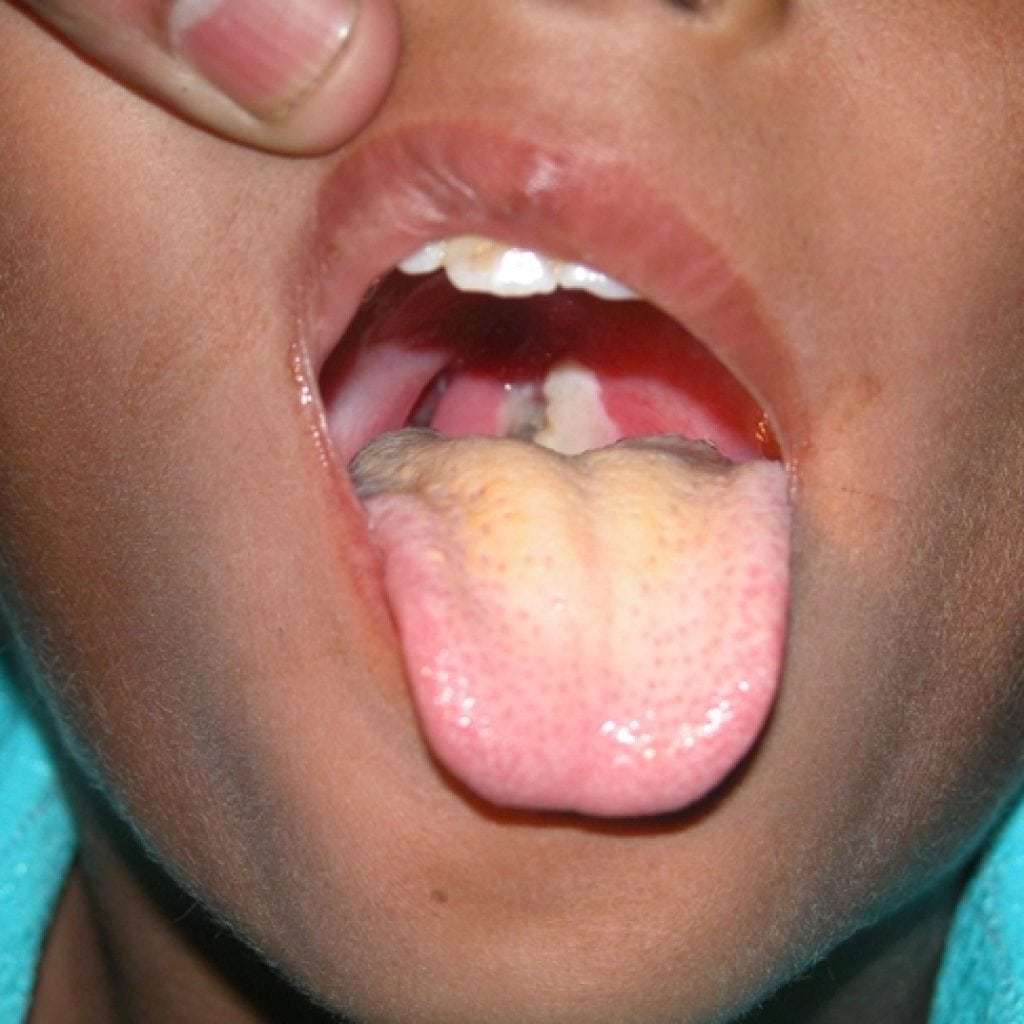
- coated tongue;
- there are noises when breathing, signs of asphyxia;
- inflamed cervical nodes.
The inflammation quickly spreads to the external (other) parts of the respiratory system. The disease progresses when the neck swells, and the baby becomes sedentary and apathetic, complains about:
- headache;
- blanching of the skin;
- leakage of fluid from the nasal cavity.
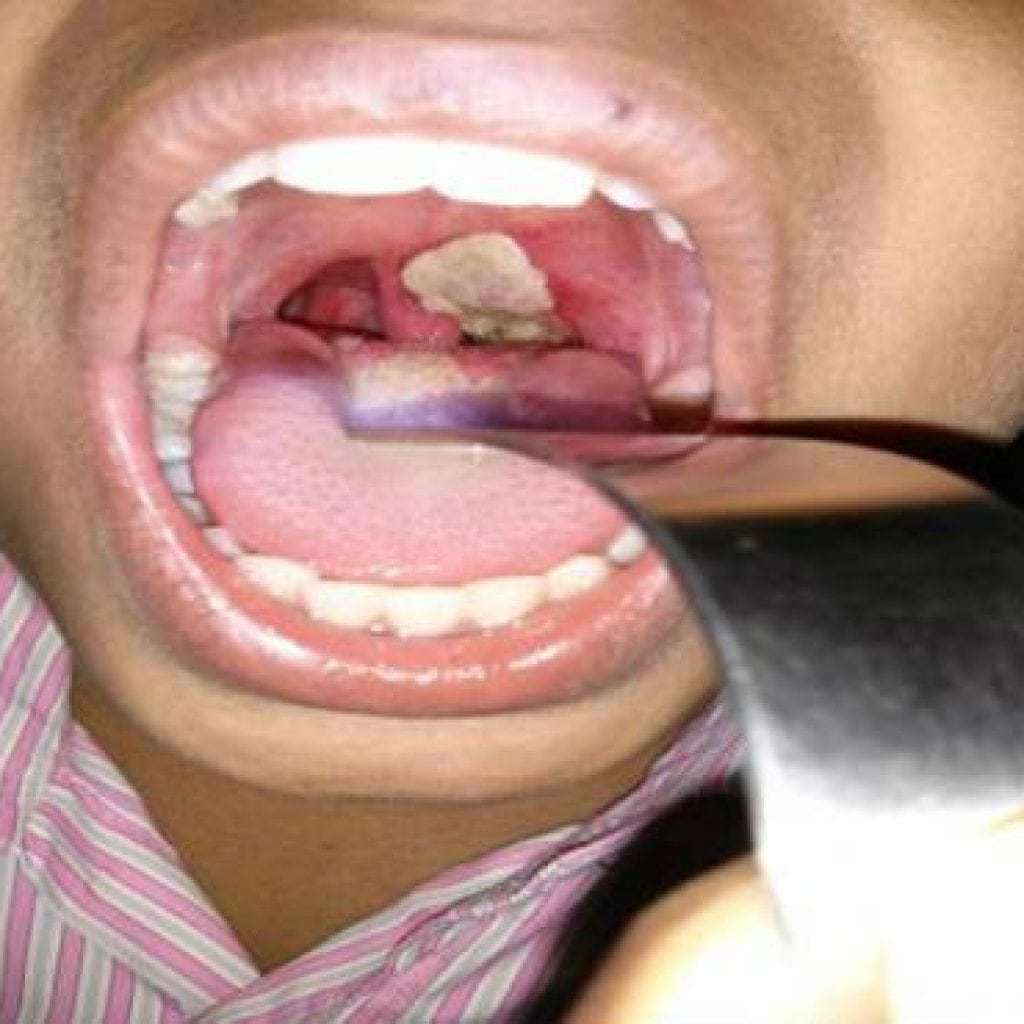
Seizures are especially dangerous. If at least 1-2 of the listed symptoms appear, it is enough to urgently consult a specialist if you suspect diphtheria. The characteristic signs of diphtheria can be seen in the following photos.

Diagnostics
The disease is detected by laboratory research methods. First of all, the doctor will visually examine the child's skin and throat, listen to possible noises in the lungs. Then he will redirect to pharyngoscopy in order to take a bacterial culture from the pharynx, nasal mucosa and study the shape, the percentage of bacteria in the flora.
Diagnostics for diphtheria is differential. Due to the similarity of the disease with purulent sore throat and lung abscess, it is important to identify the distinguishing features. Seeding for infection or the presence of a possible Clauberg medium is carried out with a sterile swab.
Additionally, it is possible to conduct a bacterioscopy, an IFA test, an RPG for the presence of specific antibodies in the blood.
Treatment methods

Diphtheria is a dangerous, contagious disease and a child, if suspected, is immediately subject to compulsory hospitalization. Treatment - complex, medicines, diet, high-quality bed rest.
It is important for doctors to find a counteraction aimed at the diphtheria bacillus in order to suppress. When prescribing medications, sensitivity tests are additionally carried out if the child has previously been vaccinated against diphtheria.
Taking into account the age of the patient, the form of the course of the disease and the primary signs, the following are prescribed:
- antibiotics (Cefuroxime, Phenobarbital);
- antipyretic drugs (Nimesil);
- antihistamines (Tavegil, Suprastin);
- intranasal preparations for administration into the nose in solutions (glucose, carboxylase, vitamin C, insulin);
- corticosteroids (dexamethasone, prednisolone);
- vitamin therapy;
- intravenous serum injection 2-3 times a day (carboxylase, glucose, protein preparations, Albumin, Tetracycline, Ampicillin, Erythromycin, Ceftriaxone) in severe disease.
Treatment is non-specific and directly depends on the existing symptoms. It is possible that enhanced therapy is carried out by infusion of intravenous solutions through a dropper or oxygen inhalation, suction masks with the accumulation of mucus in the respiratory tract and enveloping an impenetrable fibrous film.
In severe emergency cases (with the threat of asphyxia) in resuscitation conditions, the following is carried out:
- oxygen therapy by introducing a nasogastric tube;
- tracheotomy with the addition of a secondary infection and the development of inflammation in the lungs. A puncture is made in the trachea to allow air to enter and ventilate the lungs.
Read also:Symptoms and treatment of laryngitis in children
The infection can have a negative effect on the vascular and urinary systems. Children are shown bed rest, a gentle diet, and warm drinks. Complications can lead to pyelonephritis, myocarditis. Constant supervision by the attending physician is carried out.
Diet
Diet is imperative. Food in case of diphtheria infection should be gentle, easily digestible. Eating food exclusively in a liquid, semi-liquid form. If the child is unable to swallow food on his own, then the introduction is carried out through a probe when taking a “lying” position on the side and throwing the child's head back.
With the formation of a false (true) croup in the airways, it is possible to take conservative measures together with the operation, when drug treatment becomes ineffective.
With diphtheria, thermal procedures are shown to relieve pain, calm the laryngeal muscles, eliminate spasm, and normalize the quality of sleep. Inhalation of fresh cold air vapor helps to eliminate attacks of true croup in the larynx. So, after several sessions, the signs of stenosis in the chest disappear, and the baby calms down.
Resuscitation actions are carried out in combination with other medical techniques for diphtheria. The main thing is to normalize blood supply, release congested breathing in a child, and prevent dehydration of the body.
Prophylaxis
The main prevention is the immunization of the body, i.e. vaccination in order to preserve the health of the child in the future. Vaccination is carried out three times:
- for the first time - at 3 months;
- the second and third time - with an interval of 45 days by using the vaccine against diphtheria, tetanus, whooping cough.
During an epidemic, quarantine is established in kindergartens and schools in order to prevent the spread of infection and mass infection with such a dangerous disease.
Approximately 1 year after 3 vaccinations, revaccination is carried out:
- at 2 years old using the same DPT vaccine;
- at 7 years old with the use of toxoid;
- at the age of 14 with the use of toxoid;
- at 24 years old with the same ADS-M.
Attention! Even after the vaccination, the child may experience neurotic syndrome, urine analysis may change. Complications are possible with secondary infection with diphtheria. Parents need to be vigilant.
Diphtheria is a terrible disease. If the child does not receive vaccination under 6 years of age, ADS toxoid is injected twice with an interval of 45 days. If at least 1-2 suspicious symptoms appear, one should not neglect a trip to the doctor. For example, with false and true croup, it is impossible to avoid urgent resuscitation actions, and in some cases - the behavior of the operation.
The main thing is to prevent asphyxia, suffocation, stenosis, the development of severe inflammation in the cerebral cortex, in the lungs, or paralysis of the accommodation nodes in the periphery.
When a child begins to complain of impaired swallowing functions, disorders or asphyxia (choking), the symptoms are deadly. When you appear, you urgently need to show the child to the pediatrician, call emergency honey. help and treatment should be carried out immediately if at least 1-2 suspicious symptoms appear.