Gout: what is it, signs and treatment (how to treat, nutrition) of gout
Content
- What is gout?
- Gout symptoms
- Frequent symptoms and signs
- Acute gouty arthritis
- Chronic tofus gout
- Causes and risk factors for gout
- Dietary factors
- Genetic factors
- Diseases
- Medicinal causes
- Lifestyle Risk Factors
- Complications
- When to see a doctor
- How is gout diagnosed?
- Physical examination
- Laboratory tests
- Visual examinations
- Differential diagnosis
- How is gout treated?
- Home remedies and lifestyle
- Prescriptions.
- Diet for gout: foods to eat and avoid
What is gout?
Gout Is a form of arthritis that affects more than one million Russians every year. Also known as gouty arthritis, the disease is caused by the formation of uric acid crystals in the joint (most often on the big toe), which causes severe pain, redness and soreness.

While certain factors, such as genetics or kidney disorders, can predispose you to gout, diet, alcohol, and obesity can also contribute.
Treatment may include over-the-counter and prescription drugs to relieve pain and lower uric acid levels. You can also minimize the frequency of attacks by losing weight, exercising regularly, and avoiding triggers that cause pain.
Gout symptoms
Symptoms can be sudden and severe, causing pain, redness, and swelling of the affected joint, most often the big toe. Attacks occur most often at night or in the early morning hours. If left untreated, repeated attacks can lead to joint deformity and gradual restriction of movement.
Although the severity of symptoms can vary, gout tends to progress in stages and get worse over time. By recognizing symptoms early and treating them, you can avoid many long-term complications and improve your overall quality of life.
Frequent symptoms and signs

The symptoms of gout can vary depending on the stage of the disease. Seizures that occur early on can often be mild and manageable, but they tend to get worse with each seizure.
- Asymptomatic gout - this is the period before your first attacks. It was at this time that the constant increased levels of uric acid in the blood leads to the formation of urate crystals. Although you will not have any symptoms at this stage, the gradual accumulation of crystals will almost inevitably lead to seizures.
- Acute gouty arthritis - this is the stage where you begin to experience seizures lasting three to ten days. Seizures (most commonly affecting the big toe, but also the knee, ankle, heel, midfoot, elbow, wrist, and fingers) will cause sudden and severe pain accompanied by swelling, stiffness, redness, fatigue, and sometimes mild temperature.
- Chronic gouty arthritis - represents late a stage of the disease in which urate crystals consolidate into hardened lumps called tofus. The formation of these mineralized masses can gradually destroy bone and cartilage tissue and lead to chronic arthritis and joint deformity.
Acute gouty arthritis
Acute gout attacks usually last three up to 10 days with or without medication. Although the pain may strike suddenly, it tends to get worse at the onset of the attack before gradually disappearing. More than half of the cases will hurt the metatarsophalangeal joint at the base of the thumb. Other common locations include the knee, ankle, heel, midfoot, elbow, wrist, and toes.
Attacks are more likely to occur at night or in the early morning hours. This is in part due to nighttime dehydration (which increases uric acid concentration) and a decrease in body temperature (which promotes uric acid crystallization).
The most common signs of an attack gout include:
- sudden and severe joint pain, which some patients describe as akin to a broken bone, being hit, or severely burned;
- joint swelling and redness caused by acute inflammation;
- joint stiffness and pain when moving;
- mild fever;
- fatigue.
Gout attacks can often occur in groups when uric acid levels are constantly elevated (a condition known as hyperuricemia). Generally speaking, the first 36 hours will be the most painful, after which the pain will begin to subside, albeit gradually.
Chronic tofus gout
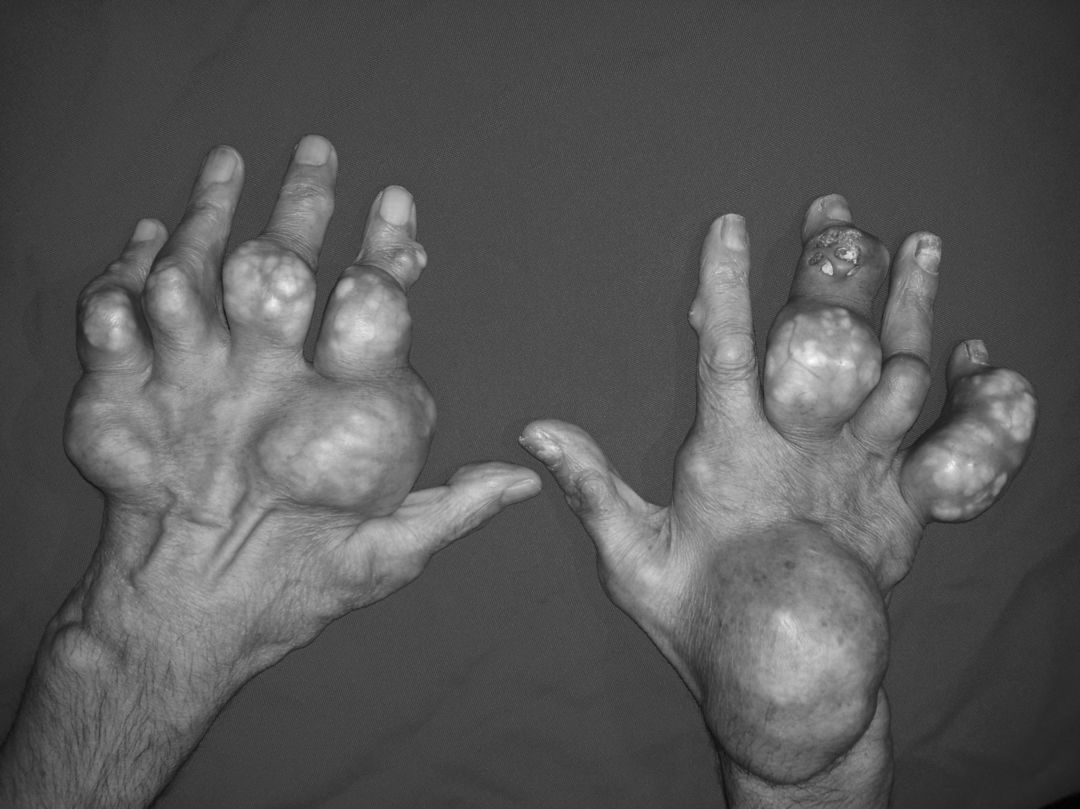
Chronic hyperuricemia can lead to extensive tophi formation under the skin, in and around the joint space. The buildup of these hard, lumpy deposits can erode bones and cartilage and lead to symptoms of chronic arthritis.
While gout is characterized by acute attacks of pain, chronic arthritis is defined by persistent pain and inflammation accompanied by fatigue, anemia and a general feeling of ill health. Over time, the joint can deform and interfere with mobility and movement.
Although most tofus develop in the big toe, around the toes, or at the tip of the elbow, tophus nodules can appear almost anywhere on the body. In some cases, they can penetrate the skin and cause brittle nodules to form. They are also known to develop in the ears, on the vocal cords, or even along the spine. Most nodules are considered harmless if they do not affect joint mobility.
Causes and risk factors for gout
While certain factors may predispose you to the disease, such as genetics or chronic kidney disease, other factors such as diet, alcohol, and obesity may also contribute to the development gout.
People usually experience their first attacks of gout at an age from 30 to 50 years old. Although men are more likely to have gout than women, the risk in women can increase significantly after menopause.
Dietary factors
Unlike other forms of arthritis, gout is caused by metabolic disorders in the body, not by the immune system. The risk of gout is associated with many factors - genetic factors, pathologies, and lifestyle - that together contribute to an increase in the level of uric acid in the blood, a condition doctors call hyperuricemia.
The foods we eat can play an important role in the development of gout symptoms. This is due in large part to an organic compound found in many foods called purine. When consumed, purine is broken down by the body and converted into waste, uric acid. Under normal circumstances, it will be filtered from the blood by the kidneys and excreted through the urine.
If uric acid is produced faster than it can be eliminated from the body, it will build up, eventually forming crystals that trigger gout attacks. Certain foods and drinks are common reasons for this. Among them:
- High Purine Foods are considered a major risk factor for gout. These include foods such as organic meat, bacon, veal, and some types of seafood.
- Beer is particularly problematic as it is made from brewer's yeast, an ingredient with an extremely high purine content. But any form of alcohol, in general, can increase the risk of a gout attack.
- High fructose drinks, including sodas and sugary fruit drinks, can cause hyperuricemia because concentrated sugars impair the excretion of uric acid from the kidneys.
Read also:Raynaud's syndrome in women
Genetic factors
Genetics can play a significant role in the onset of gout. Hereditary hyperuricemia is one such example caused by gene mutationsSLC2A9 and SLC22A12, which lead to impaired renal excretion of uric acid.
The body's inability to control the process between how much uric acid is produced and how much is excreted will ultimately lead to hyperuricemia.
Other genetic disorders associated with gout include:
- hereditary fructose intolerance;
- Kelly-Siegmiller syndrome;
- Lesch-Nyhan syndrome;
- medullary cystic kidney disease.
Diseases
There are certain medical conditions that can predispose you to gout. Some directly or indirectly affect kidney function, while others are characterized by abnormal inflammatory response, which some scientists believe may contribute to the production of urinary acid.
Some of the more common medical risk factors include:
- chronic kidney disease;
- chronic heart failure;
- diabetes;
- hemolytic anemia;
- hypertension (high blood pressure);
- hypothyroidism (low thyroid function);
- blood cancer (in particular lymphoma);
- psoriasis;
- psoriatic arthritis.
There are other health problems known to trigger a gout attack, including craniocerebral trauma, infection, recent surgery, and diet (possibly due to rapid changes in uric acid levels in blood).
Medicinal causes
Some medications are associated with hyperuricemia because they have a diuretic effect (increase the concentration of uric acid) or impair kidney function. The most dangerous are diuretics (diuretics) such as furosemide or hydrochlorothiazide. Other drugs such as levodopa (used to treat Parkinson's disease) or a nicotinic acid (vitamin B3) may also increase uric acid levels.
Lifestyle Risk Factors
The choices you make in your daily life can play the same role in increasing your risk of gout as factors you cannot control, such as age or gender.
Obesity.
Chief among these problems is obesity. By itself, being overweight is associated with high levels of uric acid.
2015 study also found a direct correlation between a person's waistline and his or her risk of gout. Among people with gout, the researchers said the risk of developing an attack with abdominal fat is higher than 47.4%, compared to people with a normal waist, who have a 27.3% risk. This is independent of a person's body mass index (BMI), which suggests that the more fat we have, the greater our risk of developing gout symptoms.
Other factors.
From a health standpoint, many of the same factors associated with chronic disease as type 2 diabetes and cardiovascular disease are associated with gout. They include:
- excess visceral fat (abdominal fat);
- high blood pressure (above 130/85 mm Hg);
- high LDL cholesterol ("bad cholesterol") and low HDL cholesterol ("good cholesterol");
- high triglycerides;
- insulin resistance;
- regular alcohol consumption;
- passive lifestyle.
Complications
Joints and skin are not the only organs that can be affected by gout. Prolonged untreated hyperuricemia can also lead to kidney crystal formation and kidney stones.

In severe cases, a condition known as acute uric acid nephropathyleading to renal failure and a rapid decline in renal function. People with kidney dysfunction are at greatest risk.
Symptoms of acute uric acid nephropathy can vary depending on the severity of the disorder, but may include:
- decreased urination;
- high blood pressure or arterial hypertension;
- nausea;
- fatigue;
- shortness of breath;
- anemia;
- swelling of tissues (swelling), mainly in the lower extremities;
- "Uremic frost", in which the urea excreted in sweat crystallizes on the skin.
When to see a doctor
Not everyone with gout will experience worsening symptoms or need urate-lowering therapy. With that being said, if you ignore the signs or take no action to avoid seizures, you could end up hurting yourself for many, many years.
People with gout sometimes think that long-term absence of symptoms means that the disease has spontaneously disappeared. This is usually a delusion. If the root cause of high uric acid levels is not controlled, the disease can progress silently and cause irreversible harm.
To do this, you should see your doctor if:
- This is the first attack. Even if no treatment is prescribed, you can benefit from lifestyle changes to reduce your risk of future attacks.
- Your symptoms do not improve after 48 hours or last for more than a week. If you are on therapy, this could be a sign that dietary and lifestyle changes need to be made.
- You have a high fever. While a gout attack is mostly accompanied by a mild fever, a high fever (over 38 degrees Celsius) can be a sign of infection.
How is gout diagnosed?
While gout may seem fairly obvious based on its appearance alone, a doctor will often want to do a series of tests to confirm the diagnosis and rule out other causes. As a disease characterized by the deposition of uric acid crystals in the joints, the doctor may want to find evidence of this by taking joint fluid with a needle for examination under microscope. In some cases, diagnosis may involve comparing symptoms with a series of laboratory and / or imaging tests.
Physical examination

In many cases, a diagnosis of gout can be made based on an analysis of your symptoms and medical history.
In addition to the physical examination, the physician wants to have a description of the seizures (including how it started and how long it lasted) and investigate any risk factors that may be present for the seizures.
Certain control symptoms may be sufficient to make a diagnosis, such as:
- acute pain in the first metatarsophalangeal big toe joint;
- extreme joint inflammation and redness within one day;
- having more than one attack in one joint.
While this may be all your doctor needs to come up with a treatment plan, it may need additional tests if this is your first attack or if recurrent symptoms become heavy.
Laboratory tests
The gold standard for the diagnosis of gout is to extract the synovial fluid from the joint and look for uric acid crystals (called sodium urate crystals) under a microscope. Synovial fluid is a light-colored thick substance that flattens the joint and lubricates the space between the joints.
A procedure known as synovial fluid analysis, begins with the injection of a local anesthetic to numb the soft tissue over the joint. After a few minutes, the doctor will insert a needle into the joint space to extract a fluid sample, which will then be sent to the laboratory for analysis. Your doctor may also examine the fluid under a microscope.
Read also:Vasculitis (angiitis): what is it, causes, symptoms (photo), types of angiitis, treatment
In addition to looking for sodium urate crystals, your doctor will examine you for hardened uric acid lumps found in advanced disease.
Other laboratory tests that can be ordered include:
- A blood uric acid test can be done to check for acid levels above 6.8 milligrams per deciliter (although people with low levels may also have gout).
- Blood tests for urea and creatinine may also be done to determine if decreased kidney function is contributing to gout or if hyperuricemia (excess uric acid) has damaged your kidneys.
- Urinalysis can be used to check the level of uric acid in the urine and assess the risk of kidney stones.
Visual examinations
To help with the diagnosis, your doctor may order imaging tests to evaluate characteristics of a swollen joint or to check for tophus, crystal deposits, bone erosion, or loss of cartilage.
Imaging options include x-rays, computed tomography (CT), magnetic resonance imaging (MRI), and ultrasound (ultrasound).
Each study has its own advantages and limitations:
- X-ray may reveal bone erosion and loss of cartilage, but may not detect problems early.
- CT and MRI scans can detect damage to bone and cartilage, as well as larger tophuses, but according to a study published in European radiologyit may not be possible to detect early onset of the disease.
- Ultrasound useful because it is portable, readily available and does not use ionizing radiation. Ultrasound can also detect the earliest signs of gout, including crystal deposits, fluid buildup, and narrowing of the joint space accompanied by loss of cartilage. On the other hand, ultrasound will not help visualize the deeper structures of the joint.
In practice, ultrasound is usually used if you are just starting to experience symptoms or recurring seizures. Other tests may be done based on the history of your signs or the severity of your condition.
Differential diagnosis
While the signs of gout may seem definitive in appearance alone, there are two others. conditions that the doctor will pay attention to that have surprisingly similar features: pseudogout and infectious arthritis.
To make the distinction, the doctor will do four tests on the synovial fluid: 1) check for crystals, 2) test her white blood (to check for infection), 3) gram culture of synovial fluid (to check for bacteria), and 4) location of pain in joints.
Gout.
Gout has certain physical and diagnostic characteristics that separate it from other conditions, namely:
- analysis of synovial fluid: needle crystals;
- leukocyte count: below 50,000;
- Gram stain and culture: positive (confirm bacterial infection);
- location of pain: usually the base of the big toe, midfoot, or ankle.
Pseudogout.
Pseudogout is a condition in which calcium crystals (not sodium urate crystals) form in the joint space. The disease can be differentiated from gout in the following ways:
- analysis of synovial fluid: diamond-shaped crystals;
- leukocyte count: below 50,000;
- Gram stain and culture: negative;
- location: usually knee or wrist.
Infectious (septic) arthritis.
Septic arthritis, also known as infectious arthritis, usually results from a bacterial infection and can be fatal if left untreated. It differs from gout in the following characteristic ways:
- analysis of synovial fluid: no crystals.
- white blood cell count: usually more than 50,000;
- staining and culture: positive (confirms bacterial infection).
- location: usually large joints (knee, hip, or shoulder).
How is gout treated?
Depending on the severity of the attack, treatment may include over-the-counter anti-inflammatory drugs. for pain relief, as well as lifestyle changes (such as dietary and alcohol restrictions) to reduce the frequency seizures.
Chronic attacks may require prescription medications to help lower blood uric acid levels.
Home remedies and lifestyle
The symptoms of gout are caused by an excessive buildup of uric acid, a condition known as hyperuricemia. Over time, buildup can lead to the formation of uric acid crystals in and around the joint, causing severe and prolonged bouts of pain and inflammation.
Thus, treatment for gout will focus on two things: reducing uric acid and relieving gout pain. There are a number of home remedies and lifestyle adjustments that can help.
Pain control.
A gout attack usually lasts three to 10 days. Pain during early attacks (usually the first 36 hours) is usually most severe.
Home treatment options include:
- Ice pack or cold compress can provide sufficient relief from mild bouts of pain. Be sure to wrap the ice pack in a thin towel and apply to the joint for only 15-20 minutes to prevent frostbite. You can do this several times a day.
- Rest for joints. Since the big toe is most commonly affected, lift your foot to reduce swelling. Walk as little as possible, and if you need to get around, use a cane or crutches.
Dietary interventions (diet and nutrition).
The food we eat is an important cause of hyperuricemia. Some contain high levels of an organic compound known as purine, which, when broken down, turns into uric acid. Others contain substances that impair the excretion of uric acid from the kidneys.
Although there is little evidence that dietary interventions can reduce the severity or the duration of the attack, there are some things you can do to reduce the risk of future seizures.
To do this, you need:
- Avoid or limit the consumption of alcohol of any kind, especially beer.
- Avoid or limit the intake of foods high in purine (beef entrails (brains, kidneys, liver, sweet meats: goiter and pancreas), meat extracts, sardines, anchovies, small shrimps, mackerel, fried legumes culture).
- Avoid or limit consumption of drinks containing fructose, which impair uric acid excretion.
May take Tylenol (acetaminophen) on instructions.. Although it does not have the anti-inflammatory properties of NSAIDs, it can help relieve pain.
Prescriptions.
Prescription medications are often used when diet and lifestyle are not working and / or there are signs of increased joint damage. Prescription medications used to treat gout can be classified into two types: anti-inflammatory and lowering uric acid levels.
Anti-inflammatory drugs.
Prescription anti-inflammatory drugs commonly used to treat gout are either prescribed on an ongoing basis or used as needed to relieve acute symptoms. Among the options:
- Colchicine Is an oral anti-inflammatory drug used to prevent and treat acute attacks of gout. Colchicine can be taken separately from other medications, but is more commonly given with a uric acid-lowering drug such as Allopurinol. Colchicine side effects include diarrhea, nausea and abdominal cramps.
- Corticosteroidstaken by mouth or by injection into a joint provide short-term relief of acute symptoms. The drugs work by suppressing inflammation and suppressing the immune system in general, and as such are generally not used as long-term therapy. Oral treatment (usually using Prednisone) can be prescribed over several days or weeks. Corticosteroid injections are most often used when only one joint is involved or there is a need to reduce the systemic (body-wide) effects of oral corticosteroids. Abuse of any form of corticosteroid can lead to weight gain, minor bruising, osteoporosis, vision problems, high blood pressure and an increased risk of infection.
Read also:Amyloidosis
Drugs that lower uric acid levels.
If other interventions fail to lower uric acid levels, doctors often turn to medications. which can either decrease the production of uric acid or increase the excretion of uric acid from organism.
Currently, the US Food and Drug Administration has approved five drugs for these purposes:
- Probenecid Is an oral medication taken daily to help the kidneys eliminate uric acid. While effective in reducing uric acid levels and symptoms, it can often take a while for the medication to take effect. In some cases, gout attacks may worsen during the first 6 to 12 months until the body adapts to treatment (an important reason why colchicene is often given concomitantly with these drug). Side effects include kidney stones, nausea, rashes, indigestion, and headache.
-
Uloric(febuxostat) is an oral xanthine oxidase (XOI) inhibitor that reduces the production of uric acid in the body. Taking daily, Uloric can reduce the severity and frequency of attacks.
- Common side effects include nausea, joint pain, and muscle pain. Do not take Uloric if you are using Azathioprine (used to treat rheumatoid arthritis) or Mercaptopurine (is used for lymphoma treatment, Crohn's disease or ulcerative colitis).
-
Allopurinol is another oral XOI drug. As with Uloric, gout attacks may occur in the early stages of treatment. To prevent them, the drug is often prescribed in lower doses and then gradually increased. In addition, allopurinol is usually given with colchicene to reduce the short-term risk of a gout attack. Side effects of allopurinol include upset stomach and rare but often severe skin reactions.
- Side effects are much less severe than other drugs that lower uric acid levels and can include rashes and upset stomach. Stomach problems usually go away when your body gets used to the medication.
-
Zurampik (lezinurad)is an oral drug that enhances the effects of XOI when XOI alone is sufficient. May be given with Uloric or Allopurinol, but use with caution as it may increase cardiovascular risk.
- Side effects can include headache, mild fever, muscle aches, joint pain, and acid reflux.
-
Cristexa (pegloticase)is a newer biologic delivered by intravenous infusion into a vein and is used only if other treatments fail. Cristexa works by converting uric acid into a substance called allantoin, which is easily eliminated from the body. It is administered every two weeks at the clinic and is therefore only intended for the most severe cases.
- Common side effects include short-term flare-ups, nausea, bruising, sore throat, constipation, chest pain, and vomiting. Serious allergic reactions may occur after repeated doses.
Other adjunctive drugs may also be used to treat gout, including Losartan, an antihypertensive drug and Fenofibrate, lipid-lowering drug. Both can help lower serum uric acid levels.
Diet for gout: foods to eat and avoid
Dietitians usually prescribe the N6 diet for patients with gout. This diet is different in that it retains the full calorie content, but at the same time, the amount of animal fats, salt and protein consumed is reduced. Diet for gout includes increasing the amount of fluid consumed.
As for food, it is crushed and given to the patient in small doses. It is by nutrition with gout that you can see how the remission process is going.
Any rheumatologist will tell you that proper nutrition in the treatment of gout is the most important component of treatment. If the patient does not change the diet of the food taken, then he simply will not recover. After all, it is the unhealthy diet that is the main factor in the occurrence of gout.
A list of foods that are recommended for people diagnosed with gout:
- Fish, meat. No more than two times within 7 days (150g). Only boiled or baked!
- Walnuts, Chicken eggs.
- Vegetables (potatoes, cabbage, zucchini).
- Porridge, flour products. In very small doses.
- Berries. Watermelon, strawberry, blueberry.
- Milk products.
- Vegetable oil, butter (no more than 10 g) per day.
- Fruits. Oranges, apples, peaches.
When composing a menu for a person with gout, one must take into account the fact that all dishes are prepared by boiling, or steamed. Only fruits and vegetables can be served raw.
Morning coffee, or tea, the patient will have to replace with compotes, fruit drinks, or decoctions of medicinal herbs (mint, rose hips).
It is useful to arrange a so-called fasting day once a week. Here is a sample menu for this case:
- Fruit fasting day. The diet includes 1-1.5 kg of various fruits. An exception is banana, grapes.
- Vegetable. The diet consists of cooked (boiled, baked) vegetables. At the same time, oil and salt must not be added to the dishes.
- Kefir. The diet is 1-1.5 liters of kefir, or up to 450 grams of cottage cheese.
Thanks to fasting days, the patient will be able to reduce the level of uric acid and improve the metabolic process.
In addition to healthy foods, there is also a list of things that a gout patient should not eat:
- By-products. Language, liver, brain.
- Meat and fish dishes with a high fat content (jellied meat, soups, broth).
- Young meat (young animals).
- Dishes cooked by smoking, pickling, spicy, fried.
- Alcohol.
- Legume dishes (peas, soybeans, beans).
- Salty dishes. Salt has a very bad effect on the gout patient.
- Hot spices, sauces and condiments.
In the event of an exacerbation of the disease, the patient needs to switch to a diet consisting mainly of liquid food (weak broths from vegetables, dairy products, juices from fruits and vegetables, liquid cereals and decoctions).
In the course of treatment, the patient should take as much ordinary (without gas) water as possible. It is very useful to drink mineral waters (Borjomi), weak green tea.