Raynaud's syndrome: what it is, symptoms and treatment in women
Content
- What is Raynaud's Syndrome? Introduction.
- Forecast
- Causes
- Causes of Primary Raynaud
- Causes of Secondary Raynaud
- Violations and pathologies
- Repetitive movements
- Injuries to hands or feet
- Chemical substances
- Medications
- Images and photographs
- Symptoms and complications
- Complications
- Diagnostics
- Involved specialists
- History
- Patient examination
- Analyzes and diagnostic methods
- Cold stimulation test
- Capillaroscopy of nails
- Other studies
- Treatment and care
- Lifestyle changes
- Protect yourself from the cold
- Avoid all other triggers
- Other lifestyle changes
- Drugs and surgery
- Living with Raynaud's Syndrome
What is Raynaud's Syndrome? Introduction.
Raynaud's syndrome (or Raynaud's phenomenon) is a rare condition that affects the arteries, that is, the blood vessels that carry blood from the heart to the rest of the body; The syndrome is characterized by short episodes of vasospasm, that is, narrowing of the blood vessels.
Vasospasm arteries causes a decrease in blood flow to the fingers and toes; 60% of patients experience symptoms of the syndrome mainly on the fingers, while in about 40% of cases, the syndrome affects the toes.
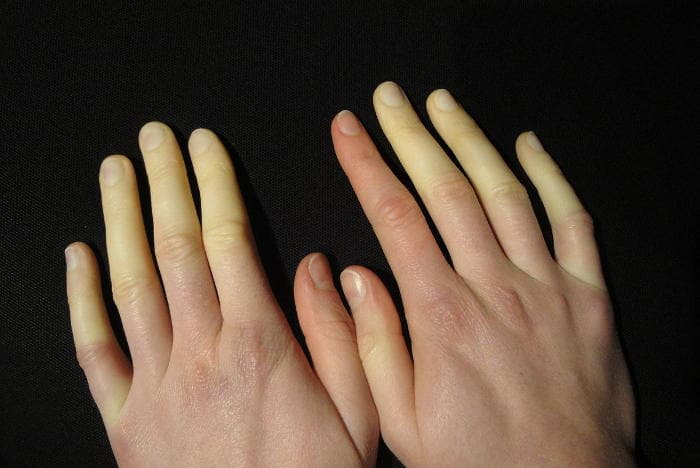
As a result, the skin becomes whitish or bluish for a short time. When circulation returns to normal, the affected areas may turn red and begin:
- pulsate;
- tingling;
- burn (burn);
- go numb.
Less commonly, Raynaud's syndrome also affects the nose, ears, nipples, and / or lips.
- In many patients, the cause of the syndrome cannot be traced and diagnosed, in these cases the disease is called primary Raynaud's syndrome;
- when the disorder is caused by another upstream pathology or detectable factors, the disease is called secondary Raynaud's phenomenon.
Primary Raynaud is more common and generally less severe than secondary Raynaud.
If a person suffers from Raynaud's syndrome, primary or secondary, a cold or stress can cause seizure, episodes during which blood circulation in the affected areas in whole or in part stops.
In both forms of Raynaud's, seizures can be triggered by even minimal or very short temperature changes: for example, fingers may turn blue, even when the patient takes something out of the freezer, or simply if the person exposes himself to a temperature for several minutes below 15 ° C.
Most of the patients who suffer from the disease do not report complications (neither tissue damage nor permanent abnormalities); in contrast, others with severe disease may develop ulcers or gangrene due to prolonged or repeated attacks ("gangrene" indicates a state of tissue death and decomposition).
Forecast
- The underlying, primary syndrome is, in most cases, little more than a nuisance and can usually be controlled by simple lifestyle changes.
- Secondary Raynaud's may be more difficult to keep symptoms under control, however patients are offered a variety of treatments available to prevent or relieve symptoms; but, in these cases, it is important to treat the upstream disorder or pathology.
Causes
The spread of the disease is difficult to estimate because it varies according to accepted criteria; by far the more common among women is a forecast of 0.5 to 20% of the total population.
- In many cases, doctors are unable to diagnose the cause of Raynaud's syndrome. Thus, the disorder is called Raynaud's syndrome or primary Raynaud's syndrome.
- In other cases, the cause of the disorder is another pathology or other identifiable factors. This type of disorder is called Raynaud's phenomenon or secondary Raynaud's phenomenon.
Causes of Primary Raynaud
As already mentioned, the root causes of the development of Raynaud's syndrome are not known, in these cases in medicine they speak of idiopathic the nature of the disorder; however, it follows from the analysis of the literature that:
- women are more at risk than men;
- the condition usually appears before the age of thirty;
- sometimes there is a hereditary predisposition.
Two factors that commonly trigger seizures are:
- exposure to cold;
- emotional stress.
Causes of Secondary Raynaud
Secondary Raynaud's (or Raynaud's phenomenon) usually appears around the age of 40 and can be caused by several factors, such as:
Read also:Myositis: symptoms and treatment (ointments, drugs)
Violations and pathologies
Secondary Raynaud's syndrome is associated with disorders and pathologies that directly damage the arteries; it can also be caused by diseases that damage the nerves that control the arteries in the arms and legs.
Scleroderma and lupus erythematosus Are two diseases that can cause Raynaud's syndrome. About 90% of affected patients have scleroderma and about 30% of patients have lupus.
The syndrome can occur as a result of pathologies such as:
- rheumatoid arthritis;
- atherosclerosis;
- blood diseases such as cryoglobulinemia and polycythemia;
- Sjogren's syndrome, dermatomyositis and polymyositis;
- Burger's disease.
Raynaud's syndrome can also be caused by pulmonary hypertension or thyroid problems gland, but as can be seen in many cases, it is associated with autoimmune diseases in which the body's immune system turns against its own body.
Repetitive movements
Raynaud's syndrome can also be caused by repetitive movements that damage arteries or nerves that control the arteries in the arms and legs.
Therefore, working on a PC, playing the piano, or repeating other similar movements many times in a row can cause secondary Raynaud's, and the use of vibrating tools or equipment, such as a jackhammer or a drill.
Injuries to hands or feet
Trauma to the hands or feet caused by accidents, frostbite, surgery, or other factors can cause Raynaud's syndrome.
Chemical substances
Exposure to certain chemicals in the workplace can cause scleroderma disorder associated with Raynaud's syndrome. An example of a hazardous chemical is vinyl chloride used in the plastics industry.
Nicotine in cigarettes can also increase the risk of Raynaud's syndrome.
Medications
Secondary Raynaud's can be caused by certain medications, including:
- Migraine medications containing ergotamine, a substance that blocks arteries
- some chemotherapy drugs such as cisplatin and vinblastine;
- over-the-counter cold and allergy medications and certain weight loss medications that can clog your arteries
- beta blockers that lower heart rate and blood pressure;
- birth control pills that alter blood circulation after hormonal modulation.
Images and photographs


Symptoms and complications
Sufferers of this condition may experience seizures when exposed to cold temperatures or emotional stress.
Seizures usually involve the fingers and toes, while less commonly the nose, ears, nipples, or lips can be affected.
During an attack, the arteries contract for a short period of time, so that circulation to the affected area tends to stop completely or partially. Thus, affected areas can:
- turn pale and then become cyanotic (cyanosis);
- become numb, cold, or start to hurt;
- redden, throb, tingle, burn when circulation resumes.
Attacks can last from a minute to several hours, and can occur every day or once a week. Often only one finger or toe is affected first, and only then spreads to other fingers. Sometimes the disease can be limited to one or two fingers, in other cases it affects an entire arm / leg.
The affected area may change over time.
The most severe cases of secondary Raynaud's can lead to ulcers or gangrene, that is, tissue death or decay; fortunately, this is a fairly rare occurrence.
Complications
In the most serious cases, fortunately, very rarely, the blood supply can be so small that it can cause the process of necrosis (death) of the tissues involved; this is a complication that usually occurs only with a secondary form of the disease.
The initial sign of this process is the formation of an open wound (ulcer) that develops on the skin and which should prompt the patient to see a doctor immediately; if neglected, the process can lead to gangrene.
Diagnostics
A doctor can diagnose Raynaud's phenomenon based on:
- stories;
- inspection;
- analysis results.
Involved specialists
Diagnosis and treatment of the disease is often carried out by the attending physician, but in the most important cases it may be advisable consult a rheumatologist, a doctor who specializes in the diagnosis and treatment of diseases of the joints, bones and muscles.
Read also:Psoriatic arthritis (PA)
Rheumatologists can diagnose and treat many of the secondary disorders associated with Raynaud's, such as scleroderma and lupus.
History
The first step for a correct diagnosis is an analysis of the risk factors for the disorder, which is carried out using a series of questions addressed to the patient, such as signs and symptoms associated with exposure to cold temperatures or stress.
For example, your doctor may ask if you notice on your fingers or toes:
- do you notice numbness in the fingers /legs, do they start to hurt when exposed to low temperatures,
- whether fingers become white and / or bluish-bluish when exposed to cold.
Patient examination
The specialist will examine the toes to check the integrity of the skin and nails, as well as the behavior of the blood circulation in this area.
The doctor may also do a more in-depth examination to look for symptoms of other diseases and illnesses associated with secondary Raynaud.
Analyzes and diagnostic methods
Your healthcare professional will likely advise you on the following tests to diagnose Raynaud's syndrome and related conditions.
Cold stimulation test
The cold stimulation test can be used to detect symptoms of Raynaud's syndrome in the clinic. During the examination, a small thermometer is attached to the fingers, after which the patient exposes the hands to the cold, usually they are briefly placed in ice water.
The patient then removes their hands from the ice water and a thermometer helps measure the time it takes for the fingers to return to normal temperature. If the patient is suffering from Raynaud's syndrome, the fingers will probably take more than 20 minutes to return to normal temperature.
Capillaroscopy of nails
The patient will likely have to undergo an examination called nail capillaroscopy. Before the examination, the doctor applies a drop of oil to the base of the nail, then examines it under a microscope.
If a specialist diagnoses an arterial anomaly, the patient is likely suffering from a condition associated with Raynaud's syndrome, such as scleroderma.
Other studies
The doctor will most likely use other tests to diagnose secondary Raynaud's diseases. Among them are: analysis of antinuclear antibodies (ANA), sedimentation rate of erythrocytes and analysis C-reactive protein.
Treatment and care
Unfortunately, there is no definite treatment for Raynaud's phenomenon today, but treatment methods can reduce the number of attacks and their severity.
Among the approaches that turned out to be the most effective, it is possible to note:
- lifestyle changes;
- drugs;
- in rare cases, surgery.
Most patients with Raynaud's primary can manage the disorder by lifestyle changes. In addition, people with secondary Raynaud's may need to resort to medication, and only in in rare cases, they will be screened for surgery or injection therapy.
If you suffer from Raynaud's syndrome and suffer from ulcers on your fingers, toes, or other areas, see your doctor right away. Timely therapy can help you avoid permanent injury.
Lifestyle changes
By making lifestyle changes, the person is likely to be able to avoid the factors and situations that trigger seizures, such as:
- low temperatures;
- emotional stress;
- certain substances found in the workplace and in everyday life;
- contact with certain chemicals or drugs.
Protect yourself from the cold
To protect yourself from the cold:
- When it's cold, wear a hat, mittens (instead of gloves), a scarf, comfortable cuffed clothing, warm socks and shoes. To stay warm, dress in layers.
- Get a hand or foot warmer and wear it in mittens, boots, socks, or pockets. These small heating pads can be found at sporting goods stores.
- When you are in an air-conditioned room, try to turn off the air conditioner or wear warm clothes.
- Warm up the car well before driving in cold weather.
- Wear gloves or mittens when you get something out of the fridge or freezer (if you have a serious cold problem).
Read also:What is CMT physiotherapy (amplipulse therapy), which diseases are treated for
Avoid all other triggers
Try to avoid any situations that cause illness or stress. Try to learn how to deal with stressful situations that cannot be avoided. Some people may benefit from physical activity to relieve stress, while others may benefit from listening to music or focusing on something calm and peaceful. Some patients benefit from yoga, tai chi, or meditation.
Try to avoid triggers at work or during your free time. For example, try to use as few vibrating tools or equipment as possible, such as a drill. Wear all protective equipment when handling industrial chemicals; also try to limit repetitive hand movements, such as typing on a computer or playing the piano.
Certain medicines can cause attacks of Raynaud's syndrome (see section 4.8). list above), so they should be avoided.
Always ask your doctor if certain medications are safe.
Other lifestyle changes
To avoid bouts of Raynaud's, it is advisable to make other lifestyle changes, such as introducing regular physical activity.
Exercise improves circulation and keeps you warm.
Reduce your intake of caffeine and alcohol, substances that can trigger seizures. If you smoke, try to quit smoking because smoking can make your symptoms worse. Ask your doctor what foods and treatments can help you quit smoking, and try to avoid secondhand smoke.
To try to stop seizures already in progress, it is helpful to implement the following strategies:
- If it is very cold, move to a warmer place, such as indoors.
- Warm your hands or feet. Place your hands under your armpits, or place your hands or feet in warm water.
- Move your fingers or toes and massage them.
- Move or shake your arms and legs.
If you suffer from Raynaud's, take care of your hands and feet. Protect them from cuts, wounds, and other types of injury, such as wearing comfortable shoes and avoiding walking barefoot.
Use a moisturizer to prevent drying and cracking of your skin, and don't wear too tight bracelets or rings.
Drugs and surgery
If lifestyle changes by themselves fail to keep the clinical manifestations of Raynaud's syndrome under control, medication or surgery is likely to be required. The drugs are used to improve blood circulation in the fingers and toes.
Medications used to treat Raynaud's syndrome include:
- calcium channel blockers;
- alpha blockers;
- skin creams;
- ACE inhibitors (the latter is used less often).
The most severe cases of secondary Raynaud's syndrome can cause ulcers or gangrene, that is, the death of the affected tissue. In this case, antibiotics or surgery to remove damaged tissue may be needed. In the most severe cases, amputation of the affected toe should be started.
Another treatment for more severe cases of Raynaud's syndrome is to block the nerves in the arms or legs that control the arteries. This intervention can be helpful in preventing seizures and is performed by surgery or injection.
Surgery often relieves symptoms, but sometimes only for a few years. Even injections may have to be repeated if symptoms persist or recur.
Living with Raynaud's Syndrome
Raynaud's phenomenon, whether primary or secondary, can be a chronic condition. However, the symptoms of the disease can be controlled by taking appropriate precautions.
For most patients with primary Raynaud's, lifestyle changes are sufficient, while patients with secondary Raynaud's may require drug therapy in addition to image changes life; less commonly, surgery or injection therapy is used.