Orchitis in men: symptoms (photo) and treatment
Orchitis in men Is an inflammatory disease of the testicle. This organ belongs to the main ones in the male reproductive system, this is due to the performance of his most important functions.
The most important of which is sperm production. The testicles are located in the scrotum. In addition, the production of hormones, both male and female, is considered another function.
The average length of an organ is about 4 cm, while the width usually does not exceed 3 cm. These organs are separate from each other. Symptoms and treatment depend on the nature of the pathogen.
Content
- Causes of orchitis in men
- Orchitis provoking factors
- Orchitis symptoms
- Diagnostics
- Complications of orchitis
- Orchitis treatment
- Prevention
- Related Videos
Causes of orchitis in men
The main reason for the development of ortitis is considered to be infection. The pathogen can penetrate into the tissue of the organ through several routes at once.
The most common among them is sexual intercourse (this is unprotected sexual intercourse, as well as the use of non-traditional types of sex), it can also be hematogenous (in this case, the focus of infection is mucous membranes, sinuses, as well as other chronic
somatic diseases).Most often, a bacterial agent acts as a causative agent, but it can also be a viral etiology, less often a fungal one.
One of the most dangerous infections for men is viral mumps (piggy), in this case, the defeat of the testicles is a complication. Against the background of the inflammatory process, irreversible infertility is formed.
Also, testicular inflammation can occur due to:
- stagnation of semen and venous blood, which occurs as a result of prolonged abstinence, regular interrupted act, masturbation, as well as an insufficiently active lifestyle;
- traumatic effects on the organs of the scrotum or small pelvis. These can be direct direct injuries, the results of surgical interventions, insufficiently successful attempts at medical interventions, such as cystoscopy, bladder catheterization.
Orchitis provoking factors
The following provoking factors are also pushing the onset of the disease:
- Irregularity in sexual activity, they include both excessive activity and abstinence.
- Reduced physical activity.
- The presence of diseases that lead to a decrease in immunity (these are various types of hepatitis, diabetes mellitus, HIV infection)
- Sharp changes in temperature, both in the direction of overheating, and vice versa, hypothermia
- Violations of the outflow of urine. This may be due to a psychological factor or mechanical resistance. Older people more often face this in advanced stages. prostate adenoma.
- Testicular inflammation can be caused by the presence of concomitant diseases affecting the genitourinary system.
Read also:Epispadias
Orchitis symptoms
In the course of the process, the orbits can be divided into several stages, this is acute orchitis and chronic.
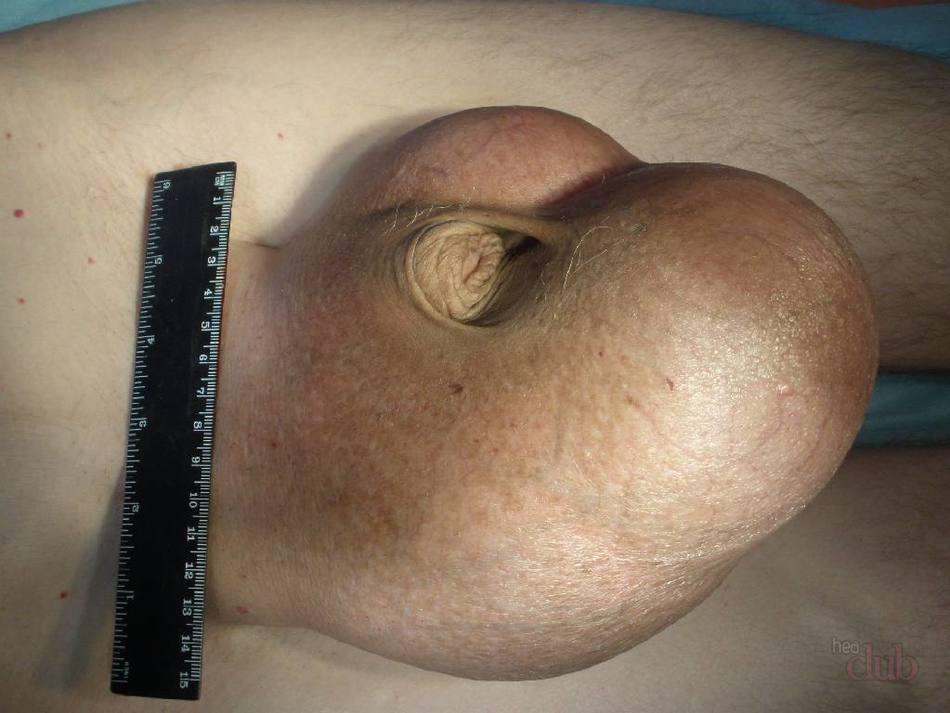
Symptoms of acute orchitis include:
- A sharp, sometimes sudden rise in temperature, in some cases it can reach febrile numbers.
- Strong also appear testicular pain. Increased pain occurs after prolonged movement, sports and physical activity. The sharp pain is due to the abundant innervation of the testicle. This increase in sensitivity does not go unnoticed.
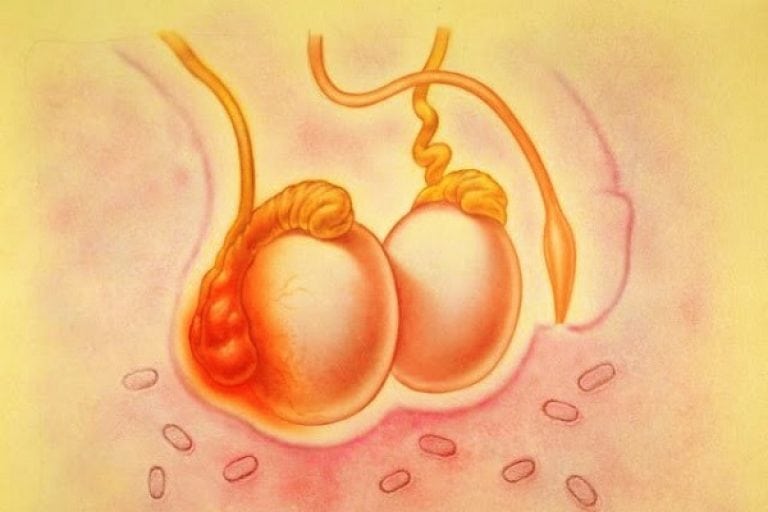
- On examination, an increase in the size of the organ is noted, sometimes up to several times. On palpation, it will be tense and sharply painful, as well as its temperature is increased.
- The scrotum seems taut, the skin folds are straightened, the color can be from slightly hyperemic to bright burgundy, a glossy shade is also formed (see photo above).
In addition to local symptoms, acute orchitis has common symptoms:
- This is the appearance of weakness, headache, nausea, dizziness, chills. All this is expressed by the general intoxication of the body.
- If there are no complications in the form of a suppurative process, then after a few days the acute symptoms decrease, this characterizes the transition of the process to the chronic stage of the course.
Acute orchitis always proceeds with a more pronounced clinic, therefore, the treatment of orchitis in this stage is considered the most effective.
Chronic ortitis.
- In this case, the process has a latent course, which is expressed in the appearance of pains of a fickle, aching nature.
- The testicle may be slightly enlarged, slightly painful on palpation.
- In this case, the body temperature almost always remains normal, only in the case of a pronounced exacerbation, subfebrile condition can appear.
- There is a decrease in the quality of life. Therefore, testicular inflammation always forces a man to see a specialist.
Diagnostics
It begins with a survey of the patient, as well as his external examination. The complaints, their nature, the duration of the course, as well as the conditions of occurrence are clarified. An assessment of the external examination and palpation of the organ is carried out. From additional methods, laboratory and instrumental types are used.
- The first group includes a clinical blood test.. It allows you to assess the intensity of the inflammatory process, and also sometimes indicates the type of pathogen.
- Bacterial urine culture. Determines the etiological cause of the disease, as well as their sensitivity to drugs, which is necessary for faster and more accurate treatment.
- Urethral swab for flora. In combination with the analysis of Sochi, it helps to identify the pathogen, as well as to give an indirect description of the degree of development of the inflammatory process.
- Sperm analysis. Gives a characteristic of the work of the testicles, their functionality, as well as the presence in their seminal fluid.
Read also:Symptoms and treatment of acute cystitis in women
Of the instrumental methods, the widespread and at the same time non-invasive is very popular. ultrasound diagnostic method. It allows you to describe the size of the organ, its structure, density, the presence of masses, as well as the degree of arterial and venous blood flow.
In the absence of an objective characteristic of this method, the method is used computed tomography. It gives a more accurate characterization of the organ.
Complications of orchitis
- The transition to the chronic course of the process.
- The development of dropsy of the testicle, formed against the background of out-of-date, cured or untreated inflammation.
- The onset of a suppurative process, a diffuse process can form, or it can be limited to certain sizes, after which an abscess is diagnosed.
- The inflammation of the testicles goes to the area of the appendages, as well as the development of the pathological process on the other testicle.
- The appearance of atrophic changes.
- The development of infertility. The pathogenesis of its formation is quite complex, since several complications at once can lead to this pathology.
- A rare complication can be a decrease in erectile function, libido, as well as the appearance of anatomical defects of the organ.
Orchitis treatment
It starts with the immediate use of medications. Since most often the cause of the disease is a bacterial nature, antibacterial agents are prescribed. In the case of an unspecified pathogen, this broad-spectrum antibiotics.
It is preferable to start treatment after its clarification. List of antibiotics is constantly updated, the name may change from manufacturer (see. above link).
In addition, groups of non-steroidal anti-inflammatory drugs are also used. These are drugs Indomethacin, Ibuprofen. It is preferable to use selective groups, they are more effective and with fewer side effects.
With severe pain syndrome and ineffectiveness of the drugs of the previous group, it is recommended to use novocaine blockade.
Of the non-drug methods, a therapeutic and protective regimen should be carried out, in the acute period it mainly bed or semi-bed, a diet is prescribed, with the restriction of fatty, acute and salty.
It is also necessary to follow the methods of prevention.
Read also:Varicocele
Prevention
These methods should be divided into two main groups, this is primary and secondary prevention. The primary is aimed at preventing, and the secondary at eliminating relapses.
To do this, you should follow a few basic rules.
- First of all, various kinds of infections should be avoided, these may include general infectious diseases, as well as those that have a predominantly sexual route of transmission. Such measures should include the preservation of the body from chronic inflammatory processes, such as prostatitis, urethritis, sinusitis etc.
- In addition, you should limit yourself from promiscuous sexual intercourse, especially without protective equipment. Currently, the only effective method is the condom. Treatment of any processes with antibiotics should be started as early as possible.
- It is recommended to avoid the appearance of stagnation in the genital area, it includes seminal fluid, as well as venous blood. For this, you cannot regularly use interrupted sexual intercourse, prolonged abstinence, as well as prolonged sitting position.
- Eliminate the intake of various harmful substances, these include smoking, alcohol and drugs.
- It is recommended to include in the lifestyle a complete, proper nutrition, with a sufficient amount of nutrients, as well as containing vitamins and minerals. Moderate exercise is a necessary component of prevention.
- Lingerie must be selected free, not constraining the outer hearth organs. In addition, the warm temperature in the testicular area should be limited.
- Taking various drugs for the treatment of orchitis should be carried out only after a doctor's prescription.
Also, at the first signs of testicular disease, you should immediately seek medical help.