What is a wart: types of neoplasms, diagnosis and treatment methods
 A relatively harmless formation like a wart can cause a lot of trouble. In addition to a non-aesthetic appearance, skin growths can cause discomfort, and in some cases pose a danger in the form of a risk of developing a malignant tumor.
You will learn about what a wart is, how it is diagnosed and treated in this article.
What is it
Almost everyone is familiar with such a concept as a wart, since such skin growths are a common phenomenon that occurs in people at any age period. It is a small growth on the skin or mucous membranes, which is characterized as benign and non-infectious in nature.
Warts vary in appearance and size. Most often, they are rough formations, which can be either single or grouped. They are usually a few millimeters in diameter, but can measure up to one and a half or two centimeters. The flower of the warts ranges from whitish and pink to deep brown. They can sometimes be confused with moles or calluses.
Warts also differ in localization zones.. The most favorite places on the human body are fingers, palms, the back of the hands, soles of the feet, intimate areas (genitals, groin, anus), face, eyelids, scalp, nasolabial folds, armpits, area under breasts.

The location and shape of warts is often caused by the type of papillomavirus (HPV) that causes the growths. For example, warts on the soles of the feet are caused by the first type of HPV, in the genital area - the sixth and eleventh, on the face or hands - the second or third types.
Types of warts:
- Simple. It is they who usually give a person an idea of what a wart is, since these are the most common growths, which are localized mainly on the hands and fingers, but can also be found on the face or scalp heads. They look like corporal, yellow or brown, rounded growths. They have a rough surface to the touch. The sizes of warts are from a few millimeters to one and a half, two centimeters. Most often diagnosed in childhood. Such formations are otherwise called vulgar or ordinary.
- Acrochoids. They are soft filamentous hanging papillomas, merging with each other. The growths are light pink to brown in color. Localization sites - armpits, face, neck, area under the breast (in women).
-
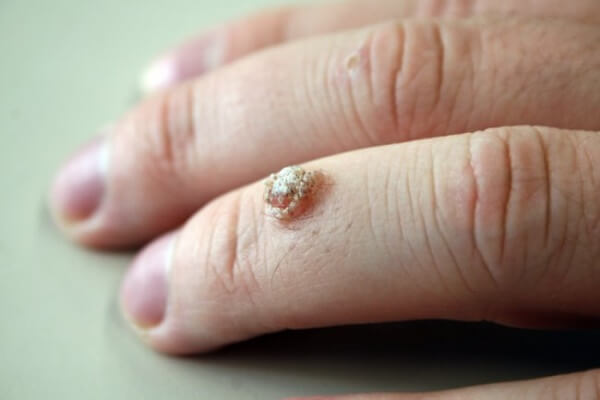 Flat. They look like small, nodular formations up to several millimeters in diameter. They are distinguished to the touch as smooth or scaly. These growths can be seen on the back of the hands, face, or mouth. Less commonly, flat warts are diagnosed on the male genital organ. Most often, adolescents suffer from this type of ailment.
 - Genital warts. They are small whitish or pink papillae. When rubbed, they turn red, are easily damaged and bleed. Merging into a single formation, they look like cauliflower or cockscombs. Most common among men and women of reproductive age. Places of education - groin, area near the anus, genitals, oral cavity, less often throat.
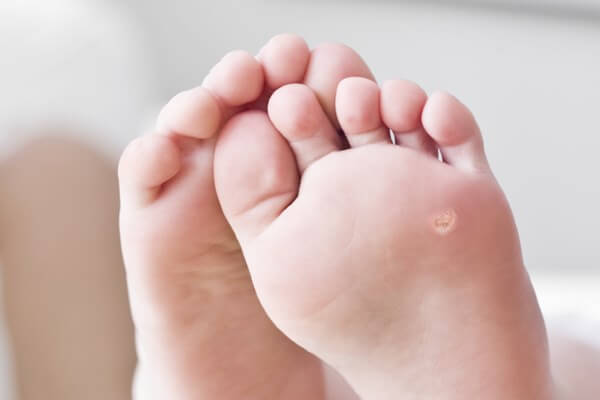
- Plantar (palmar). Localized on the soles of the feet or palms. They are indistinguishable from corns in appearance. Are painful and are worse than other types of treatment. Dense formations are a plexus of filiform papillae. On the surface of the growths, you can see black dots - clogged vessels.
- Keratomas. Dense, keratinized, rough growths of round or irregular shape from brown to almost black. Found in the elderly.
You can see how different types of warts look in the photo.
More about warts
- How do they look
- Plantar wart
Reasons for the appearance
 What is a wart from a medical point of view? This is, first of all, a pathological process launched by the papilloma virus in human skin. Getting under the skin, the viral agent begins to actively multiply, forming various growths. The main route of infection is direct contact with an infected person.
The virus can enter the bloodstream and through the personal hygiene items of an infected person. If your skin has wounds or scratches, it is easy to get HPV infection when you visit general places such as baths, saunas, swimming pools or showers.
The main routes of infection:
- plantar warts on the legs - someone else's shoes, the floor of the pool, sauna or bath;
- warts on the body or face - someone else's towel;
- warts in the intimate area, in the mouth - sexual contact;
- handshake, manicure tools, towels, doorknobs, toys.
It is almost impossible to determine the time and place of infection, since the virus has a long incubation period - from several weeks to a year, and with normal functioning of the immune system, it can even remain latent for many years old.
In this case, the reactivation of the viral agent is facilitated by a decrease in the level of immunity. That is why most often warts occur when a person falls ill or in the spring, when the immune defense is weakened due to vitamin deficiency.
How to identify a wart: diagnosis, treatment and prevention
 If neoplasms are found on the skin, then you should contact a dermatologist to identify their nature and exclude melanoma (skin cancer).
After examination and diagnosis, the doctor will prescribe the treatment that will be most effective and appropriate. You cannot self-medicate if you do not know what kind of growth it is.
Diagnostics
A fairly large number of growths are not dangerous, and the most common of them are flat and simple warty formations - go away on their own within a few months, one or two years.
The danger is neoplasms that have arisen as a result of the activity of the oncogenic HPV type.
Only a doctor can tell you how to identify a wart that causes cancer. This requires a visual examination and in-depth instrumental research to determine the type of virus, for example, a biopsy.
Most often, oncogenic types of viruses are localized on the genitals, forming genital warts. Therefore, in addition to a visual examination of the mucous membranes, a cytological and histological examination is carried out. More precisely, the nature of the formations can be determined using the polymerase chain reaction (CPR) method.
How to get rid of warts?
- Lapis pencil
- Salipod patch
- Cryopharma
Treatment
 The main methods of getting rid of warts are hardware or surgical removal, cryotherapy and chemical destruction of pathological growths. Which of the methods is better suited, the doctor decides, depending on the location of the wart, the nature of the neoplasm and the severity of the disease.
When treating flat warts, there is one trick - it is enough to remove the maternal one, and the rest of the formations will disappear on their own.
How to identify a wart that is responsible for multiple growths?
Usually this neoplasm occurs first, it is larger, and, unlike others, does not disappear periodically, but is constantly present on the skin.
-
Medical removal:
- cryodestruction - the build-up is destroyed due to sharp freezing with liquid nitrogen;
- laser therapy - altered tissues are burned out or evaporated as a result of exposure to a laser beam;
- electrocoagulation - the wart is cut off with a loop, to which a high-frequency current is supplied;
- surgical excision - the growth is cut out with a scalpel (rarely used, since scars remain after the operation);
- radio wave method - the wart is destroyed as a result of exposure to radio waves;
- chemical removal - warty formation is subject to destruction by acid or alkali.
-
 Removal by pharmaceutical preparations. At home, you can remove warts with medicinal solutions or ointments. Among the well-known drugs are salicylic acid, Supercleaner, Cryopharma, Solkoderm. The solutions are used to lubricate the wart and expect its natural destruction and fall off. This method of removing warts does not require special skills, so it can be used independently. However, some drugs are corrosive to living tissue and should be used with extreme caution.
 - Drug therapy. If there are a lot of warts, then this indicates a high activity of the papillomavirus. In this case, the doctor additionally prescribes antiviral drugs and immunostimulants. The most commonly used drugs for warts include Viferon, Acyclovir, Cycloferon.
- Folk remedies. If you know how to identify a wart, for example, when it reoccurs after diagnosis and treatment, then you can try to cope with it using folk methods. In the fight against warty formations, folk remedies such as vinegar, celandine, soda, castor oil, onions, garlic or rowan fruits are used.
Prophylaxis
 In order to avoid the appearance of unpleasant formations, it is necessary to follow the rules of personal hygiene. You cannot walk barefoot in public baths, saunas or on the floor next to the pool. Use your own hygiene products.
If cracks, scratches or wounds appear on the skin, it is necessary to treat them in a timely manner with an antiseptic solution. Should be protected during sexual intercourse or have sexual intercourse only with a single partner.
Partial use of site materials (no more than 30% of the content of the article) is allowed only with a hyperlink on www.med88.ru, full use of the article (more than 30% of the article content) is possible only with written permission edition.