Where is the epigastric region: pain, causes, symptoms, in humans
Every person is familiar with the funny expression "sucking in the stomach." It is commonly used to refer to feelings of fear, excitement, or hunger. A "spoon" is the hollow between the sternum and the upper abdomen, just below the ribs. The underlay area also has alternative names: in the people - the interwomb, in the medical vocabulary - the epigastrium. In this article, you will find out where the underlay is located.

Where is the basement region
To understand where the "spoon" area is located, you need to draw an imaginary triangle, the apex of which rests against the middle of the ribs, and the bottom corners run along the bottom line of the ribs. Today we will consider in detail the features of this area, as well as the processes that take place in it.
Content
- 1 Lining area: features
-
2 It hurts in the epigastric region
- 2.1 Causes of pain in the stomach
-
3 Sucks "in the spoon"
- 3.1 Why does it suck "in the spoon"?
-
4 Summarizing
- 4.1 Video - Pain in the epigastric region
Lining area: features
The epigastric or epigastric region is divided into three segments:
- Zone of the left hypochondrium;
- Zone of the right hypochondrium;
- Epigastric center.

Epigastric, interstitial and epigastric are different names for the same area of the human body
In general, several important organs are projected in the epigastrium: most of the stomach, loops of the thin intestine, upper poles of the kidneys, left upper hepatic lobe, the initial compartment of the 12-cored intestines. If a person complains of pain in the stomach, a health professional can determine which organs can give such symptoms and prescribe specific examinations.
So, discomfort or soreness in the central part of the epigastric region indicates ailments that have affected the liver or stomach. Pain in the left hypochondrium speaks of diseases of the spleen or liver, in the right - of problems in the gallbladder.

Various pathological and physiological conditions can cause stomach pain.
The epigastric zone plays an important role in clinical examination, since it is in it that a high percentage of the formation and concentration of pain is noted. This is due to the close location of organs to this area, as well as the vulnerability of the epigastrium itself. Given the location of the epigastric zone, it is quite sensitive to various kinds of injuries and injuries, so you need to treat the safety of the desired zone with special attention.
Note. Doctors insist that it is impossible to ignore painful sensations "in the stomach", which can be both the first bell of the disease and a serious symptom.
It hurts in the epigastric region
Above, we figured out that several of the largest organs are projected into the epigastric region at once. Accordingly, discomfort and pain in the stomach can indicate a variety of ailments. Let us briefly consider what diseases can be manifested by pain in the epigastrium.

Lining of the abdomen
Bloating due to overeating or stomach ailments, as well as functional dyspepsia (rapid filling the stomach with a small amount eaten) - factors that cause discomfort in the epigastric area. In the epigastric zone, a person can feel pressure, burning sensation, and complain that he is baking in the stomach. Usually, with these problems, the discomfort builds up gradually, and after a short time it disappears. If these sensations happen from time to time and are associated with food intake, and are also associated with a feeling of nausea or even vomiting, you cannot postpone the examination with a gastroenterologist.

Functional dyspepsia symptoms
In 80 percent, soreness in the epigastric zone is associated precisely with lesions of the digestive tract and typical diseases: gastritis (especially of autoimmune origin), pancreatitis, inflammation of the duodenum and so on. Girdle pain with a pulling character, which is accompanied by permanent nausea, is a characteristic symptom of pancreatitis. Acute and continuous pain "in the stomach", along with which a person suffers from vomiting and fever, is a signal of an inflammatory or infectious state of internal organs.
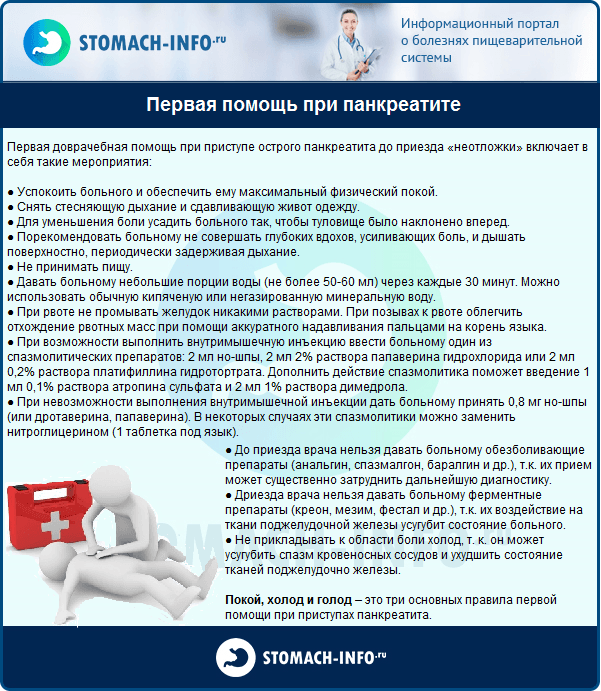
First aid for pancreatitis
Severe weakness, gagging, associated with dull pain in the epigastrium is associated with inflammation of the thin or 12 duodenal ulcer. If a person feels "under the spoon" stabbing, "dagger" pains, strong spasmodic tension of the muscles of the press - these are characteristic manifestations of an ulcer in the stomach.
You can read more information about stomach ulcers in our article.

Locations of ulcers
In this case, discomfort in the epigastric region can be associated with lung diseases (pleurisy, pneumonia, inflammation), heart attacks, chondrosis and muscle pinching, impaired blood circulation. With renal colic, pulling pains that have paroxysmal nature also appear in the womb.
Causes of pain in the stomach
In most cases, pain in the stomach is accompanied by other, more specific symptoms. Together, these symptoms can talk about serious and dangerous pathologies, therefore, it is necessary to plan a trip to the clinic in the near future.
Table 1. Causes of pain in the stomach
| Which organ is affected? | Description of the problem |
|---|---|
Lungs
|
Since the epigastric region bends around the lungs from below, a person often feels soreness and discomfort in this area with bronchitis, pneumonia, tuberculosis and similar ailments. |
Diaphragm
|
If epigastric pain intensifies on inspiration, and also radiates to the neck and shoulders, it is worth suspecting ailments such as diaphragmatic hernia or relaxation of the diaphragm. |
Spleen
|
With damage to this organ (for example, a splenic infarction), pain comes from the left hypochondrium and can flow through the center of the epigastrium into the neck. |
Heart
|
Cardiac diseases often "echo" in the epigastric region, radiate to the sternum, shoulders and even the jaw. The pain is accompanied by pressure fluctuations and palpitations. |
Liver
|
Cramping pain in the right hypochondrium indicates liver problems. |
Appendix
|
If a person has an inflamed appendix, with sudden movements or turns, pain may be felt in the right hypochondrium. Its character will not necessarily be acute - appendicitis "under the pit" is often manifested by dull growing pains. |
Stomach
|
Pain in the epigastric region associated with diseases of the stomach can be both acute and stabbing, and pulling, cramping, spasmodic. Often, soreness accompanies the tension of the abdominal muscles, nausea, vomiting, and stool disorders. |
Pancreas
|
The nature of the pain is similar to that accompanying gastric ailments: it can be shingles, acute or aching. |
Intestines
|
"Under the spoon" hurts strongly and sharply, often the soreness is accompanied by vomiting, which does not bring relief. |
Gall bladder
|
Acute cramping pains radiate to the center of the epigastrium, radiate to the neck, shoulder blades. The pain syndrome increases with deep breaths. |
Kidney
|
Kidney diseases have the following symptoms: the pain is localized in the center of the epigastric region, with movements it gives to the perineum and lower back. |

Regular pain in the epigastric region is a reason for immediate medical attention
The local therapist will prescribe the necessary examinations, and also offer symptomatic treatment for the first time. After the diagnosis is made, therapy will be prescribed more precisely. Usually, a complex type of treatment is prescribed, which restores not only the work of the digestive tract, but also the immune system.
Sucks "in the spoon"
Faced with danger, thrills, fright, or getting into a nervous situation, a person may feel unpleasant sensations in the epigastric region that cannot be called painful. They say about it like this: "Sucks in the stomach." The fact is that when the nervous system is excited, the motor activity of the stomach also increases. The second situation in which you can experience this sensation is hunger or active secretion of gastric secretions. What is the reason for the sucking feeling in the epigastric region: with the nerves or the work of the stomach? Let's clarify this issue.

The feeling that "under the spoon" sucks, in fact, is absolutely physiological
Sucking "in the spoon" can begin in a couple of hours after the meal. This sensation is often encountered by individuals with a choleric disposition of character or simply impressionable people with an active, mobile psyche. For the desired sensation, even an official name has been invented - the motor migratory complex.
MMK is the contractile activity of the stomach, which is repeated cyclically in the inter-digestive time interval. Usually, the motor migratory complex occurs while the digestive tract is at rest. As soon as a person has eaten, the MMK is interrupted, since the activity of the organ changes. Why does the body need MMK? In the process, food debris, mucus, bacteria, and gastric secretions migrate through the digestive tract.

The migrating motor complex in healthy people is distinguished by the constancy of characteristics and consists of cyclically repeating phases
The contractile motor cycle lasts from one and a half to two hours, most of this time falls on the calm phase (first phase). Muscle contractions (second phase) occur later, build up gradually, reaching the highest intensity in the third phase. It lasts no more than five to six minutes and is a maximum burst of activity of the gastrointestinal tract motility, which doctors call the motor migratory complex. It is it that people perceive as sucking "in the spoon."
When the third phase ends, a short section begins when physical activity decreases. Decreased motility is also associated with diet - the more a person is hungry, the lower the contractile activity of the gastrointestinal tract. So, after a day of hunger, activity drops by 70 percent.

The structure of the human gastrointestinal tract
An important point! The sucking sensation in the epigastric region is not to be confused with hungry stomach pains. This is a slight feeling of emptiness, not soreness. Hunger pains are the result of prolonged fasting, more than three to four days. Sucking in the epigastrium begins much earlier - from several hours to a day, depending on the rate of metabolism in the human body.
Most often, the stomach is in good shape in young, active, healthy people. Also, the stomach tone and the feeling of "sucking in the stomach" is familiar to those who have low blood sugar. If "in the stomach" sucks at night, then we can talk about hormonal disruption. So, discomfort in the epigastric region is often the cause of a lack of cortisol, leptin, ghrelin, or neuropeptides.
Why does it suck "in the spoon"?

Often suckles in the spoon a few hours after eating
Table 2. Why does it suck "in the spoon"?
| Time period, circumstances | Possible reason |
|---|---|
| No more than five minutes, passes on its own | The muscles of the stomach move, in other words, the organ simply stretches. |
| More than ten minutes, not related to hunger | Stress, panic. You should not immediately seize this feeling, you need to switch to some business, drink tea with mint, lie down. |
| Immediately after a meal or shortly after a meal | Decrease in blood sugar levels. Mistaken feeling of thirst for hunger (the centers of saturation with food and liquid are located nearby, so a person often experiences hunger when actually thirsty). |
| Regularly throughout the day | Stress, fatigue, sleep disturbances, too active work schedule, inability to fully restore the body's strength. |
| After a meal that includes fatty, spicy, spicy foods | Stress, fatigue, sleep disturbances, too active work schedule, inability to fully restore the body's strength. |
| After a meal that includes fatty, spicy, spicy foods | Pancreatic reaction. As a rule, the sucking sensation in the epigastrium is accompanied by belching, heartburn. |
| 6-7 hours after eating, accompanied by increasing pain | Gastritis, peptic ulcer. It is necessary to visit a gastroenterologist and examine the stomach. |

Proper nutrition is the key to health
Summarizing
A sucking, uncomfortable or even painful feeling in the epigastric region is a symptom that almost everyone has encountered. It is important to be able to distinguish when this trouble is associated with external factors or mild hunger. Regular pain in the stomach is a sign that is foolish to ignore. Important organs are projected into this area, disorders in which can seriously disrupt the quality of life and lead to long-term treatment.

Visit a qualified doctor
We recommend not to postpone the visit to the doctor if the epigastric region reminds of itself too often. Perhaps the pathology will not be found, but the specialist will help to adjust the diet and lifestyle in general, so that discomfort is disturbed as rarely as possible.