Green feces in a child: causes and remedies
According to statements in the medical Talmuds, the normal color of stool in humans is brown. This color can vary in several shades, from light to dark. In case of an unexpected manifestation of a different color of feces, it is necessary to find out whether this phenomenon is associated with the occurrence of any pathology. It is especially important to monitor the presence of this change in children, since the body's resistance to diseases at a young age is much lower than in adults. In this material, we will tell you why green feces appear in a child, and how to cure the corresponding disorders.

Green feces in a child
Content
-
1 Green feces in a child: causes
- 1.1 Newborn chair
- 1.2 Lure
- 1.3 Teeth are being cut
- 1.4 Reaction to food
- 1.5 Infectious processes in the intestine
- 1.6 Change in normal intestinal microflora or dysbiosis
- 1.7 Dysentery
- 1.8 Salmonellosis
-
2 How to behave when green feces are found in a child
- 2.1 Video - The child has green stools: reasons, what to do?
- 3 Let's sum up
Green feces in a child: causes
Finding green faeces in a baby's diaper or potty is shocking to some parents. Of course, they immediately begin to wonder what could have influenced the heir's digestive product in such a way. In this section, we will discuss the possible causes.
Newborn chair
The first reason for the staining of feces in the color of spring grass in a child is his recent birth. The first five days after birth, the child's body, as well as all its internal systems, are tuned to further existence outside the mother's womb. Processes of a physiological nature also take place inside the intestine, as a result of which feces can have the following shades:
- light green;
- dark green;
- black;
- yellow;
- brown, etc.

In the first days, the stool of newborns can randomly change colors due to physiological and absolutely normal processes taking place inside the body.
Whichever shade is chosen by your baby's intestines, on the third day it will begin to normalize towards the traditional color - brown. There is absolutely nothing wrong with this, already at the end of the first week of life or during the second, the baby will begin to defecate normally.
Lure
The second reason for the appearance of a green color in a baby's feces is the transition from mother's milk or special mixtures to solid foods during complementary feeding. The transition to a traditional menu begins with fibrous vegetables and fruits that do not contain irritating substances.

Eating green foods can cause staining of feces
Eating herbal ingredients forces the intestines to reconsider the well-established principles of functioning, as a result of which green feces may appear. It is most likely that you will find a surprise in the diaper that interests us, especially if you recently gave your child a taste of:
- zucchini;
- cucumber;
- broccoli;
- green apple and other vegetables of a similar color.
Many other foods are capable of reacting with each other inside your child's body, while not being colored green, however, this is still physiological and normal.
Teeth are being cut
Another possible reason for stool staining in this bright shade is the period of teething in your baby, which occurs at about one year of age. The fact is that this process is very painful for children, and it provokes the production of saliva in the oral cavity by itself, and children also try to reduce the pain by moving the tongue. As a result, the gallbladder reacts to such active salivation, and also begins to intensively produce a secret. Bile, leaving the bladder, is poured into the gastrointestinal tract in large quantities, eventually changing the color of feces to green.

Cutting teeth provoke increased gallbladder secretion
Reaction to food
Green stools are also not uncommon for children two years of age and older, as the transition to solid foods is usually complete at this age. However, the tenderness of the children's stomach has not been canceled, therefore, the reaction to some food products can still give the following effects, which are manifested, as a rule, at the same time:
- green stools;
- abdominal pain.
Malnutrition is often accompanied by dyspeptic disorders, most often diarrhea, while the general condition of the baby remains invariably good. Do not panic, just give your baby an approved enterosorbent.

Green stools can occur as a reaction to certain foods
Infectious processes in the intestine
The next reason for the greening of feces may be the ingestion of an intestinal infection into the child's body. Serious pathological processes cause the death of white blood cells, which accumulate in the intestines, staining its contents in a green tint.

Sometimes the infection becomes the reason for the acquisition of green feces.
In this case, bowel movements of a non-standard color may be accompanied by a number of the following symptoms:
- the child is worried;
- for no reason at all begins to be capricious;
- the general condition of the baby is sluggish;
- possibly an increase in body temperature;
- loss of appetite occurs;
- there is nausea and subsequently vomiting.
It is necessary to very carefully monitor the condition of the baby, since at a young age children do not have, to Unfortunately, it is possible to understandably communicate with parents, pointing out uncomfortable haunting Feel. This can be expected from an older child, while a small child will have to see signs of intoxication on their own.
If the general condition is normal, and the child poops with greenery, this is not dangerous, but otherwise, you should immediately suspect the development of an infection and consult a pediatrician.
Change in normal intestinal microflora or dysbiosis
As you know, our body is inhabited by microorganisms that are of particular benefit to us. With the help of bacteria, digestive processes take place in the intestines. However, it is also inhabited by harmful organisms that come from outside. If at some point the ratio between "good" and "bad" bacteria changes towards the latter, many unpleasant consequences can arise.

Lack of beneficial bacteria is another reason for stool staining
Here is a list of the main reasons, as a result of which a lack of beneficial bacteria develops:
- during the period when the baby's teeth are being cut, he experiences discomfort from this, and tries to scratch his gums with various toys and other objects found most often on the floor, as a result, bacteria from the outside get inside digestive system;
- taking antibiotics, aimed at stopping any disease, leads to the death of not only harmful microbes, but also beneficial bacteria;
- malnutrition - another reason for the development of disorders in the normal intestinal flora;
- poorly washed fruits, vegetables, food, raised from the floor, also contain harmful microorganisms on their surface, in large quantities, when they eat the product, get inside the abdomen;
- disease of any organ of the digestive system can also lead to changes in the ratio of bacteria.
Under the influence of all the above situations, unpleasant changes occur in the child's intestines, accompanied by the following transformations of feces:
- greening;
- the addition of mucous inclusions;
- exit in a foamy consistency;
- sour aroma;
- gray-green tint.

What green feces can look like in a child
Changes in the appearance and consistency of the stool are also accompanied by other symptoms that make the overall picture recognizable and associated with changes in microflora:
- pain in the abdomen;
- belching (regurgitation in children);
- bloating;
- colic;
- the hardness of the peritoneum.
To diagnose the desired violation most accurately, however, can only be in a medical institution. In this case, doctors will need to take the product of bowel movement from the child for examination. In the course of laboratory analysis, it will be revealed:
- how many beneficial and harmful microorganisms live in the child's intestines;
- what is the quality of each colony of bacteria.
Stool analysis is carried out in the following three types:
- scatological;
- biochemical;
- bacteriological.
Dysentery
The disease in question is caused by pathogens that have infected the child's body. It is it that is most often found in young children, causing not only external changes in feces, but also other symptoms that are very difficult for children and parents from a physical and psychological point of view respectively.

Causes of dysentery in children
Dysentery is accompanied by the following symptoms:
- greening of feces;
- liquefaction of the stool;
- an increase in the frequency of the urge to defecate;
- blood blotches are found in the feces;
- the smell at the exit of feces is found to be putrid, even more unpleasant than in a normal state;
- the child's body temperature rises;
- other dyspeptic disorders develop, for example, nausea and vomiting.
Provided that the severity of the disease is defined as average, the duration of the disease is about one and a half weeks. After this period, the symptoms usually recede, in particular, the shade of the stool also normalizes.

With dysentery, it hurts a child to go to the toilet
Despite the fact that some symptoms of dysentery clearly distinguish it from other diseases of the digestive systems, parents on their own are unlikely to be able to identify it, and even more so, will appoint an adequate situation treatment.
It is best to go immediately to the hospital to have a scatological analysis of the child's feces. Specialists working in the laboratory will examine feces using specialized equipment for the presence of:
- erythrocytes;
- leukocytes;
- muscle fibers.
Using this method, it is determined how badly the intestines are affected.
Then they also carry out:
- general blood test;
- bacteriological type analysis (with its help it is determined which element became the causative agent of the disease in order to find out if it is sensitive to antimicrobial drugs).
Salmonellosis
The disease in question is characterized by a high degree of severity. Salmonellosis disease involves long-term and active treatment. If a child has contracted the infection in question, it is most likely that his feces will turn green.
When the pathology spreads throughout the body, the following occurs:
- severe intoxication occurs;
- the body is dehydrated.
The symptomatology of the disease is very characteristic:
- the urge to defecate becomes more frequent;
- diarrhea opens;
- feces acquire a sour, unpleasant odor;
- severe vomiting occurs;
- the child is in a fever;
- feces become green (rather even marsh) in color;
- it becomes painful for children to empty the intestines;
- body temperature rises significantly.
Dehydration with salmonellosis is a consequence of the development of symptoms, and not one of the manifestations of the disease. The fact is that with frequent vomiting and diarrhea, the moisture necessary for normal functioning rapidly leaves the body. As soon as it becomes critically small, the child's life is threatened.

Give your baby water and Rehydration to stay hydrated.
The causative agent of salmonellosis is a harmful microorganism with a similar name - salmonella. Salmonella usually gets inside our body through chicken eggs. If you observe the act of defecation with green diarrhea in your child, and also note the presence of other symptoms characteristic of the desired disease, do not slowly contact your doctor for help.

Salmonellosis pathogens can live in eggs
The doctor, in turn, will prescribe a number of diagnostic tests, namely:
- bacteriological examination of feces and vomit;
- blood biochemistry;
- general blood analysis.
How to behave when green feces are found in a child
First of all, down with panic. Many mothers immediately begin to worry and worry, thinking up diseases for the baby that he does not suffer, as a result the child begins to react to the nervous behavior of the parent and get nervous, from which she becomes even more convinced of her correctness. As a result, you will lose a day, or even a few, for undergoing examinations that are unnecessary in your case, and as a result you will part with a solid number of nerve cells.
When green faeces are found in the diaper, the main thing is not to panic and track the child's condition
Take care of your own psyche, and at the same time take care of the child, taking it in hand immediately. Consider if your toddler is exhibiting any of the other symptoms that characterize a serious illness. If not, there is no reason to worry either, you just need to:
- carefully monitor the further change in the baby's well-being;
- correlate the appearance of green stools with the diet and, possibly, slightly correct it.
If you think your baby is suffering from dysbiosis or has a gastrointestinal tract infection, seek medical help as soon as possible. It is especially necessary to react quickly if green feces are supplemented with:
- an increase in temperature;
- dyspeptic disorders of various kinds;
- frequent urge to defecate;
- lethargy;
- anxiety.
In these cases, immediately call an ambulance, as even a short delay can cause irreparable harm to the life and health of your child.
All you can do before the doctors arrive is first aid. Should:
- stop dehydration by drinking the baby with a specialized pharmaceutical solution (for example, "Regidron");
- if you suspect poisoning, make the heir drink enterosorbent.
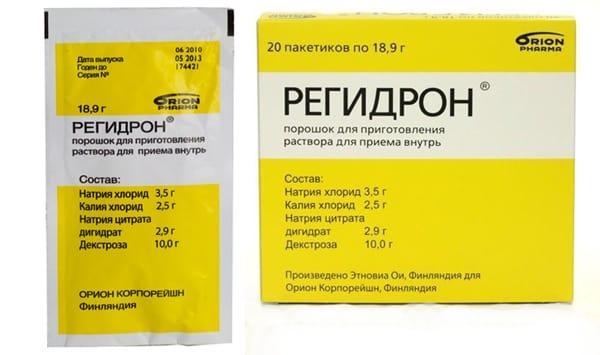
Powder for solution preparation Regidron
Why can't dehydration be stopped with plain water? It's simple. When fluid is lost, electrolytes are also released from the body. The imbalance of these two elements can even lead to death.
Video - The child has green stools: reasons, what to do?
Let's sum up
To prevent your child from making you happy with green stools one day, certain precautions must be taken:
- wash your hands before eating;
- prohibit stuffing from the floor into your mouth;
- rinse food with high quality;
- feed your baby the right food;
- periodically clean the apartment or house.
These simple methods of prevention will help your child avoid tummy pains, and you will keep the joy of life and confidence that he is completely healthy.
Precautions are the key to the health of the baby