
Preparing for an irrigoscopy: ways to cleanse the intestines
Carrying out any research manipulations with the intestine requires special preparation aimed at freeing the organ cavity from the contents. An endoscopist will not be able to examine the condition of the intestinal walls and its structure if it contains food debris, mucus, human waste and microorganisms.

Preparation for irrigoscopy
Intestinal cleansing includes an early transition to a slag-free diet and cleansing the colon cavity immediately before the examination in various ways.
Content
- 1 Slag-free diet
-
2 Colon cleansing with a modern laxative
- 2.1 Fortrans
- 2.2 Fleet Phospho-Soda
- 3 Colon cleansing with enemas
- 4 Bowel cleanse with salt water
-
5 Tips before and after the irrigoscopy procedure
- 5.1 Video - Preparing for an irrigoscopy
Slag-free diet
This type of food abstinence helps to eliminate gas formation in the intestines and the abundant formation of feces. You should switch to a special table a week before the study.

The daily diet should include cereals in water and vegetable soups - these dishes do not form toxins in the intestines and do not contribute to the formation of gas
Foods prohibited on a slag-free diet include all those that cause bloating and increased waste formation.
| Products | |
|---|---|
| What can you eat | Products made from coarsely ground flour, biscuit biscuits, crackers, steam or boiled poultry, beef, porridge on water, fermented milk products, fresh cucumbers, meat broths, boiled eggs, jelly, compotes, low-fat a fish. |
| What you can't eat | Borodinsky, rye bread, any confectionery and sweets, cereals, legumes, cereals - pearl barley, millet, oatmeal, fruits and vegetables, cottage cheese, fried food, any canned food, herbs, sugar, mushrooms. |
The basis of the diet should be fish dishes, lean meats, steamed or boiled, cheese, dairy products, eggs. Soups are preferred on the basis of weak vegetable broths, seasoned with rice.

The basis of the diet is lean meat and fish, dairy products
Instead of bread during this period, you should be content with small quantities of white croutons. If it is difficult to do without porridge, then it is best to cook semolina.

Of cereals, unsweetened semolina with a lump of butter and a boiled egg is preferred.
During the entire preparation period, one should not forget about the drinking regime: the intake of clean water into the body should be sufficient for the complete release of the body from toxins and toxins. One and a half to two liters of water is the optimal amount for an adult.

Water should be drunk as much as possible, but it should not be carbonated.
Diet is the key from which any patient's recovery begins, but it cannot be done alone to prepare the intestines for exploration.
Colon cleansing with a modern laxative
The following drugs are most commonly used for cleansing:
- Fortrans;
- Fleet Phospho-Soda.
Fortrans

The drug "Fortrans" for bowel cleansing
This drug, as well as its analogues, are the most popular among gastroenterologists and endoscopists, and are prescribed for sound and safe preparation for the examination procedure. It is used in two ways.
Method 1
In the morning on the day appointed for the procedure, the required amount of granulate is diluted in boiled water at a temperature of 20-25 ° C. 2 bags of granules are enough for a patient weighing up to 50 kg, 3 bags for a patient of 50-75 kg, 4 bags for those weighing more than 75 kg, and 1 bag is to be dissolved in 1 liter of water. The solution obtained in this way is drunk in the morning on an empty stomach in a few hours. The optimal frequency of admission is 1 glass every quarter of an hour.

How to properly prepare a solution
With this technique, the intestine begins to work within an hour and a half after the start of the procedure, and the last stool is usually released a couple of hours after the last portion of Fortrans. Irrigoscopy can be performed 4-5 hours after the last emptying.
Method 2
If the first method involves the use of a laxative on the day of the procedure, then the second scheme involves doing this the day before. In the morning, you should have a light breakfast (semolina, scrambled eggs, yogurt), and from noon go exclusively to liquid food (broth, tea, compote). Fortrans sachets are diluted in the same proportion as in the first case: 1 sachet per 1 liter of boiled water (2 sachets for a patient up to 50 kg, 3 - for 50-75 kg, with a larger mass - 4 sachets). The entire solution is drunk in the evening, within 4-5 hours, the optimal intake rate is 1 glass in a quarter of an hour.

Instructions for use of the drug
The expected cessation of stool with this option is 3 hours after the last drink. Therefore, if the last dose is taken at 21 o'clock, then at midnight the patient will empty for the last time and in the morning he will be ready to undergo an irrigoscopy.
Fleet Phospho-Soda
This is a fairly new drug, designed with the utmost convenience for patients in mind. Before you start using it, you should familiarize yourself with the contraindications for use, since certain chronic diseases are an obstacle to this. Unlike the version with Fortrans, when using Fleet Phospho-Soda, you do not need to torment yourself with the unpleasant taste of the solution and run to the toilet all day, since the whole procedure is more compact. The whole reception is divided into 2 doses - evening and morning, and the reaction of the intestines is better and more intense.

Preparation for cleansing the intestines "Fleet Phospho-soda"
However, it is worth mentioning once again that, unlike safe Fortrans, Fleet Phospho-Soda has many contraindications that threaten with a whole bunch of unwanted consequences, such as a sharp impairment of kidney function, arrhythmia, dehydration, convulsions, therefore, its use requires special care and is carried out only with permission attending physician.

Contraindications to the use of the drug
Colon cleansing with enemas
Modern medicine does not approve of the use of enemas in preparation for irrigoscopy, since many laxatives are a thing of the past, giving way to modern techniques. However, in urgent cases, the use of laxatives is possible in a hospital setting, since strong laxatives, for example, drugs based on sodium dihydrogen phosphate or macrogol can cause negative reactions.

In some cases, bowel cleansing with an enema is preferable to taking laxatives
If the doctor recommends cleansing with a series of enemas, then the following order should be followed. The day before the procedure at noon, 2-3 tablespoons of castor oil or 100-150 ml of magnesium sulfate (30%) are taken. This should be followed by self defecation. Then a couple of enemas are carried out with a period of 1.5-2 hours. The next morning, the enema is repeated until the water leaving the intestines is completely cleared. After that, the intestines are examined.

With each enema, 1-2 liters (depending on the patient's weight) of salted or acidified water at room temperature are poured in.
Bowel cleanse with salt water
Preparing for an examination with salt water is an effective, simple and affordable procedure for most. It cannot be said that it is often carried out in medical institutions, but this method is quite popular among the population.
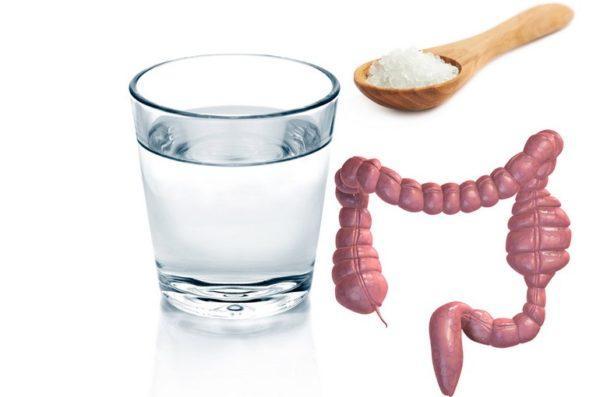
Colon cleanse with salt water is a safe, simple and effective way
With all its simplicity and preventive properties, it is contraindicated in patients with a number of diseases:
- oncological;
- hemorrhoids;
- diseases of the gastrointestinal tract;
- tuberculosis;
- heart disease;
- with exacerbation of chronic pathologies.
This procedure should be approached with caution by people over 50 years old, those who have just starved or been ill, as well as during menstruation.

Elderly people, as well as those whose immunity is weakened by a disease or diet, it is recommended to carry out such a procedure only after consulting a doctor.
If this method is used to prepare for the study of the intestine, then you should start by switching to the slag-free diet, which was mentioned above, and on which you should hold out for 5-7 days. On the eve of the study, an isotonic saline solution with a density of 0.9% is prepared. To do this, you need to dissolve 9 grams of pure table salt for each liter of water. More salt will give a hypertonic solution, less - a hypotonic solution. Both are harmful to the body.

Types of saline solutions
In the morning, you need to drink 2 glasses of isotonic solution at a human body temperature (approximately 36 ° C) on an empty stomach. Next, you should do light exercises: bends, stretches and lifts of arms and legs, body turns, squats. Then another 2 glasses are drunk, after which the set of exercises is repeated. In total, you need to drink at least 6 glasses before the first bowel urge. If it does not work, an enema should be given.

To make the solution easier and faster to pass through the digestive tract, it is necessary to perform a set of exercises
After the first emptying of the intestines, a glass of solution is drunk again and the set of exercises is repeated, and this continues until 10-15 glasses and the exit of clean water from the intestines. If the attacks of nausea are very severe, you can add a little lemon juice. If you experience abdominal discomfort, you can use a gentle tissue massage. Cleaning with a saline solution has a beneficial effect, unlike enemas, on the entire digestive tract, increases the overall tone of the body and improves well-being.

Correct use of the saline solution not only helps to cleanse the intestines, but also has a beneficial effect on the general condition of the body.
Tips before and after the irrigoscopy procedure
The day before the study, one should not lead an active life, somewhere for a long time away from home, so as not to waste energy and not be tempted to eat something forbidden. Food must be liquid.

It is recommended to limit physical activity the day before the study.
Before the procedure, you should notify the doctor:
- in what way the intestines were cleansed;
- about existing chronic diseases;
- about the drugs taken that affect blood clotting;
- about cases of bleeding from the rectum.

Before carrying out the procedure, the doctor must make sure that there are no contraindications.
Important! Focus the doctor's attention on notifying you about intestinal obstruction found during the study.
After the procedure, a gradual transition to the usual diet is important, so as not to harm the intestines. The first solid food should be boiled rice with butter, or thin oatmeal. Bread should be eaten no earlier than 24 hours later. On the first day after irrigoscopy, coffee, milk, alcohol, sugar, vegetables and fruits are excluded from the menu. Meat should only be eaten on the third day.

The first food after the procedure should be rice or oatmeal with a little butter.
Armed with these tips, the recommendations of your doctor and common sense, you can safely hope that the irrigoscopy is safe, informative and healthy for you procedure.


