Is allergy inherited to a child?
Content
- The role of heredity in the development of allergies
- How to prevent the inheritance of allergies?
In modern society, against the background of serious environmental problems and the rapid pace of life, allergy has taken a leading niche among other diseases on a global scale. At least 80% of people have experienced allergy symptoms at least once in their life. Whether allergies are hereditary is the topic of our article today.

The role of heredity in the development of allergies
Nowadays, experts have been able to prove with high accuracy that not the allergic disease itself can be genetically transmitted, but only the predisposition to its development.
Statistics say that the disease manifests itself in a child in about 25% of cases, if one of the parents has an allergy in the family. If mom and dad have pathology at the same time, the risk of developing an allergic disease doubles and is 50% or more.
If family members are relatively healthy, and allergies have not been observed in previous generations, the likelihood of developing the disease in a child will vary within 10%. The culprits of allergies in this situation can be negative factors (poor ecology, the mother's taking antibiotics during pregnancy, etc.), and not genetics.
Once again, I would like to note that it is not the allergy itself that is inherited and not the increased susceptibility of the body to specific irritants. A disease in a child can manifest itself in a completely different form and to completely different allergens, since only a predisposition to it is inherited.
For example, the child's father suffers from a seasonal allergy to the pollen of a particular plant and the disease manifests itself exclusively in the form of allergic rhinitis and conjunctivitis. In this case, the child may not have susceptibility to this particular plant, for example, he will suffer from food allergies to completely different allergens.

To explain this fact, it is enough to remember how allergies develop. The disease manifests itself as a result of a pathological increase in vascular permeability, against the background of which specific stimuli begin to penetrate into the human bloodstream without any obstacles. The immune system shows an increased intolerance to penetrated allergens, perceiving them for foreign bodies. The synthesis of antibodies aimed at destroying allergens begins.
It is this mechanism of the development of allergies that is the factor that determines the predisposition to it, and it can be inherited. But what will be the allergen that provokes this reaction, and what type of disease will develop and will whether it is at all is impossible to predict, since other pathogenetic factors interfere with this process.
How to prevent the inheritance of allergies?
Modern medicine does not consider allergy to be a genetic disease, but it does not exclude the inheritance of a predisposition to it from close relatives. Therefore, before planning a pregnancy, both parents-to-be should strictly follow medical recommendations to prevent the development of allergies in a child.
The pattern of inheritance of a predisposition to allergies in the family, according to modern research, is as follows:
| The likelihood of an allergy in a child | Inheritance conditions |
|---|---|
| 60–80% | Both parents suffer from the same allergic disease. |
| 40–60% | Both mom and dad suffer from allergies, but of different types. |
| 20–40% | Allergy in the family was diagnosed in one parent. |
| 5–10% | The parents are healthy. |
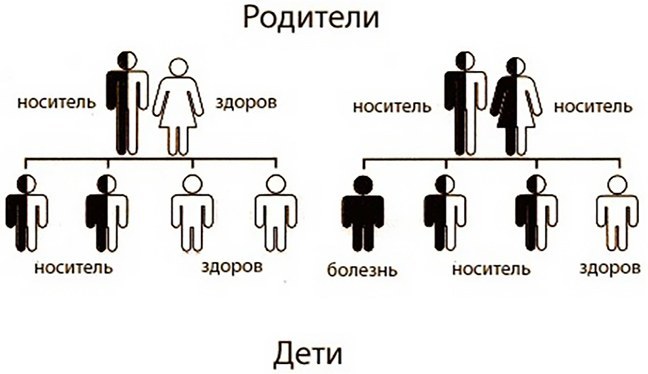
Regardless of the hereditary factor in the transmission of susceptibility to allergic reactions, you can try to reduce its appearance to a minimum. This requires the following recommendations:
- It is important to approach pregnancy planning responsibly. Both parents-to-be must give up bad habits at least 3 months before the intended conception.
- If both parents or one of them are employed in hazardous work, it is recommended to change jobs in favor of more favorable working conditions. And this must be done no later than 6 months before conception.
- If the environmental conditions of the area where the future parents live leave much to be desired, for example: the house is near a highway or a family lives in a metropolis, everything must be done to minimize this unsafe influence. It is advisable to travel more often to forest park zones, to spend vacations outside the city, etc.

- Use household chemicals as little as possible, it is important to avoid secondhand smoke, as well as to limit the use of cosmetics and perfumes to reasonable limits.
- Do not carry out any repair work in the living quarters during conception, pregnancy and during the first year of the child's life.
- Follow the principles of a hypoallergenic diet. The mom-to-be should not abuse potential food allergens. It is important to remove citruses, chocolate, strawberries, etc. from the diet of a pregnant woman.
The most important thing is not to be afraid of the problem. It is important to direct all efforts to maintain the immune system in a normal state so that a relapse of the disease does not occur during the process of carrying a child.
You should also protect yourself from the negative effects of the environment and give up bad habits. Under these conditions, the possibility that the transmission of a genetic predisposition to allergic diseases to a child will be minimized.