Japanese nose filters for allergies
Content
- What are nose filters?
- How do they work?
- Indications for use
- Contraindications
- The structure and composition of the material
- How do I use nasal filters?
- Advantages and disadvantages
The health of the respiratory system and the well-being of a person depend on the air that he breathes. Nowadays, the ecological situation even outside the big cities leaves much to be desired. Allergy nose filters can help protect yourself from harmful substances in the air, such as allergens.

What are nose filters?
Filters, in another way they are also called invisible respirators, are devices that are so small that they can be inserted into the nasal cavity. These devices, designed to filter air, are completely invisible to others, while they are quite easily inserted into the nasal passages and removed in the same way.
Nasal filters should not cause any discomfort in the person who uses them, especially after regular use - you get used to wearing them pretty quickly.
The filter device is capable of retaining up to 98% of substances that have entered the nasal cavity along with inhalation.
These substances include:
- pathogenic microflora, which provokes diseases of the respiratory tract;
- allergens, for example: plant pollen, mold spores, chemical components, etc.;
- dust;

- hazardous industrial substances that are in the environment as a result of atmospheric pollution by car exhaust, household dust, burning, etc.
How do they work?
Nose filters, as defined by their official developers, need to be inserted into the nasal passages and secured with an arch that should be positioned under the nasal septum. The principle of operation of nasal filters consists of four main stages, we will consider them in the table.
| Cleansing stages | Operating principle |
|---|---|
| Stage one | When inhaling, the air is retained by the external retainers. At this stage, the largest pathogenic components, for example, dust, are stopped. |
| Stage two | Air enters through the artificially narrowed space between the external and internal fixing devices, while its flow becomes turbulent or vortex. |
| Stage three | Penetrating deeper, the air flow must pass through a series of columns of filter material. As a result, the smallest dust components, pollen, etc., settle on their surface. |
| Stage four |
 The air that has passed through the filters is almost completely cleaned of allergens and other pathological objects. |
Indications for use
Nasal filters can significantly improve your quality of life. The main indications for their use are:
- frequent allergic reactions, individual intolerance to certain components that irritate the mucous membranes of the respiratory tract;
- frequent ARVI and other viral infections, the route of transmission of which is airborne;
- residence in an area with predominantly unfavorable environmental conditions, for example, in large industrial cities;
- chronic pathologies of the upper and lower respiratory organs, for example, bronchial asthma, hay fever, allergic rhinitis, etc.;

- diseases that are related to ophthalmic practice, occurring with hypersensitivity of the mucous membrane of the eyes, for example, allergic conjunctivitis;
- a period of mass incidence of colds (flu epidemic, etc.) or a visit health care facilities where nasal filters can be used as an alternative replacement for gauze or a disposable dressing;
- pregnancy, breastfeeding, the moment when a woman needs a lot of care about her own health;
- weakening of the immune defense;
- work in enterprises with harmful conditions, for example, increased concentration in the atmosphere of household dust, etc.
Contraindications
Despite the fact that invisible respirators are harmless and cannot cause allergies, there are still contraindications to their use:
- tendency to nasal bleeding;
- polyps in the nasal cavity;
- curvature of the nasal septum;

- violation of the integrity of the mucous membranes in the nose;
- children up to 4 years old or until the child can understand what kind of devices they are and what their principle of operation is.
The structure and composition of the material
Nasal filters can be produced in different models by different manufacturers (England, Japan, Denmark, etc.), so they may look slightly different from each other. However, there is still something in common in their design - this is a fixing arc. It is thanks to its presence that the filters themselves can be retained in the nasal cavity. This arc is made of absolutely transparent materials, so it is quite problematic for others to see it with the naked eye.

The internal structure of the filter has a dome-shaped retainer. This form was chosen by the manufacturers for a reason, with its help the device is securely fixed in the nasal passage. The material responsible for the internal filtration of the air flow is located here, which effectively blocks most of the pathogenic substances. The outer part of the invisible respirators is made of a soft pliable polymer. After inserting the device into the nasal passages, only the fixing arch remains outside.

Filters can be not only of different models, but also sizes. Let's take a look at a cleansing device like Japanese allergy nasal filters.
| Varieties of filters | Their description |
|---|---|
| Standard for dry nose. | The device retainer in diameter is 9.2 mm, which is the best choice for an adult who wants to prevent the negative impact of pathogenic environmental factors on the body. |
| Small for a "dry nose". | The retainer has a smaller diameter compared to the standard one - 7.8 mm. These filters are recommended in childhood for the prevention of allergic and respiratory diseases, provided that there is no runny nose. |
| Standard for wet nose. |
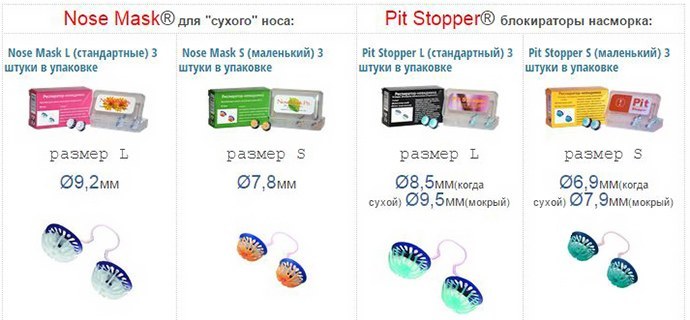 This device is recommended for rhinitis and nasal congestion. Retainer diameter 8.5 mm dry, 9.5 mm wet. |
| Small for a "wet nose". | Children's option. Dry - 6.9 mm, wet - 7.9 mm. |
Each package of Japanese invisible respirators contains 3 devices, each can be used for 5-10 days. Numerous reviews of people using these filters confirm that one package is enough for 30 days of constant wear.
How do I use nasal filters?
First of all, you must carefully read the instructions on the packaging. The very fact how thoroughly the air entering the respiratory tract will be purified depends on how the filters will be installed, whether they will be the correct size, and how often they will be applied replacement.
The general principles of their application will be as follows:
1. Open the packaging and take out one pair of devices. If the filter is to be used against the background of rhinitis, it must be moistened with clean water before insertion and only after that further manipulations should be carried out with it.
2. Insert filters into the nasal passages, in this case, you need to pay attention to the fact that their lower part fits snugly to the lower part of the nasal cavity, is not in free movement and does not deviate to the sides.
3. Take a few breaths - this is necessary to firmly fix the inner domed part of the respirators.
4. After the device is installed, it can be worn continuously for up to 12 hours. The nasal filters recommended for dry wear are worn this way - continuously. If we are talking about "wet" filters used for rhinitis, then they cannot be constantly worn - as needed, for example, every 2 hours they are taken out of the nasal cavity and washed thoroughly.

After each wearing, the device needs to be cleaned. This is done by rinsing invisible respirators in water. Then the devices are placed on a flat surface and dried at room temperature for at least 4 hours.
Do not artificially speed up the drying process by placing nose filters near heating devices or in direct sunlight - this can lead to their rapid wear and tear.
In general, nasal filters designed to protect against allergies and other negative factors are easy to use. But the first introduction of the device into the nasal cavity and wearing may be associated with slight discomfort, namely, an unusual feeling of distention in the nasal passages, burning sensation on the mucous membrane. This condition is called the addictive stage and usually lasts no more than 2 hours. After that, the discomfort for the majority of people using these devices disappeared in full.
Invisible respirators, which are recommended for air purification in "dry wear" mode, perform less efficiently. If nasal filters are worn by a child under the age of twelve, the device must be inserted under the mandatory supervision of an adult. Nasal filters can be used equally well indoors and outdoors. For example, their use will be relevant for an allergy sufferer who plans a trip out of town and runs the risk of encountering potential allergens there - pollen.
You can store nasal filters for an unlimited period of time if they have not been used for their intended purpose at any time. The term of use of "dry" respirators is on average about 5 to 10 days. Wearing "wet" devices is limited to 7-10 days.
Advantages and disadvantages
Invisible respirators have recently appeared on the free market, but they are already popular among consumers. And, indeed, they can be called devices that can significantly make life easier for many people, especially those suffering from allergic diseases, expectant mothers and other citizens.
The main advantages of these filters are:
- compactness of the device and its unique shape, which exactly repeats the anatomical features of the nasal cavity, in as a result, the device is successfully held for a long time and does not cause any uncomfortable experiences;
- nasal respirators do not interfere with the process of eating, communicating, laughing and expressing other emotions familiar to everyone;
- effective purification of the air that enters the body during inhalation: the filtering components of the device are capable of retaining at least 98% of pathogenic substances, the size of which is no more than 10 microns;

- unlike disposable masks, these devices do not spoil the appearance and do not affect makeup, which is especially important for women;
- in the manufacture of respirators, manufacturers use exclusively hypoallergenic and durable materials, taking into account the fact that they will be used by allergy sufferers;
- universal application allows using filters in various situations - with or without a cold. Variability of sizes, allows you to choose a device not only for an adult, but also for a child;
- the possibility of using the device during pregnancy and in children from the age of four;
- reducing the need to take antiallergic drugs: since invisible respirators effectively prevent the penetration into the respiratory pathways to allergens, the symptomatic picture of the disease is qualitatively mitigated, against which the intake of antihistamines often becomes superfluous.
Despite all the listed advantages, there is one significant drawback to nasal filters - their cost. Three pairs of respirators cost at least 450 rubles.
At the end of the article, I would like to emphasize that nasal respirators are a worthy alternative to disposable masks, since they combine all their advantages. Used correctly, the devices will help protect the respiratory system from allergens, viruses, bacteria and contaminants.