Wedge-shaped defect of teeth: what is it, causes, symptoms, treatment, prevention
Content
- What is a wedge-shaped defect?
- The causes of the appearance of pathology
- Symptoms of a wedge-shaped defect
- Stages of tooth damage
- Differences between a wedge-shaped defect and other dental diseases
- Consequences of a running wedge-shaped defect
- Wedge-shaped defect treatment
- Folk remedies
- Prophylaxis
What is a wedge-shaped defect?
Wedge-shaped defect Is a common non-carious dental disease. Pathological phenomenon looks like caries, localized in the area of the tooth neck, but in reality is only a wedge-shaped depression that appears on the lower part of the outer side of the tooth. The sharp part of the wedge is directed to the gum.
Pathology is observed mainly on molars and premolars - teeth that are most stressed when chewing food.
Sometimes the defect is noted on the canines, very rarely affects the incisors. With pathology, both upper and lower teeth can be affected. But on the dentition of the lower jaw, which is subjected to a more intense chewing load, a wedge-shaped defect is diagnosed more often.
When a wedge-shaped depression is formed, the enamel usually does not change color. If the enamel has darkened, it means that the erosion processes have spread from the superficial to the deeper layers of the tooth. With deep damage to dental tissues, the sensitivity of diseased teeth increases. Erosion is exclusively wedge-shaped, by this sign it can be distinguished from carious lesions.
The disease develops very slowly over several years. The patient may not notice the first stages of the disease. In recent years, the number of people visiting the dentist with this problem has increased significantly. It should be noted that most often the pathological phenomenon is diagnosed in women after 30 years.
The causes of the appearance of pathology
Until now, medical specialists cannot say for sure what factors cause the appearance of wedge-shaped erosions on the teeth. There is a list of the alleged etiologies of the onset of the disease:
- Improper oral hygiene - we are talking not only about the lack of oral care, but also about improper cleaning of teeth. Cervical areas of the teeth are destroyed when the movements of the brush are carried out not in the correct vertical, but in the wrong horizontal direction. And also pathology develops when a brush with stiff bristles is used or teeth brushing occurs immediately after consuming sour fruits and berries;
- Incorrectly selected paste - some modern toothpastes contain components that increase the fragility of enamel;
- Changes in the acidity of the oral cavity - certain diseases of the digestive tract, accompanied by a violation of acidity, can provoke a defect;
- Malocclusion - due to the malocclusion observed in a significant part of the population, the teeth rub against each other, causing abrasion of the enamel;
- Using teeth whitening products - many bleaching preparations contain aggressive components that destroy enamel;
- Hormonal disbalance - disorders of the thyroid gland and other diseases, accompanied by hormonal disruption, can cause tooth decay. It should be noted that the likelihood of developing dental pathologies significantly increases in pregnant and breastfeeding women;
- Gum pathology — periodontitis, gingivitis and other gum diseases often provoke exposure of the cervical part of the teeth;
- Injury to teeth and gums - a wedge-shaped defect is often observed in people who prefer solid food, constantly picking their teeth with forks, toothpicks and other sharp objects;
- Inadequate diet - pathology develops in people in whose diet there are few foods rich in calcium and fluoride;
- Bad habits - alcohol and toxic substances contained in cigarettes flush minerals from the body, which leads to the development of diseases of the teeth and bones;
- Improper nutrition - sour berries and fruits, natural juices are undoubtedly useful. But their frequent use negatively affects the condition of the tooth enamel;
- Certain diseases - some infectious pathologies are provocateurs of problems with teeth and gums. Also, a wedge-shaped defect can develop after radiation and chemotherapy;
- Incorrectly placed braces - orthodontic braces are capable of destroying enamel if they are selected and placed incorrectly by the dentist.
Symptoms of a wedge-shaped defect
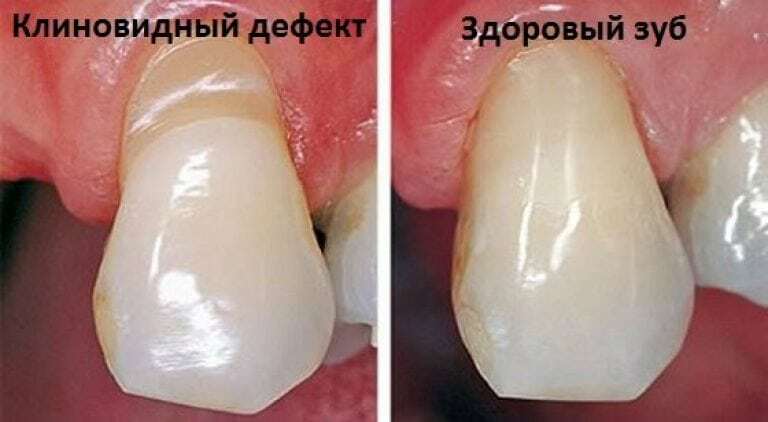
At the onset of the disease, wedge-shaped erosion of the teeth is an asymptomatic pathology. The patient goes to the doctor when, due to wear and tear, the teeth begin to look unattractive (see. photo above). In the initial stages, the slowly developing disease is completely invisible, the damaged teeth retain their natural color and normal enamel structure.
Sometimes, when the teeth are exposed to mechanical, thermal or chemical stimuli, the patient experiences minor discomfort. An increase in the sensitivity of diseased teeth is due to the rate of development of the pathological process.
If erosion develops slowly, then dentin, which protects the dental nerve from irritating factors, has time to form on the damaged area of the tooth. If the wedge-shaped erosion progresses rapidly, then the pulp is open and exposed to negative factors.
The disease can occur on only one tooth, or it can affect several teeth on one side of the jaw or on both sides. The surface of the pathological depression is smooth, shiny, and hard. The depth of erosion varies, but the cavity of the tooth remains closed. It happens that a crown breaks off on a sore tooth due to the load.
Stages of tooth damage
There are 4 stages in the development of wedge-shaped erosion of the teeth.
- Initial. The erosion process is visually invisible, but the decaying part of the tooth loses its shine, becomes sensitive to irritants.
- Average. The destruction of the enamel is progressing. Sensitivity to irritants becomes pronounced.
- Progressive. Erosion in depth can reach 4 mm. The wedge-shaped depression is clearly visible.
- Deep. Erosion extends more than 5 mm deep into the tooth, captures the internal dental tissues. The enamel is destroyed, the tooth darkens due to damage to the dentin.
Differences between a wedge-shaped defect and other dental diseases
The wedge-shaped defect has clear external manifestations, so it is almost impossible to mistake it for any other dental disease. The following are the differences of this pathology from caries, erosion and acid necrosis:
- Caries. The wedge-shaped defect differs from the initial and middle stages of caries in that it is always localized in the cervical part of the tooth, has the shape of a wedge, the tip of which is directed towards the gum, and pain is either absent or present insignificant. With caries, the damaged area of the tooth is covered with soft and dark dentin, the disease is accompanied by intense pain, aggravated by the influence of irritating factors on the carious cavity.
- Erosion. It differs from a wedge-shaped defect in that it forms a bowl-shaped depression with a rough surface, it can be localized not only in the cervical part, but also on any part of the tooth. Both diseases are rarely accompanied by increased sensitivity of the teeth, never cause softening and darkening of dental tissues.
- Acid necrosis. It is observed mainly on incisors and canines, causing grayening, tarnishing and roughness of the enamel. The sensitivity of the teeth to any irritants is significantly increased. With advanced necrosis, the hard coating of the tooth dissolves, gradually the dental crowns acquire a wedge-shaped shape, and then completely collapse, as a result a bare root remains. A wedge-shaped defect, unlike acid necrosis, is not accompanied by darkening of the enamel and complete destruction of the hard part of the tooth. Hard tissues are destroyed only in the area of the tooth neck.
Consequences of a running wedge-shaped defect
If wedge-shaped erosion is not promptly treated, the pathology can be complicated by more serious and unpleasant dental diseases:
- Pulpitis. Launched erosion leads to inflammation of the internal tissues of the tooth, supplied with capillaries and nerve fibers. The inflammatory process is accompanied by intense throbbing pain. If untreated, pulpitis leads to nerve necrosis;
- Caries. A plaque accumulates on the worn out enamel, in which pathogenic bacteria actively multiply. As a result, a carious hole is formed;
- Tooth hypersensitivity. With an advanced defect, the tooth tissue is abraded almost to the very pulp. The tooth becomes sensitive to even the slightest irritants;
- Loss of a tooth. With deep erosion, the neck of the tooth narrows so much that due to the directional mechanical action, the tooth can break off.
Wedge-shaped defect treatment
The principle of treatment is determined by the degree of tooth damage. Complex therapy includes getting rid of the irritating factor, the transition to proper oral hygiene, dental procedures.
If the depth of erosion is shallow, it is not necessary to fill the tooth. The wedge-shaped recess is closed with a special medicinal compound that reduces the sensitivity of dental tissues, preventing further destruction of the enamel. Usually dentists carry out fluoridation of enamel using fluorine-containing formulations.
Additionally, therapeutic measures are taken to normalize the calcium content in tooth enamel.
Patients are advised to use high-quality fluoride-based toothpastes and remineralizing gels at home. The most effective oral care products are:
- paste and gel R.O.C.S. Medical minerals;
- President Sensitive gel;
- ApaCare gel Liquid enamel;
- Elmex paste;
- Vivax Dent paste;
- Sensigel gel;
- Biodent Sensitive paste;
- Sensodyne F.
To achieve a positive result in the restoration of teeth, the above pastes and gels should be used for a long time. After each brushing of your teeth, it is additionally recommended to treat the oral cavity with rinses. The best rinsing agents are:
- Elmex Sensitive Plus;
- Colgate Plax;
- Desensin Plus;
- Senquel Sensitive;
- Lacalut Sensitive.
It is necessary to treat the oral cavity with rinse for at least a minute.
Fluoridation of teeth is usually carried out in a dental office. But you can carry out the procedure yourself at home. To do this, you need to purchase a special preparation containing high concentrations of calcium and fluoride. Typically, dentists advise patients to use drugs:
- R.O.C.S. GC Tooth Mousse;
- R.O.C.S. Medical minerals;
- Voco Bifluorid 12;
- Diplain-Denta;
- Fluocal gel;
- Nanofluor.
To eliminate a wedge-shaped defect provoked by an incorrect bite, dentists recommend that patients wear braces that are tailored according to age and physiological characteristics organism. Even teeth alignment is carried out through selective grinding and the use of crowns.
In case of deep erosion of the tooth, a filling is required. The wedge-shaped recess is filled with a composite preparation or glass ionomer cement. Since the damage to the tooth is not carious, the hole is drilled out slightly. But so that the superficially located filling does not fall out, fixing notches are made on the enamel. By filling, the tooth is restored to its attractive appearance, hypersensitivity is eliminated.
Sometimes patients agree to the installation of veneers - ceramic and composite plates, which are additional protective enamel. Dentists recommend placing veneers when the dental tissue is so deeply damaged that filling is pointless.
At a deep stage of tooth damage, prosthetics are performed. An additional therapeutic measure is fluoridation of the damaged area of the tooth. Fluoridation of the tooth before prosthetics is imperative, otherwise the dental tissues will continue to collapse under the prosthesis, forming cavities in which pathogenic bacteria will begin to multiply. The result will be the appearance of caries and tooth loss.
Folk remedies
The first step is to change your diet and lifestyle. You should give up cigarettes and alcoholic beverages, introduce food rich in minerals into the diet. The following foods rich in calcium and fluoride should be present on the menu every day:
- sea fish and seafood;
- chicken and chicken liver;
- legumes;
- seaweed;
- buckwheat;
- green tea;
- walnuts;
- honey;
- horseradish;
- apples, bananas, citruses.
With a wedge-shaped defect in the teeth, it is recommended to use a medicinal salad every day. You need to take seaweed, parsley, sage and basil, mix the ingredients, salt. The salad is dressed with olive oil.
It is interesting to note that wine is a good source of fluoride. But you need to understand that we are talking about natural and high-quality wine consumed in reasonable quantities. And the abuse of alcoholic beverages leads to the leaching of minerals from the body. Therefore, most alcoholics either have dental problems or have a toothless mouth.
A good folk remedy for wedge-shaped erosion is rubbing a mixture of honey and cinnamon into the gums.
Dentists advise to rinse the oral cavity daily with alcoholic propolis tincture diluted with warm water.
You can also use an effective and unusual folk remedy. Mother-of-pearl shells are taken, washed, dried, ground to a powdery state. The powder is poured onto the tip of the tongue and gently spread over the entire surface of the teeth. The shell powder, rich in minerals, is an excellent restorative material for tooth enamel.
Prophylaxis
Since the disease is provoked by many reasons, preventive measures for each patient are individual, aimed at eliminating a specific negative factor. However, there are a few general rules that can be followed to keep your teeth healthy. These rules include:
- daily proper oral hygiene;
- careful and moderate consumption of acidic foods;
- protecting teeth from mechanical, chemical and thermal effects;
- using a toothbrush with medium bristles;
- timely normalization of the bite.
The wedge defect is a low risk dental disease. However, you should not ignore the pathological phenomenon, otherwise it will be complicated by serious and unpleasant dental diseases.