
Apert syndrome (Aper): what is it, causes, symptoms, treatment, prognosis
Content
- What is Apert's Syndrome?
- Signs and symptoms
- Causes
- Affected populations
- Diagnostics
- Symptomatic Disorders
- Treatment
- Forecast
What is Apert's Syndrome?
Apert's syndrome (Aper's syndrome or acrocephalosyndactyly type 1) Is a rare genetic disorder that occurs at birth. Patients with Apert's syndrome develop characteristic malformations of the skull, face, arms, and legs.
Aper's syndrome is characterized by craniosynostosis, a condition in which the fibrous joints (sutures) between the bones of the skull close prematurely. This can damage the facial bones and cause the top of the head to appear pointed. In case of illness, splicing of fingers or toes may be observed. Affected children may also have intellectual disabilities. The severity of symptoms varies.
Apert's syndrome is almost always the result of new genetic changes (mutations) that happen by chance. Rarely, the disease is inherited in an autosomal dominant manner. Patients with the syndrome may undergo therapy that targets specific symptoms, including reconstructive surgery of the skull, face, arms, and legs.
Signs and symptoms
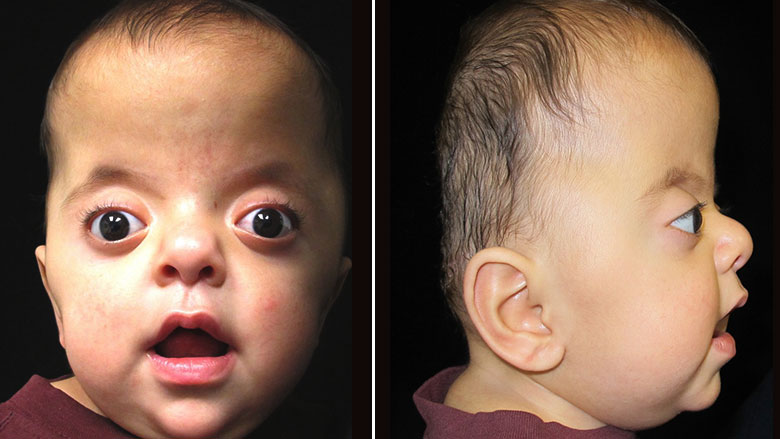
Apert's syndrome is characterized by craniosynostosis, premature closure of fibrous joints (sutures) between certain bones of the skull. In children without craniosynostosis, the stitches allow the head to grow and expand. Then, these bones fuse together to form the skull.
In people with craniosynostosis, the brain is still growing after these sutures are closed prematurely.
The pressure that builds up as the brain grows can cause the various bones of the skull and face to deform during development.
Depending on which sutures close prematurely, their severity varies. In most sick people, premature closure of the sutures between the bones that form the forehead and the top of the skull occurs. This leads to the fact that the head from birth becomes pointed at the top (acrocephaly). In addition, the back of the skull may appear flattened, with a high and wide forehead (see illustration). photo above). The skull may have a large “fontanelle” with late closure.
Some people may also have hydrocephalus, in which cerebrospinal fluid accumulates in the cavities of the brain. This can cause intracranial pressure.
Facial bones can also be affected by craniosynostosis. This can lead to characteristic facial defects. People with Apert syndrome often have wide-set eyes (hypertelorism), bulging eyes (exophthalmos), or downward slanted eyes. They may also have underdeveloped mid-facial areas (maxillary hypoplasia) and cleft palate. The right and left sides of the face may not be symmetrical.

People with the disease may have a flattened nose with a low bridge. People have delayed tooth growth, crowded teeth, or an open bite.
If the openings between the nose and throat are narrowed or blocked, or the tracheal cartilage is damaged, it can interfere with breathing and swallowing. People with these problems can have upper respiratory tract infections, sleep apnea, and malnutrition.
Apert's syndrome has several characteristic hand and foot malformations. Affected people may have short, wide, and large toes that swing outward. They can also have partial or complete fusion (syndactyly) of certain fingers and toes. Many sick people have complete fusion of the bones of the second and fourth fingers and one single solid nail ("mitten" syndactyly). However, other mergers are also possible.
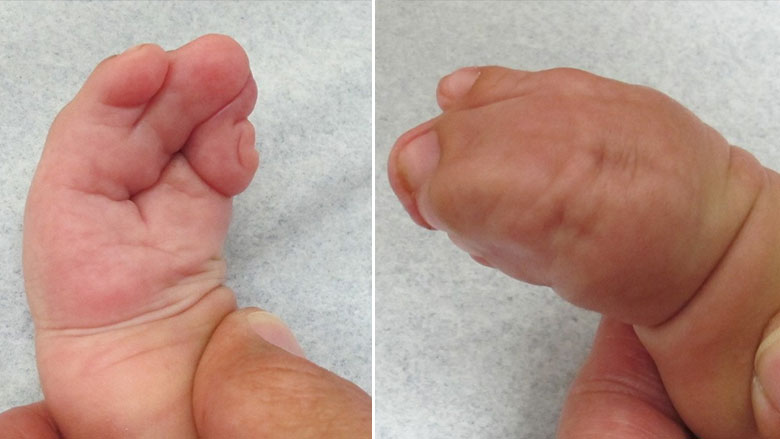
The joints of the fingers become stiff by the age of four. In the feet, syndactyly also commonly affects the second, third and fourth toes. The toenails can be partially continuous or separate. As a rule, the syndrome affects the upper limbs more than the lower ones.
Apert's syndrome can affect other organ systems as well (see. table).
| Skeletal system |
|
| Nervous system |
|
| Ears |
|
| The cardiovascular system |
|
| Abdomen |
|
| Kidneys and genitourinary system |
|
Causes
Apert's syndrome results from a change (mutation) in a gene fibroblast growth factor receptor 2 (eng. Fibroblast growth factor receptor 2, abbr. FGFR2). This gene plays an important role in skeletal development. Genes provide instructions for making proteins that play different roles in the body. When a gene mutation occurs, the protein product may not work properly. With Aper syndrome, mutations in FGFR2 cause these receptors to improperly bind to fibroblast growth factors. This affects the formation of normal sutures in the brain and can interfere with the development of many other structures in the body. This malformation is the cause of the malformations seen in Apert's syndrome.
In almost all registered patients, the disorder was caused by one of two specific gene mutations FGFR2. (These mutations are designated “Ser252Trp” and “Pro253Arg.”) These mutations can cause slightly different manifestations, including the degree of syndactyly (finger splice). Various mutations in the gene FGFR2 can cause several other related disorders, including Pfeiffer syndrome, Cruson syndrome, and Jackson-Weiss syndrome.
In 95% of patients, Aper syndrome occurs as a result of a new mutation in the gene FGFR2. These new mutations appear randomly for unknown reasons (sporadically). It has been reported that isolated cases of the disease are associated with an increase in the age of the father.
Rarely, the syndrome is inherited in an autosomal dominant manner. Dominant genetic disorders occur when only one copy of a mutation is needed to cause a specific disease. The risk of passing the mutation from an affected parent to offspring is 50% for each pregnancy. The risk is the same for men and women.
Affected populations
Apert syndrome is estimated to occur in about one in 65,000 newborns. Men and women get sick in relatively equal amounts. More than 300 new cases have been reported since the disorder was originally described in 1894 and 1906. It has been reported that people from Asia have the highest incidence of this syndrome.
Diagnostics
The diagnosis is most often made at birth or during infancy. Patients are diagnosed through clinical evaluation and various specialized tests. Physical signs such as facial abnormalities or syndactyly are identified.
Skeletal abnormalities and congenital heart defects are detected by imaging, such as computed tomography (CT) or magnetic resonance imaging (MRI). Hearing impairment can be detected during a hearing test in a newborn.
People can also get tested for mutations in a gene FGFR2that can provide a genetic diagnosis for Aper's syndrome.
In some cases, signs of Apert's syndrome can be detected before birth. This can be done with prenatal 2D or 3D ultrasound or magnetic resonance imaging (MRI). An ultrasound scan (ultrasound) is a non-invasive procedure that allows you to get an image of the fetus. The procedure can detect differences in skull shape, facial abnormalities, and syndactyly. Fetal MRI can provide more detail in the fetal brain than ultrasound.
Symptomatic Disorders
Symptoms of the following disorders may be similar to those of Apert's syndrome. Comparisons can be useful for differential diagnosis.
- Carpenter's Syndrome Is a rare genetic disorder associated with craniosynostosis, polydactyly, or syndactyly. The crown of the head may appear unusually pointed (acrocephaly) or the head may appear short and wide (brachycephaly). In addition, the cranial sutures often merge unevenly, causing the head and face to appear asymmetrical from one side to the other. In some cases, additional physical abnormalities are present, such as short stature, congenital heart defects, mild to moderate obesity, umbilical hernia, or cryptorchidism. Many people with the disorder suffer from mild to moderate mental retardation.
- Cruson's syndrome Is a rare hereditary disease associated with craniosynostosis. People with Crouzon syndrome also have midface malformations, bulging eyes, and blockages in the airways, which can lead to difficulty breathing and swallowing. Some people have a very large head (hydrocephalus). Crouzon syndrome is not usually associated with mental retardation or problems affecting the arms, legs, hands, or feet. Cruson syndrome is caused by a change in one of the genes FGFR, usually FGFR2, and is inherited in an autosomal dominant manner.
- Jackson-Weiss Syndrome (ADD) is a rare inherited disorder characterized by craniosynostosis and leg abnormalities. The range and severity of symptoms and signs varies greatly, even among affected family members. Primary signs may include unusually flat, underdeveloped mid-facial areas (mid-facial hypoplasia parts of the face), abnormally wide big toes and / or a malformation or fusion of certain bones into feet. ADD can occur sporadically or be inherited in an autosomal dominant manner.
- Pfeiffer syndrome Is a rare genetic disorder characterized by craniosynostosis and abnormally wide and medially deviated thumbs and toes. Most people who are affected also have bulging eyes and conductive hearing loss. There are three forms of Pfeiffer syndrome. Types II and III are more serious. Pfeiffer syndrome is an autosomal dominant disorder associated with gene mutations FGFR2 and FGFR1.
Treatment
Treatment for Apert's syndrome varies depending on what symptoms the patient is experiencing. Treatment may require the care of a team of healthcare professionals, including pediatricians and surgeons, neurosurgeons, physicians, specializing in diseases of the skeleton, joints and muscles (orthopedists), doctors specializing in diseases of the ears, nose and throat (otolaryngologists), doctors specializing in cardiac disorders (cardiologists).
Special treatments for Apert's syndrome are symptomatic and supportive. Craniosynostosis and hydrocephalus can lead to abnormally high pressure within the skull and brain. In such cases, early surgery (within 2-4 months after birth) may be recommended to correct craniosynostosis. For patients with hydrocephalus, surgery may also involve inserting a tube (shunt) to drain excess cerebrospinal fluid (CSF) from the brain. CSF is drained into another part of the body where it is absorbed.
Corrective and reconstructive surgery can be recommended for correcting craniofacial malformations. Surgery can also help correct polydactyly and syndactyly, as well as other skeletal defects or physical abnormalities. Patients with congenital heart defects may require treatment with certain drugs, surgery, and / or other therapeutic measures. For some people with hearing impairments, hearing aids are helpful.
Early intervention can be important to ensure that children with Apert syndrome reach their full potential. Specialized therapeutic interventions such as physiotherapy, occupational therapy and specialized training will also be helpful.
Genetic counseling is recommended for affected individuals and their families. The genetic counselor will be able to explain the causes of the disease. He can also discuss the possibility of having new children with the disease. Additionally, psychosocial support is needed for the whole family.
Forecast
The prognosis for children with Aper's syndrome depends on how serious the condition is and which body systems it has affected. The disease can be more serious if it affects the baby's respiratory system or if pressure builds up inside the skull, but these problems can be corrected with surgery.
Children with the syndrome often have learning disabilities. Some children suffer more severely than others.
Because the severity of the disease can vary widely, life expectancy is difficult to predict. The disease may not significantly affect a child's life expectancy, especially if he does not have heart defects.


