Cat's eye syndrome: what is it, symptoms (photo), treatment, prognosis
Content
- What is cat's eye syndrome?
- Signs and symptoms
- Causes of cat eye syndrome
- Affected populations
- Diagnostics
- Treatment for cat eye syndrome
- Forecast
What is cat's eye syndrome?
Cat eye syndrome (abbr. SKG or also feline pupil syndrome, Schmid-Frakkaro syndrome) Is a rare chromosomal disorder that occurs at birth. People with normal chromosomes have two 22 chromosomes, both of which have a short arm (shoulder) known as 22p and a long arm known as 22q. However, in people with SCH, the short arm and a small portion of the long arm of chromosome 22 (i.e. 22pter-22q11) are present four times, not two (partial tetrasomy). In a small number of people with feline pupillary syndrome, the 22q11 region is represented in triplicate (partial trisomy).
The name "cat's eye syndrome" derives from a distinctive ocular anomaly present in just over half of patients. This defect, known as coloboma, usually appears as a cleft or slit in the iris under the pupil, and therefore the pupil resembles the appearance of a cat's eye.
However, there are other signs and symptoms associated with SCH that affect many organs and systems. These symptoms result from abnormal development during the embryonic stage. Associated symptoms vary greatly in presence and severity from one person to another, including among members of the same family. Feline Pupil Syndrome is best viewed as a spectrum of disorders. While some patients may have few or mild symptoms, others may have multiple serious malformations.
Signs and symptoms
The classic symptoms associated with SCH are ocular coloboma, anal atresia, and minor preauricular ear defects (see table). below). However, the syndrome is extremely variable and it has been estimated that only 41% of patients with SCH have this classic triad of symptoms. In general, SCG-related abnormalities tend to affect the eyes, ears, anal region, heart, kidneys, and so on. organs, and some people experience intellectual (mental) disability.
The most common signs of Feline Pupil Syndrome are discussed below. Some people may be asymptomatic or have few symptoms, making it difficult to diagnose the disorder.
- Coloboma and other visual impairments.
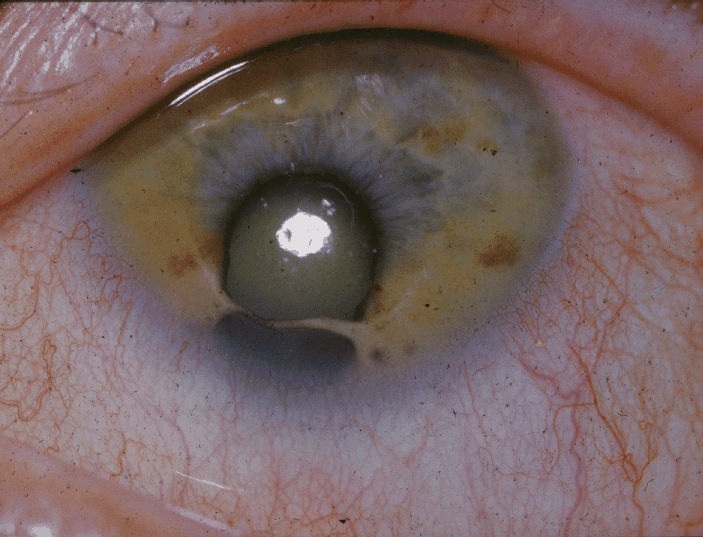
Coloboma is characterized by partial absence of eye tissue (see. photo), often both eyes (bilateral). It occurs due to the inability to close the cracks in the lower part of the eye during early development, resulting in a persistent cleft or tear. The colored part of the eye that controls the amount of light that enters the eye (iris) is affected. dark brown, middle layer (choroid) and / or nerve-rich inner membrane (retina) of the eyes.
An iris coloboma can give the iris an unusual 'keyhole' appearance. If only the iris is involved, vision does not change. However, a more extensive coloboma involving other layers of the eye can lead to visual impairments and / or blindness. Although coloboma was initially considered the main feature of the disorder, this anomaly is present in only half of patients with SCH.
Some victims have additional visual impairments, including:
- unequal direction of the eye pupils (strabismus);
- abnormal smallness of one of the eyeballs (one-sided microphthalmia).
Less commonly, other eye defects may be present, including:
- lack of an iris (aniridia);
- Clouding of the domed, usually clear area of the front of the eyeball (cornea)
- lack of tissue in areas of the eyelid (eyelid coloboma);
- loss of transparency of the lens of the eye (cataract)
- Duane's syndrome (congenital rare type of strabismus).
The latter is a condition characterized by the limitation or absence of certain horizontal eye movements and retraction or "retraction" of the eyeball into the eye cavity (orbit) when trying to look inside. In some cases, depending on the severity and / or combination of the existing eye abnormalities, varying degrees of visual impairment, including blindness, are possible.
- Anal abnormalities.
In about a quarter of people who are sick, the anus may be unusually small or narrow (anal stenosis), or the anal canal absent (anal atresia), sometimes with a passage (fistula) from the end of the colon (rectum) to the wrong places. In men, fistulas can form between the rectum and the muscle organ that collects urine (urinary bladder), the tube that drains urine from the bladder (urethra), or the area behind the genitals (crotch). In women, fistulas may be present between the rectum and the bladder or vagina. Anal atresia and fistulas are surgically corrected.
- Hearing impairment.

The third classic feature of SCG is preauricular ear defects. This is the most common SCH feature, seen in over 80% of people. Patients may have small skin growths and / or small depressions (pits) in front of the outer ears (see. Photo). In addition, the outer parts of the ears (pinnae) may be low-set and / or malformed, sometimes with confusing or missing outer ear canals (microtia). In most cases, absence (atresia) of the external auditory canal tends to affect one ear and can cause mild hearing loss due to inadequate transmission of sound from the outer to the inner ear (conductive loss hearing).
- Heart defects.
About half of people with cat eye syndrome have structural heart abnormalities at birth (congenital heart defects), in particular, “common abnormal pulmonary venous return" or "Fallot's tetrad». Associated symptoms and signs vary depending on the size, nature, and / or combination of heart defects present. In people with severe medical conditions, congenital heart defects can lead to life-threatening complications.
- Common abnormal pulmonary venous return (TAPVR) characterized by impaired blood flow to the heart. The pulmonary veins usually return oxygenated blood from both lungs to the upper left chamber (left atrium) of the heart. However, in children with TALVV, the pulmonary veins do not correctly return blood directly to the upper right chamber (right atrium) of the heart or to the veins passing through the right atrium. There is also an opening between the two atria (atrial septal defect), which causes oxygenated and oxygen-deprived blood to mix. Associated symptoms and signs may include bluish discoloration of the skin and mucous membranes due to low oxygen levels in the blood (cyanosis), abnormally fast breathing (tachypnea), increased blood pressure in the lungs (pulmonary hypertension), the inability of the heart to pump enough blood to meet the body's oxygen needs (heart failure) and / or other violations. Although HALVV is a rare heart defect, accounting for 1–2% of heart defects in children, it is one of the most common malformations in SCH.
- Fallot's tetrad - a complex of heart defects. These include an abnormal opening in the septum separating the two lower chambers of the heart (ventricular septal defect); obstruction of the correct outflow of blood from the right ventricle to the lungs due to narrowing of the opening between the ventricle and the pulmonary artery (pulmonary stenosis), displacement of the aorta, allowing oxygen-deprived blood to flow from the right ventricle into aorta; and thickening (hypertrophy) of the heart muscle of the right ventricle.
- Abnormalities of the kidneys and urinary system.
Typical kidney defects associated with SCH include:
- underdevelopment of one or both kidneys (unilateral or bilateral renal hypoplasia);
- absence of a kidney (unilateral agenesis);
- the presence of an additional kidney (doubling of the kidney);
- abnormal swelling (bloating) and accumulation of urine in the kidneys (hydronephrosis);
- abnormal development renal cysts (cystic dysplasia).
Typical reproductive tract defects in women include:
- underdevelopment of the uterus;
- absence of a vagina;
- defects of the genitals.
In men, defects include:
- undescended testicles (cryptorchidism)
- defects of the external genital organs.
- Intellectual disabilities.
Most patients with SCH have normal intelligence. However, some of the patients may have mild to moderate levels of mental retardation. In 2001, scientists compared the IQ scores of 51 patients and found that 47% of IQs were in the normal range, 22% were in the normal range, 18% were with mild mental retardation, and 14% were moderate. Rare cases of severe mental retardation have also been reported. People with intellectual disabilities may experience delays in reaching developmental stages that require coordination of muscle and mental activity (psychomotor delays).
- Defects of the skeleton.
Typical skeletal abnormalities may include:
- rachiocampsis (scoliosis);
- abnormal fusion of certain bones in the spine;
- lack of bone on the side of the thumb of the forearm (radial aplasia);
- absence or abnormal fusion (synostosis) of certain ribs;
- lack of certain fingers;
- dislocation of the hips.
- Anomalies in the development of the peritoneum and abdominal organs.

In some people with cat's eye syndrome, portions of the intestines may protrude through the abdominal wall at the navel (umbilical hernia) or into a canal through the lower muscle layers of the abdominal wall (inguinal hernia).
Additional signs noted include an abnormal saccular protrusion (Meckelev diverticulum) from the lower part of the small intestine (ileum) or Hirschsprung's disease, leading to a violation of the innervation of a fragment of the intestine (congenital agangliosis), and / or the absence of groups of nerve fibers (ganglia) in the muscular wall of the colon, resulting in the disruption or absence of involuntary rhythmic contractions (peristalsis) that propel waste through the lower digestive tract.
Related signs may include:
- abnormal accumulation of feces in the colon;
- expansion of the colon over the affected segment;
- bloating;
- periodic vomiting;
- loss of appetite;
- anorexia.
In addition, the bile ducts may not develop or develop abnormally (biliary atresia). Bile, a fluid secreted by the liver, plays an important role in the transport of waste products from the liver and in the breakdown of fats in the small intestine. The bile ducts are narrow tubes through which bile passes from the liver to the first section of the small intestine (duodenum). Due to the absence or insufficient development of the bile ducts, bile cannot reach the intestines and accumulates abnormally in the liver.
Related signs may include:
- yellowing of the skin, mucous membranes and sclera of the eyes (jaundice);
- dark urine;
- pale colored feces;
- hepatomegaly (enlarged liver);
- growth problems.
Without proper treatment, scarring and liver dysfunction can lead to potentially life-threatening complications.
- Cleft palate.

Cleft palate - gap, cleft in the middle part of the palate. Various degrees of this defect can occur in 14-31% of people with the disease.
- Low growth.
A slight increase was noted in 15-50% of people with SCH. However, it is not yet clear whether this is due to growth hormone deficiency in most of the victims.
- Facial anomalies.
Most people with the disorder have abnormal features of the cranial and facial areas. Common features include ptosis of the upper eyelid; wide-set eyes (ocular hypertelorism); abnormally small lower jaw (hypoplasia of the lower jaw or micrognathia); flat nasal bridge.
Causes of cat eye syndrome
Feline Pupil Syndrome is a rare condition associated with an extra chromosome fragment in which a short shoulder (p) and a small part of the long arm (q) of chromosome 22 are usually present in four copies (partial tetrasomy) rather than two copies in cells organism.
Chromosomes are found in the nucleus of all cells in the body. They carry the genetic characteristics of every person. Pairs of human chromosomes are numbered 1 through 22, plus two X chromosomes in females and a 23rd pair of X and Y chromosomes in males. Each chromosome has a short arm, denoted "p", a long arm, denoted by the letter "q," and a narrow region where the two arms (centromere) are connected. Chromosomes are further subdivided into stripes numbered outward from the centromere. For example, the short arm of chromosome 22 includes bands 22p11.1 through 22p13; the end of the short arm is known as 22pter. The long arm (shoulder) includes bands from 22q11.1 to 22q13.
Thus, people with a normal chromosome structure have two 22 chromosomes, each of which consists of a short arm (22p), a long arm (22q), and a centromere. However, almost all people with cat's eye syndrome have an unusual extra chromosome (bis-satellite marker chromosome). This marker chromosome comes from two segments of chromosome 22, each of which consists of a short arm, centromere, and portions of the long arm (22q11), both fused together to form one additional chromosome. Therefore, this chromosomal region (22pter-22q11) is present in the cells of the body four times: twice as part of two normal chromosomes 22 and twice together on the marker chromosome. In addition, in some people, this extra chromosome may only be present in a certain percentage of the body's cells (mosaicism).
In rare cases, a portion of chromosomal segment 22q11 may appear three times: once on normal chromosome 22 and twice on chromosome 22 with internal duplication. Part of the 22q11 region is considered critical for the expression of all or most of the features associated with SCG. This region is referred to as the SCG critical region and contains approximately 12 genes.
The exact cause of cat eye syndrome is not understood. In most cases, the chromosomal abnormality appears to be due to an error in the parent's reproductive cell division (meiotic error); in such cases, the parent has normal chromosomes. The formation of a marker chromosome may result from specific sequences in the region that predispose to chromosomal rearrangement. It is not related to any specific parenting behavior during pregnancy.
A small percentage of parents (especially those with milder symptoms) will pass on the SCG chromosome to their offspring. In some of these cases, the parent has a marker chromosome in some cells in the body while other cells in the body are not affected (mosaicism). There have been cases where mosaicism for this chromosomal abnormality could be passed down through several generations; however, as noted above, the expression of related features can be variable. As a result, people with multiple or severe symptoms can be identified while the previous generation remains unrecognized and undiagnosed. In any case, it is important to note that people with the syndrome who have children are at significant risk of passing on an extra marker chromosome to their offspring.
Affected populations
SKG was recognized over a century ago. More than 100 cases have been reported in the medical literature, including apparently sporadic and familial cases. There are many more victims, but they are not described in the medical literature. However, the syndrome is very rare and there are currently no accurate estimates of the prevalence of SCH in the population. In 1981, it was estimated that cat's eye syndrome occurred in 1 in 50,000 to 1 in 150,000 people. Affected both men and women. However, because some people have few associated symptoms, the disorder may go unrecognized for them. There is currently no way to assess how poorly diagnosed this syndrome is.
Diagnostics
The diagnosis of SCH is based on the presence of extrachromosomal material derived from chromosome 22q11.
It is possible that a diagnosis of SCH may be suspected before birth (in utero) based on specialized examinations such as ultrasound (ultrasound), amniocentesis and / or biopsy chorionic villi. During an ultrasound scan of the fetus, the reflected sound waves create an image of the developing fetus, potentially revealing certain defects, such as a heart defect, that could indicate SCG. During amniocentesis, a sample of amniotic fluid containing fetal cells is removed and analyzed. Chorionic villus sampling removes a tissue sample from a portion of the placenta. Chromosomal studies performed on these cells can reveal the SCG chromosome.
Feline eye syndrome can also be recognized postnatally (postnatally) by careful clinical evaluation that identifies a subset of the characteristic physical signs (see below). (See symptom section above). The suspected diagnosis is then confirmed by standard chromosomal studies to identify the SCG chromosome or duplication in the 22q11 region.
After a chromosomal diagnosis is made, various specialized tests may also be performed to determine the presence of other signs of the disease. In particular, a thorough assessment of the condition of the heart may be recommended to detect any cardiac abnormalities. Such an assessment may include a thorough clinical examination, assessment of heart and lung sounds using a stethoscope, X-rays, electrocardiography (ECG), echocardiography, cardiac catheterization, and / or other tests hearts. An ECG that records the electrical activity of the heart muscle can reveal abnormal electrical patterns. During an echocardiogram, sound waves are sent to the heart, allowing doctors to study the function of the heart. When cardiac catheterization is performed, a small hollow tube (catheter) is inserted into a large vein and pierces the blood vessels that lead to the heart. This procedure can be used for a variety of purposes, including assessing the pumping ability of the heart, measuring blood pressure in the heart, and taking blood to measure oxygen content.
Additional examinations should include a thorough examination of the eyes and hearing. Early detection of potential visual impairment and / or hearing loss can play an important role in ensuring prompt intervention and appropriate early correction or supportive care.
Specialized imaging techniques and / or other studies can also be used to detect and / or characterize possible gastrointestinal, genitourinary, renal, skeletal or biliary defects, as well as other physical abnormalities arising from SCG. Research on cognitive function may also be worthwhile.
Treatment for cat eye syndrome
Treating cat eye syndrome may require a coordinated effort by a team of healthcare professionals such as pediatricians, surgeons, cardiologists, gastroenterologists, ophthalmologists; health professionals who identify, evaluate and help manage hearing problems; doctors who diagnose and treat disorders of the skeleton, muscles, joints and related tissues (orthopedists); and / or other healthcare professionals.
Treatment for a disease is directed at the specific symptoms that each person experiences. People with congenital heart defects may require treatment with certain medications, surgery, and / or other measures. In addition, surgical correction is necessary for anal atresia. In some cases, the recommended treatment may also include surgical repair, correction, or treatment of certain ocular defects, skeletal anomalies, genital defects, hernias, Hirschsprung's disease, biliary atresia and / or other malformations associated with disorder. Specific surgical procedures may depend on the size, nature, severity and / or combination of anatomical abnormalities; associated symptoms; the age of the patient; and other factors.
Before and after surgery for certain heart defects, people may be susceptible to bacterial infections of the lining of the heart and valves (endocarditis). Therefore, prophylactic antibiotic therapy may be prescribed before and after certain surgical procedures and dental visits. In addition, respiratory infections must be treated quickly and at an early stage.
For people with certain skeletal disorders, treatment may include physical therapy and various orthopedic techniques, possibly including surgical measures. In addition, growth hormone therapy may be prescribed for people with growth problems in combination with growth hormone deficiency in the body.
Early intervention is essential for children with SKH to reach their potential. Specialty services that may be helpful include specialty education, specialty social support, and / or other medical, social, and / or professional services.
Genetic counseling will also be beneficial for affected individuals and their families. Chromosome studies can be recommended to parents of sick children to determine if they carry the SCG chromosome. or exhibit mosaicism, especially if they exhibit any features that may be associated with the disorder. Genetic counseling is also helpful for adults with SCH who want to have children.
Forecast
The long-term outlook (prognosis) for people with cat eye syndrome varies from person to person and throughout depends a lot on the severity of the condition and the accompanying signs and symptoms, especially if you have heart problems or kidneys. Some babies with cat eye syndrome die during infancy, but most people with cat eye syndrome do not have a shortened life expectancy.