Paget's disease: causes, symptoms, treatment, prognosis
Content
- What is Paget's disease?
- Symptoms and Signs
- Complications
- Causes and risk factors
- Affected populations
- Diagnostics
- Treatment
- Forecast
What is Paget's disease?
Paget's disease (osteitis deformans) is a chronic condition that interferes with the normal process of bone remodeling.
Bone remodeling - a process by which new bone tissue gradually replaces old bone tissue. This relationship is vital to maintaining normal blood calcium levels. Over time, the disease can cause the affected bones to become brittle and deformed. Paget bone disease most commonly occurs in the pelvis, skull, spine, and legs.
The risk of the disease increases with age. The risk is also increased if a family member has the disorder. Complications of Paget's disease of bones can include bone fractures, hearing loss, and pinched nerves in the spine.
Bisphosphonates - medicines used to strengthen bones weakened by osteoporosis are the mainstay of treatment. In severe cases, surgery may be required.
Symptoms and Signs
Usually, Paget's disease does not cause any symptoms. However, bone pain, enlargement, or deformation of the bones may occur. Bone pain can be deep, aching, and occasionally severe, and may worsen at night. When the bones are enlarged, the nerves can be compressed, which leads to increased pain. With the development of osteoarthritis, joint pain and deterioration in their mobility are observed.
Other symptoms may vary depending on which bone is affected by the pathological process.
It is possible to enlarge the bones of the skull, with protruding superciliary arches and forehead (the so-called protruding frontal tubercles). The patient pays attention to such an increase when the headgear becomes small. The enlarged skull bones can damage the inner ear (cochlea), sometimes leading to hearing loss and dizziness. Enlarged skull bones can compress the nerves, causing headaches. Possible swelling of the veins in the scalp, probably due to increased blood circulation in the bones of the skull.
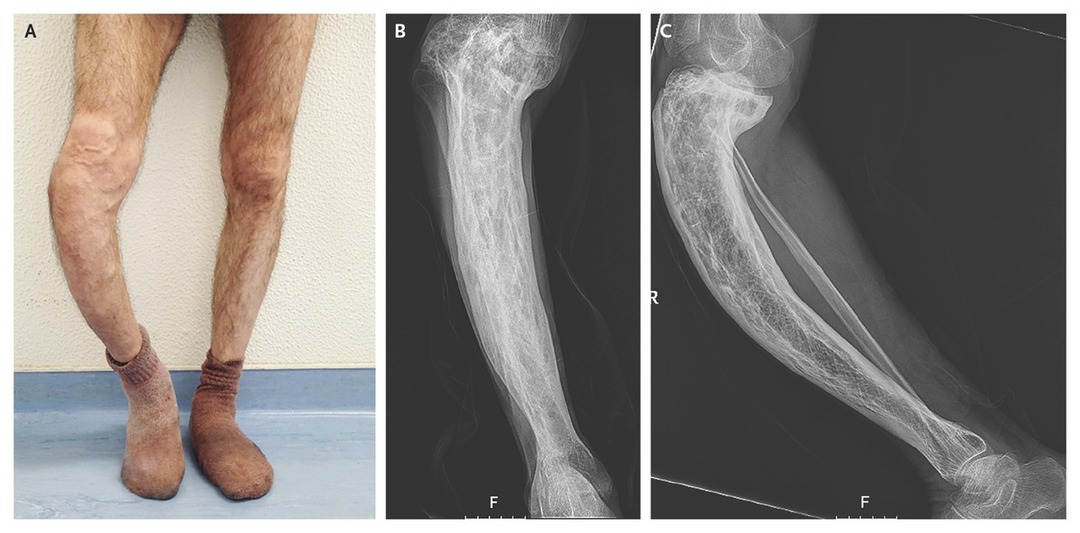
The bones of the shoulder, thigh, or lower leg may become arched and fracture is more likely because the bone is weakened by Paget's disease. There may be an increase in the size or collapse of the vertebral bodies, or both, due to the weakening of the bones affected by the disease. Weakening of the vertebrae can lead to decreased growth, slouching, or pinching of the nerves in the spinal cord, which can cause pain, numbness, or weakness.
Complications
The most common complication of Paget disease is osteoarthritis (joint disease).
Osteoarthritis develops in almost 50% of patients and can occur in joints near the affected bone.
Fractures in the affected bones tend to be easier than usual because those bones are weakened by Paget's disease. Such fractures are called pathological fractures.
With bone growth, compression of nerves and other structures passing through small holes is possible. A decrease in the lumen of the spinal canal and compression of the spinal cord are possible.
In rare cases, it develops heart failurebecause the increased blood flow through the affected bone increases the stress on the heart muscle. Because blood circulation in the affected bone is unusually increased, there may be massive bleeding into such bone tissue during surgery. In patients with the disease, in almost 1% of cases, a malignant tumor develops in the affected bone tissue. If the disease progresses to a malignant bone tumor, these patients usually develop osteosarcoma (malignant tumor of bone tissue).
In very rare cases, people with Paget disease who are bedridden may have elevated blood calcium levels (hypercalcemia).
Causes and risk factors
Normally, cells that destroy old bone tissue (osteoclasts) and cells that form new bone tissue (osteoblasts), through coordinated work, maintain the structure and integrity of bones. In Paget's disease, in some areas of the bone, there is an increase in the activity of both osteoblasts and osteoclasts, and the rate of destruction and renewal of bone tissue (the so-called bone remodeling) in such areas is significantly increases. Areas of increased activity increase in size, but despite this, they are characterized by structural abnormalities and reduced strength.
The causes of Paget's disease in most patients have not been established. This disease can be hereditary. Specific identified gene abnormalities are detected in about 10% of patients with the disease, and in the rest, other genetic abnormalities are likely to contribute to its development. In addition, some information points to the involvement of the virus. However, there is no evidence of the infectiousness of this disease.
Affected populations
Paget's disease is rarely diagnosed in people under the age of 40, but can occur in 8% of the population over the age of 60. The disease affects people of all ethnic and racial groups. However, it rarely affects people of Asian descent. Both men and women, with a slight predominance of men, suffer from the disease. The prevalence of the disease is estimated to be 1–2 percent of the world's total population.
Diagnostics
Paget's disease is often discovered by chance, during an X-ray examination or laboratory tests prescribed for other indications. Alternatively, a diagnosis of a disease can be made if the disease is suspected based on symptoms and physical examination.
To confirm the diagnosis, an X-ray examination can be used, with the help of which abnormalities characteristic of Paget's disease are detected, as well as laboratory analysis, the results of which determine an increase in blood levels of alkaline phosphatase (an enzyme involved in the formation of bone cells), calcium and phosphates.
A bone scan (technetium radioisotope scan) can help identify affected bones.
Treatment
A patient with Paget's disease requires treatment when symptoms cause discomfort, or there is a significant risk or potential for complications such as hearing loss, osteoarthritis and deformations. People without symptoms may not need treatment.
Frequently used pain relievers (analgesics) such as acetaminophen (paracetamol) and non-steroidal anti-inflammatory drugs (NSAIDs) can reduce bone pain. When one leg is crooked and shortened, heel pads make it easier to walk. Rarely, surgery may be needed to relieve nerve compression or replace a joint affected by arthritis from Paget's disease.
Bisphosphonates are drugs that inhibit bone remodeling. One or more bisphosphonates, alendronate, etidronate, pamidronate, risedronate, tiludronate, or zoledronate, may be used to slow the progression of the disease. With the exception of pamidronate and zoledronate, which are usually given intravenously (into a vein), these drugs are all taken orally. Such drugs are prescribed in the following situations:
- before orthopedic surgery to prevent or reduce bleeding during surgery;
- to relieve bone pain caused by Paget's disease;
- to prevent or slow the progression of complications (eg, hearing loss, deformity bones, arthritis, weakness or paralysis), especially in people who are contraindicated for surgical intervention;
- for patients in whom the level of alkaline phosphatase in the blood is twice or more higher than normal.
Sometimes calcitonin is used in the form of subcutaneous or intramuscular injections. It is less effective than bisphosphonates and is only used when other drugs are contraindicated. Denosumab may be another alternative for patients who cannot take bisphosphonates.
Doctors recommend that patients use weight-bearing activities (such as standing up and walking). Excessive bed rest (with the exception of night sleep) should be avoided if possible to prevent hypercalcemia.
Because bone remodeling occurs quickly, you should consume adequate amounts of calcium and vitamin D in your diet. Vitamin D helps the body absorb calcium and incorporate it into bones (a process called bone mineralization). Vitamin D and calcium supplements are often needed. Otherwise, there may be insufficient mineralization and weakening of the bones (osteomalacia).
Forecast
The prognosis for patients with Paget's disease is generally good. However, some patients may develop bone cancer with a poor prognosis. If other rare complications develop, such as heart failure or spinal compression brain, the prognosis is also unfavorable, if you do not carry out timely and successful treatment of such complications.