Cyclic neutropenia: causes, symptoms, treatment, prognosis
Content
- What is Cyclic Neutropenia?
- Signs and symptoms
- Causes
- Affected populations
- Related disorders
- Diagnostics
- Standard treatments
- Forecast
What is Cyclic Neutropenia?
Cyclic neutropenia Is a rare blood disorder characterized by repeated episodes of abnormally low levels of certain white blood cells (neutrophils) in the body. Neutrophils help fight infection by surrounding and destroying bacteria that enter the body. Symptoms associated with cyclic neutropenia may include fever, a general feeling of feeling unwell (malaise), and / or mouth ulcers. In most cases, people with low neutrophil counts are abnormally susceptible to recurrent infections.
Signs and symptoms
The main symptom associated with cyclic neutropenia is a regularly recurring, severe decrease in the level of certain white blood cells (neutrophils). In most cases, episodes of neutropenia recur every 21 days (cyclical), and severe neutropenia can last 3 to 6 days. The cycle period usually remains constant and consistent among the affected people. In addition, abnormal red blood cell levels (
anemia), changes in the level of blood particles that promote clotting (platelets), the presence of immature red blood cells (reticulocytes), and cyclical changes in other white blood cells. An almost constant feature is an increase in the number of blood monocytes at the lowest point in the neutrophil cycle.During episodes of neutropenia, patients may experience:
- fever;
- general ill health (malaise);
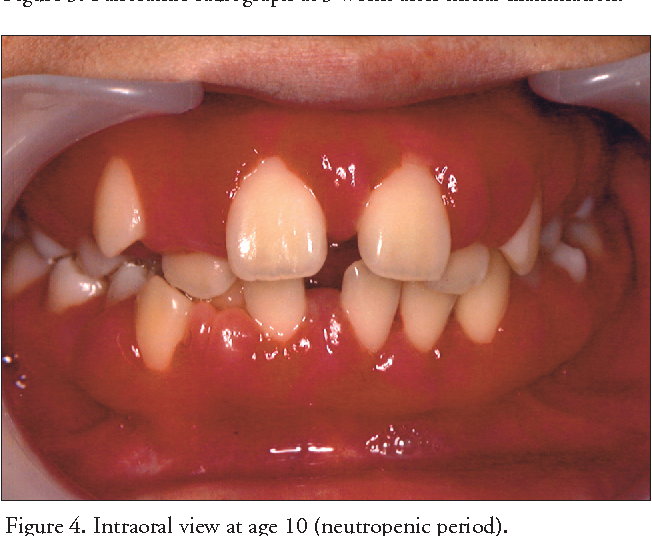
- inflammation and deep ulceration (ulceration) of the oral mucosa (aphthae and stomatitis);
- sore throat (pharyngitis);
- inflammation and degeneration of the tissue that surrounds and supports the teeth (periodontal disease);
- loss of appetite.
Periodontal disease can lead to weakening of teeth and early tooth loss in young children and adults.
People with cyclical neutropenia are abnormally susceptible to bacterial infections, which often affect the skin, digestive (gastrointestinal) tract, and respiratory system. Such bacterial infections vary in severity and, in some cases, can lead to life-threatening complications.
Causes
Cyclic neutropenia is usually hereditary, but there are few reported cases of acquired cyclic neutropenia. In the medical literature, there are reports of several generations (childbirth) with an increased frequency of cyclic neutropenia. Based on these genetic studies, we know that it is an autosomal dominant disorder and can be transmitted from a single affected parent.
Researchers have found that sporadic and autosomal dominant cyclic neutropenia is caused by a disorder or changes (mutations) in a gene ELANE, responsible for the production of a neutrophilic protein called neutrophil elastase. Mutations in this gene cause the production of abnormal neutrophil elastase, and this is the main cause of cyclic neutropenia. Neutrophils form in cavities in many bones (bone marrow). Neutropenia, fever, and infections occur when the bone marrow does not produce enough neutrophils.
Affected populations
Cyclic neutropenia affects men and women in equal numbers. Most cases of cyclic neutropenia are thought to be present at birth (congenital); however, in some cases, the diagnosis may not be obvious until adolescence or early adulthood.
Cyclic neutropenia is a subset of severe chronic neutropenia. Severe chronic neutropenia affects approximately 0.5-1 per million people.
Related disorders
Symptoms of the following disorders may be similar to those of cyclic neutropenia. Comparisons can be useful for differential diagnosis:
- Neutropenia (agranulocytosis, granulocytopenia). There are many different causes of neutropenia. Neutropenia can result from a viral infection, from the use of certain medications, and / or after exposure to certain poisons. In addition, in some cases, the body can make antibodies against neutrophils (autoimmune neutropenia), causing these white blood cells to decrease abnormally. Some people may develop neutropenia after being treated with certain chemotherapy drugs to treat cancer. Neutropenia can also occur as a secondary disease due to other primary diseases (for example, leukemia).
- Severe chronic neutropenia is a group of disorders characterized by abnormally low levels of certain white blood cells (neutrophils) in the body. The three main classifications of severe chronic neutropenia are congenital, idiopathic, and cyclic. Congenital forms of severe chronic neutropenia are usually present at birth or early childhood and are often most severe. Idiopathic neutropenia is a group of disorders that cannot be categorized as one of the other categories of neutropenia. The exact cause of these disorders is not known (idiopathic). Congenital forms of severe chronic neutropenia can be inherited in an autosomal dominant or recessive manner. Unlike severe congenital neutropenia, cyclic neutropenia is not associated with the risk of developing acute myeloid leukemia.
Diagnostics
Cyclic neutropenia is diagnosed based on the patient's detailed history and careful clinical evaluation. The diagnosis can be confirmed by monitoring the individual neutrophil count 2 or 3 times a week for 6 weeks. People with cyclic neutropenia should be genetically tested for mutations in the gene ELANE.
Standard treatments
Prompt, correct treatment of infections associated with cyclic neutropenia is important. Such treatment may include antibiotic therapy. Careful oral and dental care is also required. In addition, people with cyclical neutropenia should avoid activities that could cause minor injury.
Since 1987, the human growth factor called granulocyte colony stimulating factor human recombinant (rhG-CSF), is used to treat cyclical neutropenia and other forms of severe chronic neutropenia. One form, the orphan drug Neupogen (Filgrastim), has been approved for use in the treatment of cyclic and other types of severe chronic neutropenia.
Studies have shown that long-term therapy can raise neutrophil counts to normal levels in most people, thereby reducing infections and other associated symptoms. Careful assessment before starting therapy and constant observation during therapy are essential to ensuring the long-term safety and effectiveness of such treatment in people with severe chronic neutropenia.
Genetic counseling is recommended for individuals with hereditary forms of cyclic neutropenia and their families. Other treatments are symptomatic and supportive.
Forecast
There is a very high risk of life-threatening infections and death at an early age. Quality of life and survival are significantly improved with rhG-CSF treatment, which has been practiced since the late 1980s. Unlike severe congenital neutropenia, people with cyclical disease have a better response to rhG-CSF and are not at risk of developing myelodysplastic syndrome (MDS) and acute myeloid leukemia (AML). However, with long-term follow-up of more than 300 patients with the disease, there was one case of chronic myelogenous leukemia (CML) and one of AML, which indicates that it is also a pre-leukemia condition, but the risk is “very low” and the risk “correlates with the severity of the disease, not the occurrence of mutations ELANE».
Andrey Zakirov/ article author
I am engaged in the prevention and treatment of coloproctological diseases. Higher medical education. On the site tvojajbolit.ru I will be responsible for the quality and literacy of articles.
Specialty: Phlebologist, Surgeon, Proctologist, Endoscopist.
More about the Author.