Pediculosis: what is it, causes, symptoms, treatment, prevention
Content
- What is head lice?
- How does the infestation of head lice occur?
- Head lice symptoms
- How to independently identify head lice?
- Head lice treatment
- Resistance problem
- Treatment with folk remedies
- Prophylaxis
- Prognosis and complications
What is head lice?
Pediculosis - This is an infestation with lice, small white-grayish insects that parasitize the human body and feed on blood. Depending on their shape and the part of the body where they tend to settle, three types of lice can be distinguished:
- Pediculus humanus capitis or head lice that live exclusively on the hair;
- Pediculus humanus corporis, or body lice colonizing body and clothing;
- Phthirus pubis, pubic lice, commonly called crab lice, are morphologically well differentiated from two of the aforementioned types, affecting the pubic areas, but which can be exclusively found on the eyebrows, eyelashes and under the armpits.
Head lice affects mainly schoolchildren from 3 years of age and older (peak at age 9), and is very common in children's communities, especially in schools, where it affects 5 to 22% of children, regardless of their social status. This phenomenon is growing more and more and is a social health problem.
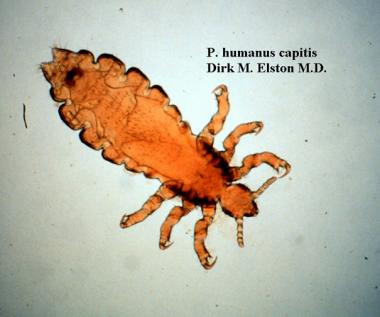
Adult lice, visible to the naked eye, are 1-3 millimeters long, gray and have hook-like legs that cause them to cling tenaciously to their hair. Lice complete their entire life cycle on the host's head within 1-2 months. The female lays 5-10 eggs per day, called nits, for a total of 300 eggs. Nits adhere tightly to the hair at a distance of about 1 cm from the scalp, as 37 ° C is the ideal temperature for maturation.
Nits tear-shaped, their diameter reaches a maximum of 1 mm and are opaque yellow-gray. After 7-10 days, young insects are born, called nymphsthat begin to feed on the host's blood; within a week they mature and become capable of laying new eggs. Every 4-6 hours, the louse bites the host's skin and enters it through the tubular part, releasing an anticoagulant and a vasodilator to facilitate blood sucking. Lice do not survive in the absence of blood and die within 1–2 days. Nits, on the other hand, are much more resilient and can survive in the environment for up to 10 days.
How does the infestation of head lice occur?
In order to prevent the appearance of lice, it is necessary to know the main routes of infection. The transmission of insects from an infected person to a healthy person occurs in 70% of cases with a large crowd of people, for example, in public transport.
It is important to remember that clean hair attracts parasites more than greasy hair, as it can take hold and start multiplying. Colored and damaged hair is also a kind of protection against head lice. Also, places of increased risk are:
- swimming pools;
- baths;
- Metro;
- hospitals;
- schools (kindergartens).
Emerging local epidemics, poor nutrition, and insufficient hygiene contribute to the spread of lice. The duration of the latent period of the development of the disease is from 30 to 45 days. Later, characteristic symptoms appear.
Head lice symptoms
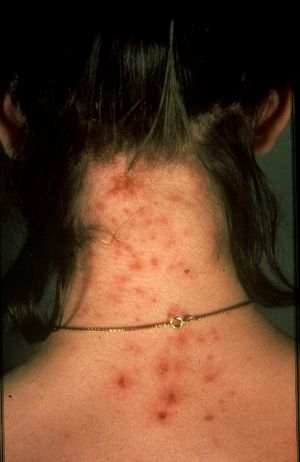
Lice usually "attack" the area around the back of the head and behind the ears, but can also be found on the eyebrows, eyelashes and beard. A typical symptom head lice is:
- itching, due to an irritant-allergic reaction to the enzymes contained in the saliva of the lice;
- scalp inflammation;
- the head continues to itch after shampooing;
- the appearance of a rash (a sign of an allergic reaction to bites);
- desire to scratch (due to itching that does not pass for a long time).
It is important to emphasize that itching takes days or even weeks to appear, which means that if itching occurs, the infection may be at an advanced stage and may have already infected other people.
First symptom head lice, which becomes noticeable on the skin - itching, acute dermatitisthen small ones appear education - bright red papules and vesicles. If you do not take measures to localize the process, do not use means to combat dermatitis, then the symptom will develop into an independent disease - chronic dermatitis, which will be accompanied by suppuration papules.
The next problem that develops against the background of dermatitis is associated with the formation of secondary infections, often against their background it develops anemia.
In the case of head lice formation on the head, a coma of matted hair is a characteristic symptom. They stick together and smell unpleasant, as nits produce a special substance that allows them to stick to the hair. In addition to the head, the place of localization of parasites can be the pubic zone, the body (if body lice appear). You can determine the presence of head lice by the bite sites:
- occipital part;
- whiskey;
- the area behind the ears.
Surface damage caused by scratches can cause impetigo of the head and inflammation of the lymph glands located behind the ears, as well as in the occiput (regional lymphadenopathies). Sometimes an infection may not have any special symptoms, making it even more difficult to detect.
How to independently identify head lice?

Recognizing the disease at home is not difficult. It is necessary to compare the above symptoms, look for attached nits and lice on the head and hair. It is best to self-diagnose during the day and in good lighting. Additionally, you can use a flashlight. In case of suspicion, it is recommended to visit a specialist.
Head lice treatment
Products sold for treatment head lice, contain one or more parasiticides and are available in various formulations. Based on the experience of the past few years, it seems that no active ingredient is an ideal choice in terms of effectiveness and absence of toxicity, and in no case can any of them be used as a preventive measures. The most widely used:
- malathion;
- pyrethrins;
- permethrin.
Malathion - This is a phosphoric ester, which is quite effective in the treatment of head lice. Its action causes an irreversible block of acetylcholinesterase, which leads to the accumulation of acetylcholine at the receptor level and, therefore, paralyzes the airways of the lice.
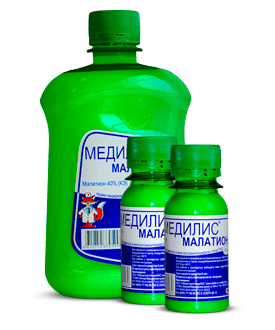
However, the same effects in rare cases can be toxic to humans when taken by mouth. in large quantities, causing the appearance of cholinergic symptoms (nausea, vomiting, increased secretion, bradycardia, bradypnea, coma, cardiovascular arrest). Symptoms appear in 30-60 minutes. In addition, the safety level of malathion in children under the age of six has not yet been determined, and there have been recent cases of treatment resistance.
Pyrethrins (pyrethrum extract) and permethrin (an artificial derivative of pyrethrum) mainly acts by blocking the peripheral nervous system of lice, causing paralysis and death. These substances have low toxicity to humans, if not taken in large doses, in which case they can cause nausea, abdominal pain, contact dermatitis, rhinitis, asthma. However, in the past few years, their effectiveness against head lice has declined dramatically due to the huge increase in resistance in recent generations of lice.
Resistance problem
It is generally accepted that development of resistance is the main reason for the growing spread of head lice since the 90s. Lice infections in schools and communities occur every year and are increasingly difficult to eradicate. Overuse of parasiticides leads to a kind of "tolerance" for lice, making them gradually resistant and therefore able to spread even more.
This situation, in addition to the risk of toxicity to humans, necessitates alternative strategies that can combine efficacy, lack of resistance and harm to humans. In addition, it is important to implement preventive measures to avoid infections and transmission in schools and communities, not only through accurate periodic examination of the hair and scalp, but also using products that can be applied topically and daily. as a preventive measure.
Treatment with folk remedies
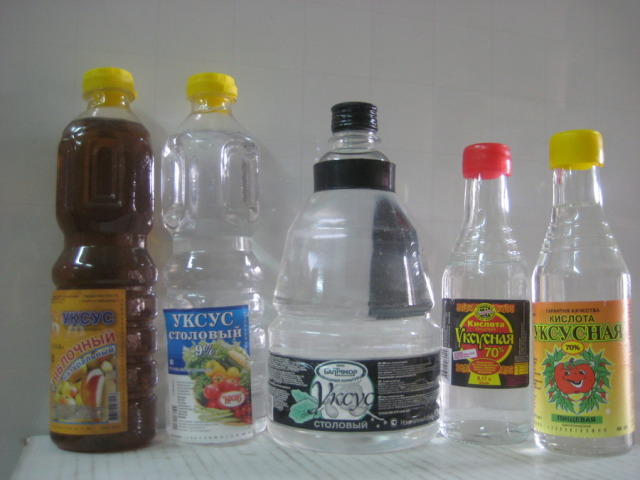
Vinegar - a substance common in folk medicine. In order to get rid of lice, it is recommended to wet the hair with it along the entire length, then wrap your head with a thick cloth or towel. Soak for 2 hours, and then rinse hair thoroughly with warm water and shampoo or soap. You can use not only table vinegar, but also apple cider, wine.
Works no less efficiently turpentine. Before use, the composition must be diluted using vegetable oil in a ratio of 1: 8. After that, you will need to apply the mixture on the head, cover it with a film and stand for 60 minutes. Then rinse the curls thoroughly and comb them.
It is used in the fight against insects and gruel prepared from fresh garlic. It should be rubbed into the scalp 2-3 times a day, and then comb out the nits.
An effective oriental recipe will quickly get rid of lice and not damage the hair structure. To prepare it you will need:
- Apple vinegar;
- Roman coriander.
The ingredients are mixed in equal amounts, and then applied to the head and hair along the entire length. It is recommended to warm up the head a little and soak the composition on the hair for 20 minutes.
Folk remedies for the treatment of head lice have not undergone any clinical studies and they cannot guarantee getting rid of the disease. It is recommended to consult a dermatologist and begin treatment with drugs.
Prophylaxis
In order to prevent the reappearance of parasites or to protect against infection, you will need to take simple actions aimed at preventing the disease. First of all, you need:
- observe hygiene,
- and carry out timely cleaning in the premises.
When it comes to children, in order to reduce the risk of lice infestation, it is necessary to regularly comb your hair, conduct daily head examinations of babies and schoolchildren. If girls have long hair, then it is best to braid them in tight braids or make bunches, so the lice will not be able to gain a foothold in the curls.
All clothes and bed linen must be changed in a timely manner, at least once a week. It is important to explain to children that it is unacceptable to use someone else's hairbrushes or hats.
In the event that cases of head lice are detected in children's institutions, it is necessary to take safety measures and carry out prevention among children. All children are examined by a doctor or nurse in accordance with current rules and regulations. Those who have a problem are sent to quarantine - the child will be able to visit an institution only after getting rid of the lice completely. You will need to visit a specialist who will prescribe a course of drugs. Then he conducts an examination and, in case of recovery, issues an appropriate certificate. In turn, in the premises where the presence of parasites was recorded, it is required to carry out general cleaning and high-quality disinfection. It is possible to talk about a serious problem only when lice are found in 3-4 children at the same time.
If we are talking about preschool institutions, then the check is also carried out in the rooms of the groups, all lockers used for clothes, storage of toys and personal belongings of the child. The doctor should give advice on the further treatment of sick people and the prevention of healthy children.
Prognosis and complications
Treatment is usually very effective at killing nymphs and mature lice, but less effective at killing eggs.
Reasons for therapeutic failure include the following:
- erroneous diagnosis;
- inappropriate treatment;
- inconsistency;
- insufficient use of drugs;
- lack of ovicidal activity of pediculicide and the impossibility of re-treatment within 7-10 days;
- lack of removal of live nits;
- lack of environmental liquidation;
- separation of clothes, bedding and towels used by a person with an infected body or pubic lice;
- inability to treat close contacts;
- resistance to pediculicide.
Frequent use of pediculicides can cause persistent itching. Lice can carry diseases such as epidemic (louse-borne) typhus, trench fever, and recurrent fever caused by lice. Breaking the integrity of the skin from a bite can lead to bacterial contamination by organisms such as Staphylococcus aureus. More often than not, head lice infestation results in social embarrassment and isolation rather than medical illness.