Migraine: what is this disease, symptoms, treatment, prevention
Content
- general information
- Causes and risk factors
- Symptoms
- Diagnostics
- Treatment
- Medications
- Prophylaxis
general information
Migraine headache - This is usually a throbbing pain that can be moderate to severe. In this case, the pain can be one-sided or two-sided. Pain is aggravated by physical activity, light, sound, or odors, and is accompanied by nausea, vomiting, and sensitivity to sounds, light, and / or odors.
- Migraines can occur due to lack of sleep, weather changes, hunger, overstimulation of the senses, stress, or other factors.
- This type of pain can be exacerbated by physical exertion, exposure to light, sounds, or odors.
- The doctor's diagnosis is based on typical symptoms.
- Migraines cannot be cured, but drugs are used to relieve the pain and severity of migraine attacks to stop the migraine at the start.
Although migraines can start at any age, they usually develop during puberty or young adulthood. In most cases, migraines recur periodically (less than 15 days a month). After age 50, migraines usually become significantly less severe or completely disappear. In women, migraines are observed 3 times more often than in men. Globally, approximately 18% of women and 6% of men suffer from migraines for some time each year.
A migraine headache can become chronic. That is, it can occur more often than for 15 days every month. Chronic migraines often develop in people who abuse migraine medications.
Migraines are usually hereditary. In more than half of the patients with the disease, close relatives also suffered from migraines.
Causes and risk factors
Migraines occur in people whose nervous systems are more sensitive than other people. In such people, the nerve cells of the brain are easily stimulated, producing electrical activity. Electrical activity spreads throughout the brain, temporarily disrupting various functions such as vision, sensitivity, balance, muscle coordination, and speech. Such disorders cause symptoms that appear before the onset of the headache (the so-called aura). The headache occurs after stimulation of the 5th cranial (trigeminal) nerve. This nerve sends impulses (including pain impulses) to the brain from the eyes, scalp, forehead, upper eyelids, mouth and jaw. Stimulating the nerve releases substances that cause painful inflammation in the blood vessels of the brain (cerebral blood vessels), as well as in the layers of tissue covering the brain (cerebral shells). Inflammation causes a throbbing headache, nausea, vomiting, and sensitivity to light and sound.
The trigger for migraines is estrogen, the main female hormone, which may explain why migraines are more common in women. It is possible that migraines can occur with an increase or fluctuation in estrogen levels. During puberty (when estrogen levels rise), migraines become much more common in girls than in boys. Some women experience migraines just before menstruation, during or immediately after menstruation. Often, migraine attacks are less frequent, and their severity decreases during the last trimester of pregnancy, when the level estrogen levels remain relatively constant, and then they increase after the baby is born, when estrogen levels are rapidly decreases. As you approach menopause (when estrogen levels fluctuate), managing migraines becomes especially difficult.
Oral contraceptive use (which contain estrogen) and estrogen therapy exacerbate migraines and may also increase the risk stroke in women with seizures migraines with aura.
Other triggers of the disease are:
- lack of sleep, including insomnia;
- weather changes, especially barometric pressure;
- Red wine;
- some food products;
- hunger (when meals are skipped);
- excessive stimulation of the senses (for example, flashing lights or strong odors);
- stress;
The occurrence of migraines has been associated with the consumption of various foods, but it is still not clear if they are the cause of migraines. These foods include:
- foods containing tyramine, such as aged cheeses, soy products, beans, hard sausages, smoked or dried fish, and certain nuts
- Foods containing nitrates such as hot dogs and sausages
- Foods containing monosodium glutamate, a flavor enhancer found in fast foods, broths, condiments and spices;
- caffeine (including chocolate).
Different foods cause disease in different people.
Migraines sometimes occur or worsen with head injuries, neck pain, or a problem with the jaw joint (temporomandibular joint disorder).
A rare subtype of migraine called familial hemiplegic migraine, is associated with genetic abnormalities on chromosome 1, 2, or 19. The role of genes in the more common forms of migraine is being investigated.
Symptoms
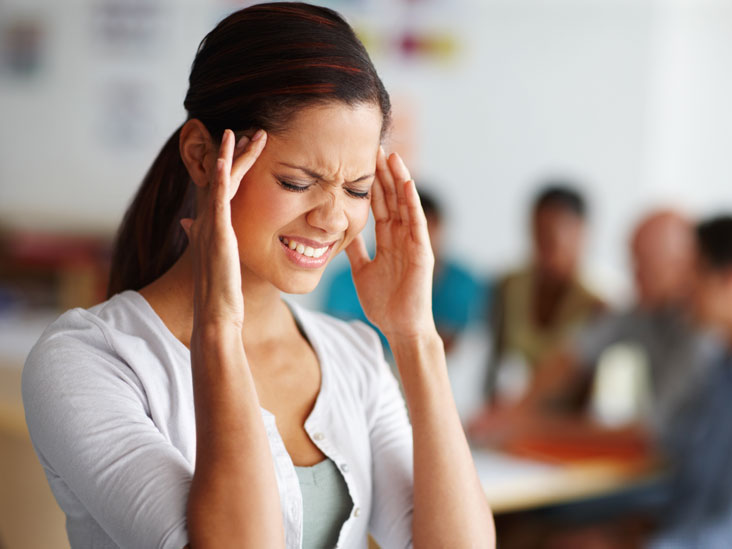
With migraines, throbbing pain is usually felt on one side of the head, but it can also be bilateral. The pain is usually mild, but it often becomes severe and leads to temporary disability. The headache can be aggravated by physical activity, bright lights, and certain odors. This increased sensitivity causes many people to retire in a dark, quiet room, lie down and, if possible, fall asleep. During sleep, migraines usually go away.
The headache is often accompanied by nausea, sometimes vomiting, and sensitivity to light, sounds, and / or smells.
Severe seizures can lead to temporary disability, disrupting daily routines and work.
Seizures vary widely in frequency and severity. Many patients experience several types of headaches, including mild attacks without nausea or sensitivity to light. These attacks may resemble tension headachebut they are a mild form of migraine.
Prodrom often seen before the onset of migraine. Prodrome is a sensation that warns that an attack is about to begin. These sensations may include mood changes, loss of appetite and nausea.
In about 25% of patients, before the onset of migraine, there is aura. Aura is a temporary, reversible disturbance in vision, sensitivity, balance, muscle coordination, or speech. People may see zigzag, flickering, or flashing lights, or blind spots with flickering edges. Less commonly, they have a tingling sensation, loss of balance, weakness in an arm or leg, or difficulty speaking. The aura lasts from a few minutes to one hour before the onset of the headache, and may also persist after the pain begins. Sometimes an aura appears, but only a mild headache develops or it does not occur at all. Such mild pains are similar to tension headaches.
Migraine attacks can last from several hours to several days (usually from 4 hours to several days). Severe seizures can lead to temporary disability, disrupting family life and work.
With age, migraines usually become less intense.
Do you know that…
- Sometimes migraines cause symptoms such as blurred vision or balance in the absence of a headache.
- Taking pain relievers too often can make migraines worse.
Diagnostics
Diagnostics include:
- examination by a doctor;
- sometimes computed or magnetic resonance imaging
Doctors diagnose migraines when symptoms are typical and physical examination results (including neurologic examination) show no abnormalities.
This diagnosis cannot be confirmed by any procedure. If headaches are recent or if there are certain warning signs, then to rule out other conditions often perform computed tomography (CT) or magnetic resonance imaging (MRI) of the head, and sometimes a spinal tap (lumbar puncture).
If people who already have migraines develop a headache similar to the previously experienced migraines, doctors rarely do tests. But if the nature of the headache is different, especially if there are warning signs, a doctor's examination is necessary and often tests are performed.
Treatment
Treatment includes:
- elimination of triggers;
- behavioral intervention;
- yoga;
- drugs that stop the progression of migraines;
- pain control drugs;
- drugs to prevent migraines.
Migraines cannot be cured, but they can be controlled.
Doctors recommend that patients keep a headache diary. This diary records the number and timing of seizures, possible triggers, and response to treatment. With this information available, triggers can be installed and, if possible, eliminated. Patients can then participate in their treatment by avoiding triggers, and doctors can better plan and adjust treatment.
Doctors also recommend behavioral interventions (eg, relaxation, biofeedback) to control migraine attacks. connection and stress relief), especially when the trigger is stress, or if patients are taking too many drugs to control migraine headaches.
The intensity and frequency of migraines can be reduced by practicing yoga. Yoga combines physical postures that strengthen and stretch muscles with deep breathing, meditation, and relaxation.
Medications
Some drugs stop (interrupt) a migraine attack after it starts or prevents it from developing. Some are taken for pain control. Others are taken to prevent migraines.
When migraines appear or increase in severity, medications are used to stop (interrupt) the migraine attack. Such drugs are taken at the slightest sign of the onset of migraine. These include:
- Triptans (5-hydroxytryptamine [5-HT] or serotonin agonists) are used mostly. Triptans interfere with the release of substances that trigger migraines from the nerves. Triptans are most effective when taken early in a migraine. They can be taken orally or used as a nasal aerosol, or injected subcutaneously (subcutaneously).
- Dihydroergotamine administered intravenously, subcutaneously and by nasal aerosol to control severe, persistent migraines. It is usually given in combination with a drug to relieve nausea (an antiemetic drug) such as intravenous prochlorperazine.
- To relieve mild to moderate migraine attacks, you can use certain antiemetic drugs (for example, prochlorperazine). In case of intolerance to triptans or dihydroergotamine, prochlorperazine is prescribed for oral administration or in the form of suppositories to stop migraines.
Because triptans and dihydroergotamine can cause constriction (spasm) of blood vessels, these drugs are not recommended if angina pectoris, coronary heart disease or uncontrolled high blood pressure. When taking such drugs in the elderly or in the presence of risk factors for coronary heart disease, careful monitoring of patients is necessary.
If the migraine is usually accompanied by nausea, an antiemetic combined with a triptan is recommended when symptoms occur. Antiemetic drugs (such as prochlorperazine or metoclopramide) used alone can stop mild to moderate migraines from developing.
For severe migraines, intravenous fluids can relieve headaches and improve well-being, especially if patients are dehydrated after vomiting.
For mild to moderate migraine attacks, pain relievers (analgesics) can help control pain. Often prescribed non-steroidal anti-inflammatory drugs (NSAIDs) or acetaminophen. Analgesics can be taken as needed during a migraine with or instead of triptan. For rare mild migraines, analgesics containing caffeine, an opioid, or butalbital (barbiturate) may help. However, overuse of analgesics, caffeine (in analgesic medications or in caffeinated drinks), or triptans can lead to daily, more severe migraines. These headaches, called drug abuse headaches, occur when drugs are taken more often than 2-3 days per week.
Skipping or lowering a migraine drug or taking a drug late can trigger or worsen migraines.
If other treatments do not work for people with severe migraines, opioid analgesics may be required in extreme cases.
Prophylaxis
If treatment does not prevent frequent or disabling migraines, taking daily medications to prevent migraine attacks may help. Taking preventive medications can help people who take pain relievers too often medicines or other medicines for migraine to reduce the frequency of use of such drugs.
When choosing a prophylactic drug, the side effects of the drug, as well as the presence of other diseases, are taken into account, for example, as described below:
- Beta blockers such as propranolol are often used, especially in people with anxiety or ischemic heart disease.
- If you are overweight, an anticonvulsant drug, topiramate, may be taken to promote weight loss.
- An anticonvulsant such as divalproex can help stabilize mood and improve the condition if migraine attacks make it difficult to function.
- Patients with depression or insomnia may be given amitriptyline.