Gastroschisis: what is it, causes, symptoms, treatment, prognosis
Content
- What is gastroschisis?
- Signs and symptoms
- Causes and risk factors
- Affected populations
- Symptomatic disorders
- Diagnostics
- Standard treatments
- Forecast
What is gastroschisis?
GastroschisisIs a rare birth defect in which the intestines protrude through the right side of the umbilical ring with the umbilical cord intact on the left side. Gastroschisis can be detected by routine prenatal ultrasound during the mother's pregnancy, usually between 18 and 20 weeks of gestation. Although the exact cause of the pathology is unknown, the most likely explanation is that gastroschisis follows multifactorial inheritance, so that multiple genes and environmental factors acting together cause anomaly. Treatment is surgery that slowly returns the intestines to the abdomen.
The name gastroschisis comes from two words. From gastro, stomach, belly and shisis, cleavage. You might think that gastroschisis involves splitting the stomach, but in fact it is not the stomach that splits, but rather the amnio-ectodermal junction at the right edge of the umbilical ring.
Signs and symptoms
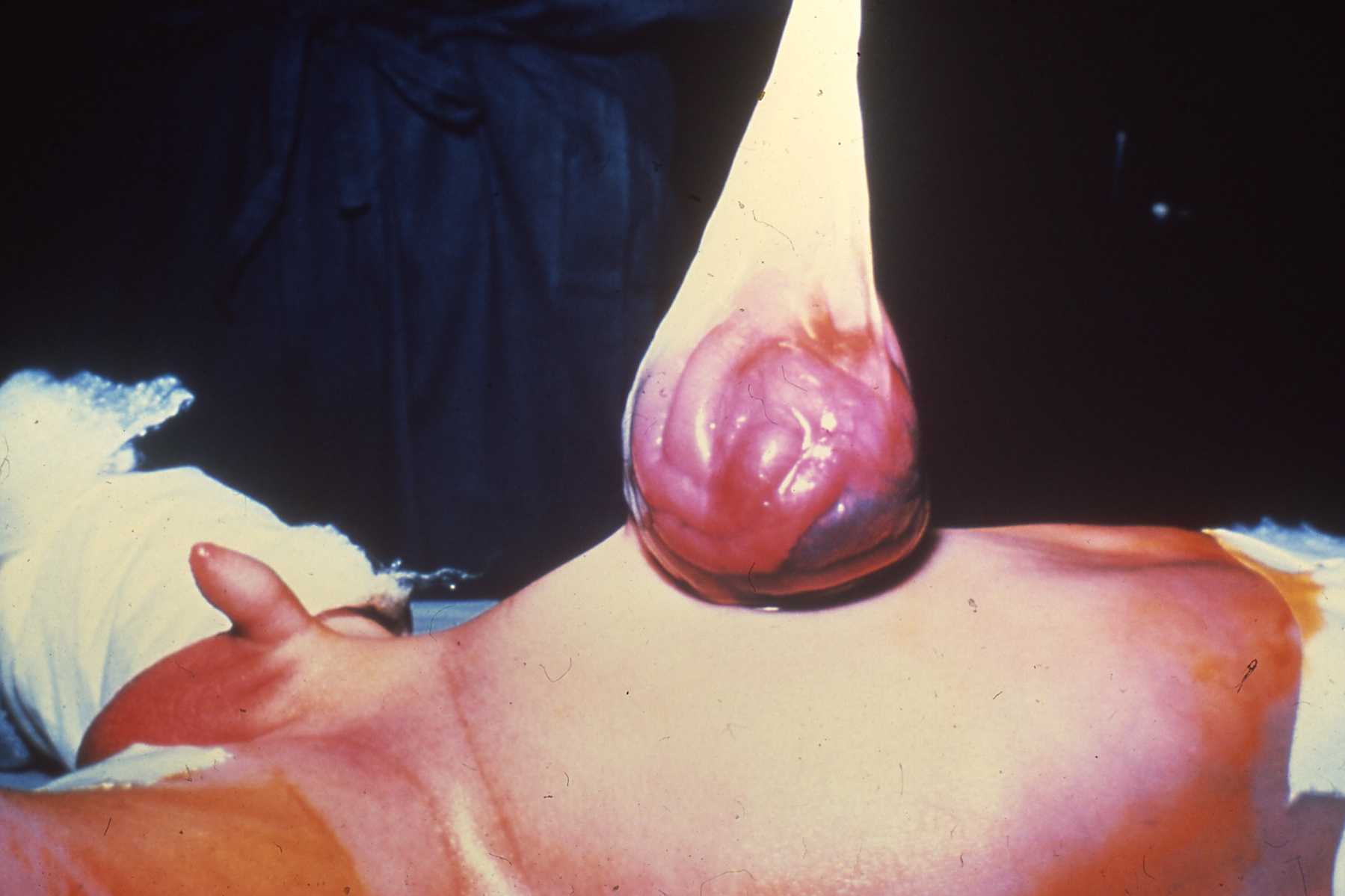
Gastroschisis appears at birth and can also be detected prenatally with ultrasound. Babies with this condition have a 2–5 cm opening inside the umbilical ring, in which abdominal organs appear on the outer surface of the abdomen. The abdominal cavity is smaller than normal, and the elongated intestine and other organs do not have a membrane sac covering it. This hole is usually on the right, next to the umbilical cord (belly button) attached to the left side. The stomach, small intestine, and large intestine are the most common organs that extend outside the abdomen.
The intestines may look swollen, inflamed, thickened, short, and covered with thick fibrous skin due to exposure to the fluid that surrounds the fetus during pregnancy (amniotic liquid). Twisting (improper rotation) of the bowel is present, and the exposed bowel is at risk of obstruction, leading to destruction and disruption of blood supply due to the small size of the defect.
In most children, bowel function is delayed due to malabsorption and lack of movement (hypomobility). Also, in 10% of children with gastroschisis, the intestines are absent or closed and there are other pathologies of the gastrointestinal tract.
Other medical problems associated with this disorder:
- infection;
- dehydration of the body;
- dangerously low body temperature (hypothermia).
Some babies with gastroschisis may have other health problems, such as a shortened bowel, slow growth before childbirth, prematurity, or heart defects.
Causes and risk factors
The exact mechanism of gastroschisis is unknown, but several theories have been proposed.
More recently, it has been suggested that gastroschisis is a defect in the midline of the primary umbilical ring, based on findings in the human embryo and newborns. As early as 35 days after conception, after the fusion of the two stems of the body, the amnio-ectodermal junction is either absent on the right side, or later separates, allowing the intestines and other organs to protrude. This hypothesis is based on a detailed clinical assessment of human fetuses in addition to our current understanding of amniote evolution and developmental biology.
Several families have been reported in which gastroschisis has occurred in siblings or distantly related children across generations. Various studies show that in some families gastroschisis can follow an autosomal recessive or dominant mode of inheritance.
Recessive genetic disorders occur when a person inherits an abnormal gene from each parent. If a person receives one normal gene and one abnormal gene for the disease, the person will be an asymptomatic carrier of the disease. The risk that two carrier parents will both pass on the abnormal gene and therefore conceive a sick child is 25% with each pregnancy. The risk of having a child who will be a carrier, like the parents, is 50% with each pregnancy. The probability for a child to receive normal genes from both parents is 25%. The risk is the same for men and women.
Dominant genetic disorders occur when only one copy of a non-working gene is needed to cause a specific disease. A broken gene can be inherited from either parent, or it can be the result of a gene mutation (change) in the affected person. The risk of passing a non-working gene from an affected parent to offspring is 50% with every pregnancy. The risk is the same for men and women.
Chromosomal or genetic abnormalities have not been consistently reported as the cause of gastroschisis. The most likely explanation is that isolated gastroschisis follows multifactorial inheritance, so that multiple genes or genetic susceptibility combined with an environmental factor act together to cause anomaly. Maternal age is the two most persistent risk factors for gastroschisis. (highest risk in the youngest group of women under the age of 20) and maternal exposure to smoking cigarettes. In addition, five studies reported that urinary tract infections the mother increases the risk of gastroschisis.
Changes (mutations) in several genes (ICAM1, NOS3 and NPPA). These results are considered preliminary and more research is needed to determine if these mutations can cause gastroschisis.
Affected populations
Estimated as of 2015 this disease will affect 2 to 5 cases per 10,000 newborns. The Centers for Disease Control and Prevention (CDC) estimates that approximately 1,871 babies with gastroschisis are born in the States each year.
Symptomatic disorders
The clinical manifestations of the following disorders may be similar to those of gastroschisis. Comparisons can be useful for differential diagnosis:
Omphalocele (hernia of the umbilical cord, umbilical hernia, embryonic hernia) is a protrusion of the internal organs of the abdominal cavity due to a defect in the umbilical ring. The protrusion may be very small, with several bowel loops protruding, or it may contain the entire intestine, liver, and stomach. Unlike gastroschisis, the protruding organs are covered with a membranous sac. It has been suggested that omphalocele and gastroschisis may be the same disease, but omphalocele may rupture during fetal growth, thus engulfing the membrane sac. This theory has not been proven to date.
Diagnostics
Gastroschisis can be diagnosed with prenatal ultrasound screening or at birth. It differs from omphalocele in the presence of free floating abdominal organs in the amniotic cavity without a membrane covering. Organs appearing on the outer surface of the abdomen after childbirth confirm the diagnosis.
Standard treatments
Pregnant women who have been diagnosed with gastroschisis should be taken to a tertiary care center where neonatal and pediatric surgical care is available.
Surgery is necessary to close the abdominal defect and slowly return the intestines to the abdominal cavity. After all the organs have been returned to the abdomen, the opening is closed. Before and after surgery, babies are fed through an IV and slowly introduced into a normal diet (total parenteral nutrition). This allows the infant to receive adequate nutrition as it takes time for bowel function to normalize.
Forecast
Children with gastroschisis are usually smaller than average. After birth, it may take a while for them to catch up. Long-term problems most often arise in very difficult cases. It could be due to nutritional problems, gut problems, or an infection.
Infants with gastroschisis can have very different experiences depending on the severity of each case. They must first recover from their initial surgical treatment, start eating well, and their intestines should heal. After that, most children with gastroschisis can live normal, healthy lives without the complications associated with the condition.