Hirschsprung's disease: what is it, causes, symptoms, treatment, prognosis
Content
- What is Hirschsprung's disease?
- Signs and symptoms
- Causes
- Affected populations
- Symptomatic disorders
- Diagnostics
- Standard treatments
- Forecast
What is Hirschsprung's disease?
Hirschsprung's disease (congenital megacolon, agangliosis) Is a congenital disease characterized by the absence of certain nerve cells (ganglia) in a segment of the intestine of a newborn. The absence of ganglion cells causes the intestinal muscles to lose their ability to move stool through the intestines (peristalsis). Peristalsis is a healthy process in the body. Peristalsis creates wave-like contractions in the muscles lining the intestines. These cuts propel stool and other waste products through the digestive system. Ineffective peristalsis causes the stool to remain in the intestines. The affected person may develop constipation and partial or complete intestinal obstruction. Pain and discomfort may occur. If left untreated, a potentially serious bacterial infection can develop. Specific symptoms can vary from one person to the next. Agangliosis can occur as an isolated problem or as part of a serious illness that affects multiple organ systems.
Signs and symptoms
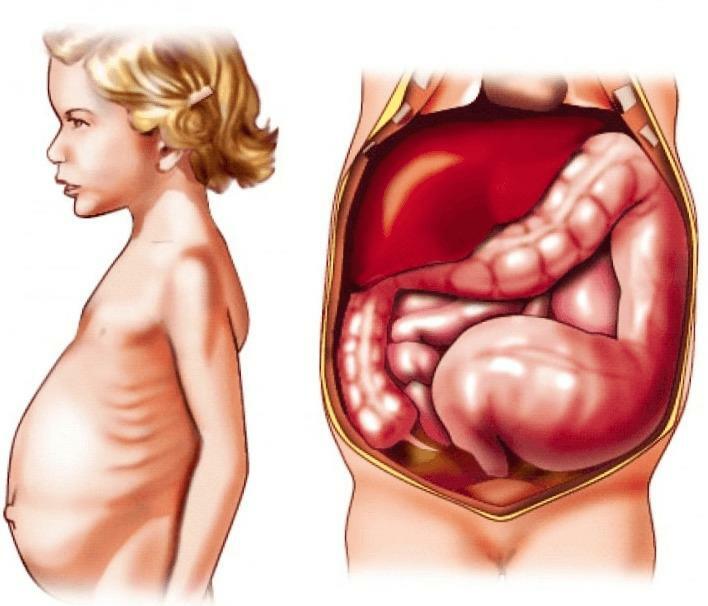
Symptoms during the neonatal period include an inability to pass meconium shortly after birth. Meconium is a dark, sticky substance that is usually present in the intestines at birth and appears as a baby's first bowel movement after birth. Failure to skip the first stool within 24 to 48 hours suggests a child's Hirschsprung disease.
Children with the disease very often have bloating, abdominal pain and vomiting. Victims children have constipation and often exhibit poor weight gain and slow growth.
Hirschsprung's disease can sometimes lead to a condition called enterocolitis, which is inflammation of the small intestine and colon. The condition is often referred to as Hirschsprung-associated enterocolitis. Enterocolitis is the most common complication of the disorder, affecting 30-40% of people with Hirschsprung's disease, and can be mild or severe in nature. Hirschsprung-associated enterocolitis is often accompanied by fever, explosive diarrhea, bloating, lethargy, and vomiting. Some people with severe or untreated Hirschsprung's enterocolitis may develop sepsiswhich is a widespread bacterial infection of the bloodstream and is potentially life-threatening. Severe or untreated enterocolitis can also lead to toxic megacolon, another life-threatening complication.
Approximately 90% of initial diagnoses are made during the first year of life. Most of the remaining 10% are placed in early childhood, and less than 1% during adolescence or adulthood. Not surprisingly, these people often report life-long constipation.
Causes
Hirschsprung's disease, which occurs as an isolated disorder, is associated with mutations in several different genes. Approximately 50% of affected people have one of these genetic abnormalities. These genetic changes cause people to become susceptible or predisposed to developing the disease. A person genetically predisposed to the disorder carries the gene (or genes) for the disorder, but it can only be expressed if provoked or “activated” under certain circumstances, for example, due to certain environmental factors (multifactorial inheritance).
The inheritance of these gene changes can be dominant or recessive depending on the gene involved, but it is likely that many abnormal genes are needed for disorders. Abnormal genes associated with a disease can cause different symptoms in members of the same family. If a parent has a child with a disorder, the likelihood of having another child with the disorder increases.
The genes associated with the disease are found in two main groups called genes RET and EDNRB. When the disorder affects a short segment of the colon, the major gene involved is RETlocated on chromosome 10q11.2.
When the disease occurs along with other abnormalities, the cause is often a chromosome abnormality or genetic syndrome. People with Down syndrome are at greater risk of developing Hirschsprung's disease than people in the general population. Genetic syndromes that may be associated with agangliosis include:
- Wilson-Mikiti syndrome;
- Waardenburg syndrome;
- Bardet-Biedl syndrome;
- hypoplasia syndrome of the development of cartilage and hair;
- congenital central hypoventilation syndrome;
- Frins syndrome;
- type 2 multiple endocrine neoplasia syndromes;
- Smith-Lemli-Opitz syndrome;
- L1 syndrome;
- Pitt-Hopkins syndrome.
The signs and symptoms of Hirschsprung's disease arise from the inability of certain nerve cells, called ganglia, to develop in part of the infant's colon. The disorder is sometimes referred to as neurocristopathy, which means the disorder is the result of abnormalities in cells and tissues arising in the neural crest. A neural crest is a temporary group of cells found in a developing embryo. The neural crest provides different types of cells to the body. In Hirschsprung disease, ganglia do not develop properly from the neural crest. Since there are no ganglia in the intestines, stool cannot pass through the intestines and leave the body through peristalsis.
The length of the patient's intestines may vary. In about 80% of affected children, the colon, commonly called the colon and rectum, is affected. The rectum is the last part of the large intestine and connects the anus to the sigmoid colon. Babies with no ganglion cells in the rectum and sigmoid colon are said to have "short-segment" Hirschsprung's disease. While approximately 12% of children have a lack of ganglion cells in most of the colon, and their condition is called "Long-segment", and about 7% lack ganglion cells in the entire colon and, possibly, in part of the small intestine, they are called total intestinal agangliosis.
Affected populations
Hirschsprung's disease affects men 3-4 times more often than women, although the sex ratio for long-segment agangliosis is 1: 1. The disease occurs in about one in 5,000 live births. The disease usually begins soon after birth, but can be present in older children and adults. Hirschsprung's disease is considered in people with a history of severe constipation.
Symptomatic disorders
Symptoms of the following disorders may be similar to those of Hirschsprung's disease. Comparisons can be useful for differential diagnosis:
- Chronic intestinal pseudo-obstruction (CKD) is a rare, potentially disabling gastrointestinal disorder characterized by abnormalities that affect involuntary, coordinated muscle contractions (a process called peristalsis) of the gastrointestinal tract (Gastrointestinal tract). Peristalsis propels food and other substances through the digestive system under the control of nerves, pacemaker cells, and hormones. CCP usually results from disorders affecting the muscles or nerves involved in peristalsis. Consequently, peristalsis changes and stops working effectively. The symptoms of CKP are similar to those caused by mechanical obstruction of the small intestine. Mechanical obstruction refers to anything (such as a tumor, scar tissue, etc.) that physically blocks the passage of food and other material through the gastrointestinal tract. People with CKP do not have this physical obstruction, hence the term pseudo-obstruction. Common symptoms include nausea, vomiting, abdominal pain, bloating, and constipation. Ultimately, normal nutritional needs cannot be met, resulting in unintended weight loss and wasting. CCP can potentially cause serious, even life-threatening complications.
During the neonatal period, some other conditions may have signs or symptoms similar to those seen in Hirschsprung's disease. These conditions include narrowing (atresia) of the colon, causing intestinal blockage; a temporary condition called meconium plug syndrome; meconium intestinal obstruction - a condition often found in cystic fibrosisin which the meconium in the baby's intestines is unusually thick and sticky, causing a blockage in the intestines; ileal atresia. Sometimes necrotizing enterocolitis can cause symptoms similar to agangliosis.
Diagnostics
A diagnosis of agangliosis can be suspected based on physical examination, complete medical history of the patient and family, identification of characteristic symptoms, and various specialized tests. Most people (85-90%) are diagnosed in early childhood. The first symptom is usually an inability to pass the meconium. Rectal aspiration biopsy is the preferred diagnostic tool for Hirschsprung disease. A biopsy involves surgically removing a small sample of the affected tissue and examining it under a microscope. The absence of ganglion cells confirms the diagnosis.
Additional tests that can be used include abdominal x-rays, which can reveal the presence of an intestinal blockage, anorectal manometry, which includes the use of balloons and pressure sensors to assess the condition and function of the rectum, as well as a contrast or barium enema, including the use of a contrast medium in the rectum intestine. A contrast agent is a substance that is used to improve the appearance of a structure or body part on an X-ray. After using a contrast enema, an X-ray is taken in the rectum to assess the health and function of the colon.
When other abnormalities are present in addition to agangliosis, it is possible that the disorder is due to a chromosomal abnormality or genetic syndrome. People with multiple abnormalities should be screened by a geneticist to try to establish an underlying diagnosis.
Standard treatments
In almost all cases, the treatment of Hirschsprung's disease requires surgery to remove part of the thick bowel and / or rectum, which lacks normal nerve development, and to connect two healthy ends together. There are three standard surgical procedures designed to correct this disorder. The choice of procedure depends on the training and experience of the surgeon. Each procedure removes the affected portion and reattaches the healthy portion of the intestine to the rectum, completing the so-called "pulling" procedure. Currently, most procedures are performed in one step.
If the baby was born prematurely, is of low birth weight, or is seriously ill, the surgeon may advise the parents on a multi-step strategy. The first step is to create a temporary colostomy, in which the healthy terminal intestine, located above the affected intestine, is brought to the surface of the abdomen, creating a stoma. Through this opening, or "stoma," the contents of the intestine are discharged into a special bag and removed. After a while, a second stage “pulling” procedure is performed, when the stoma can be closed. Most children with the disorder do not need a colostomy or ileostomy.
According to the medical literature, most children experience better quality of life after successful surgery. Some children may need bowel treatment after surgery. In rare cases, some children may need a second "through" operation.
Forecast
Long-term results reported after definitive treatment for Hirschsprung's disease are controversial. Some researchers report high levels of satisfaction, while others report significant incidences of constipation and incontinence. Overall, more than 90% of patients with the disease report satisfactory results; however, many patients experience bowel dysfunction for several years before normal abstinence is established. Approximately 1% of patients with the disorder have debilitating incontinence requiring a permanent colostomy.
Total aganglionosis of the colon is associated with a worse prognosis: 33% of patients have permanent incontinence, and 14% require permanent ileostomy. Patients with associated chromosomal abnormalities and syndromes also have a poor prognosis.
Hirschsprung's disease is limited to the rectosigmoidal region in about 75% of cases. Approximately 60% of children with the disease have comorbidities, ranging from mild to severe. Ophthalmic problems affect 43% of children, 20% have congenital anomalies of the genitourinary system, 5% have congenital heart defects, 5% have hearing impairments and 2% have central nervous system abnormalities.