Lichen sclerosus: what is it, symptoms, treatment, prognosis
Content
- What is lichen sclerosus?
- Signs and symptoms
- Causes and risk factors
- Affected populations
- Symptomatic disorders
- Diagnostics
- Standard treatments
- Forecast
What is lichen sclerosus?
Lichen sclerosus Is a chronic inflammatory skin disease that most commonly affects women before puberty or after menopause. Although rare, the disease can also be found in men. When found in men, the disease is called obliterating xerotic balanitis.
Lichen sclerosus is characterized by skin changes in the external genitalia. The most common site is the vulva and perianal area. The head of the penis and other parts of the body can also be affected. In fact, this condition can affect any surface of the skin. Some patients with lichen sclerosus have no symptoms, while others have severe itching, discomfort, and / or erosion / ulceration. The disease usually has a recurrent course, which is complicated by permanent scarring of the affected areas. This leads to functional problems such as difficulty urinating, defecation and intercourse in affected women and difficulty urinating or erections in men. The disease is not contagious and is not sexually transmitted.
Modern research confirms that the disease is caused by a combination of dysfunction of the immunological system and genetic factors. The understanding of the causes of this disorder is still incomplete. The mainstay of treatment is the use of strong topical (topical) steroids in women with genital involvement. Studies have shown that regular use of strong topical steroids in women prevents scarring and reduces the risk of skin cancer in the lichen area. Topical steroids are also used to treat other areas affected by lichen sclerosus. Pelvic floor therapy, surgery to remove scarring (for example, male circumcision) and in some cases oral immunosuppressants.
Signs and symptoms
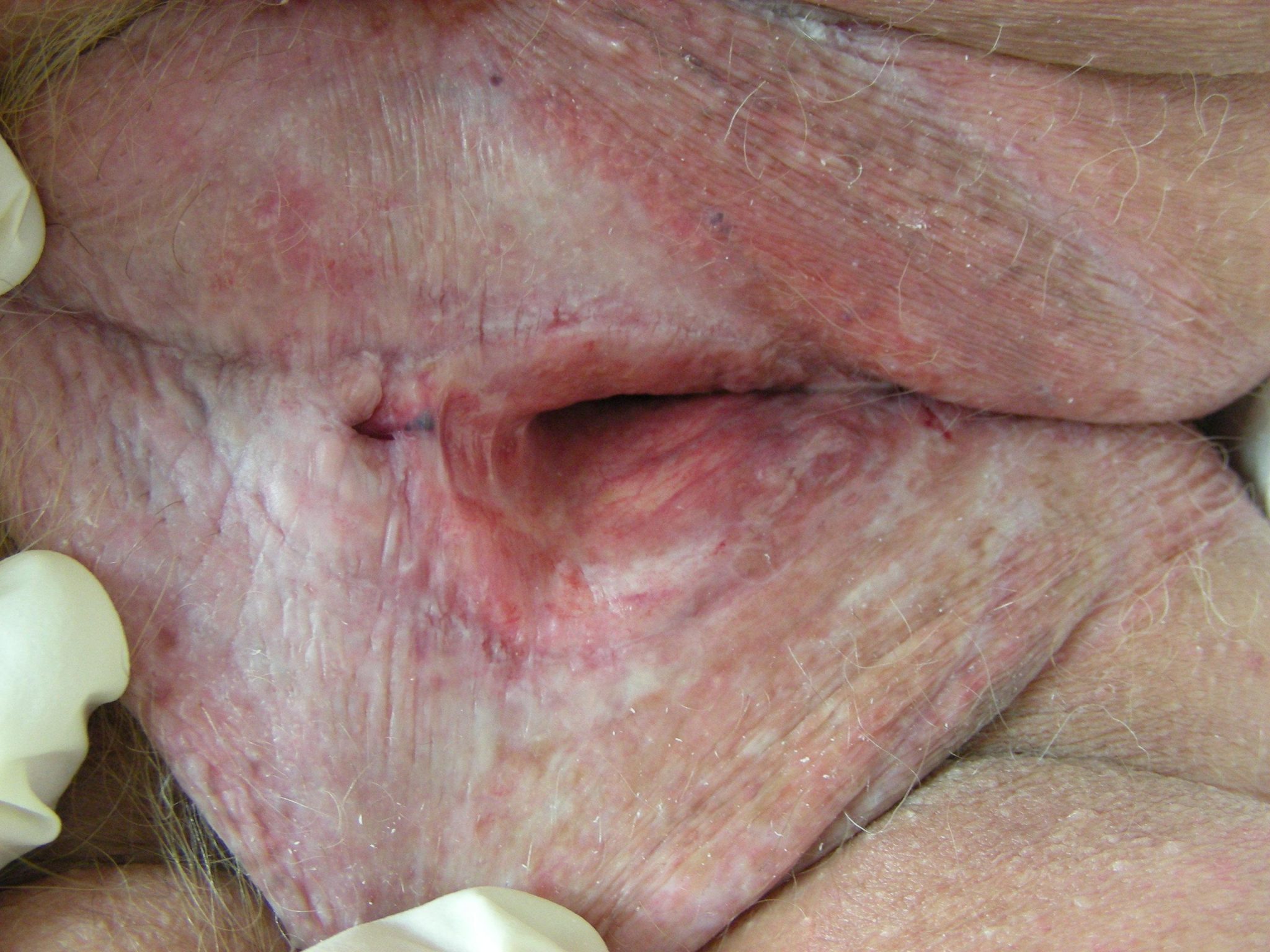
Lichen sclerosus usually affects the external genitalia (vulva or penis) and / or the area around the anus (perianal area). Sometimes the lesion is accompanied by severe (irresistible) itching, burning, and pain. If the disease is severe, even minor abrasions or irritations can cause bleeding, rupture, and blistering. Scars resulting from lichen sclerosus treatment cause problems with urination, bowel movements and intercourse. Having thin, easily irritated and torn skin affects physical activity and clothing choices.
In children with a disorder affecting the perianal region, constipation may be one of the first signs of the disease. Lichen sclerosus is much more likely to affect men who have not been circumcised than men who have been.
In rare cases, the disorder can also affect other areas of the skin, such as the chest, wrists, shoulder, neck, back, hip, and mouth.
Skin tissue often becomes thin, shiny, wrinkled, and parchment-like. Cracks and purple spots (ecchymosis) often appear.

The earliest areas of lichen sclerosus have a white center surrounded by redness. photo above). As a result, larger areas of lichen sclerosus are formed. Blisters or bruises may appear in areas subject to rubbing. Long-term signs are areas of shiny, thin skin that tend to be dry, cracked, or bleed. The disease also results in loss of normal genitalia, narrowing of the opening of the urethra / vagina / anus, and phimosis (inability to remove the foreskin) in men. The presence of non-healing ulcers or raised ulcerated areas on the external genital organs of women raises suspicion of the development of squamous cell carcinoma.
In men, the disease most often affects the foreskin of the penis, although it can also affect other parts of the body. The opening at the end of the foreskin may become narrow and scarred. Skin discoloration and changes may also occur. Symptoms also include itching, pain, irritation, and painful erections. In men, perineal involvement is rare.
In some rare cases, skin lesions can also develop in the mouth. Lesions consist of bluish-white, flat, irregular, patchy areas on the inside of the cheeks and / or palate. The tongue, lips, and gums may also be involved.
Causes and risk factors
The exact cause of lichen sclerosus is unknown. Most studies state that it is autoimmune disease. Autoimmune disorders occur when the body's natural defenses against "foreign" or invading organisms (such as antibodies) begin to attack healthy tissue for unknown reasons. In some cases, lichen sclerosus can be associated with the formation of certain antibodies (for example, a protein thyroid gland (thyroglobulin) or certain cells that line the walls of the organs).
Some scientists believe there is a genetic predisposition to the disorder. Genetic predisposition means that a person can carry a gene for a disease, but it cannot be expressed unless something in the environment provokes the disease. Other researchers believe hormonal, irritant, and / or infectious factors (or a combination of these) cause this skin disease. Cases of lichen sclerosus appearing on the skin after injury and trauma have been reported.
Recent research suggests that the most likely cause of the disorder is an autoimmune reaction in genetically susceptible people.
Affected populations
Lichen sclerosus mainly affects women, usually between the ages of 40-60. Women are 6 times more likely to have the disease than men. Younger women and men are also discussed in the medical literature. It was also reported about the disease in girls under the age of 30.
Symptomatic disorders
Symptoms of the following disorders may be similar to those of lichen sclerosus. Comparisons can be useful for differential diagnosis:
- Localized scleroderma occurs in adults and children. Recent studies show that up to 20% of people with localized scleroderma, especially women in postmenopausal, may have changes resembling lichen sclerosus in the genital area. In addition, localized scleroderma can coexist with lichen sclerosus on the body. For this reason, people with shingles should have their skin examined for signs sclerodermaand for persons with scleroderma, lichen sclerosus.
- Lichen planus Is a rare condition associated with recurrent, itchy, inflammatory skin rashes. These are usually small, individual, angular spots that can coalesce into coarse scaly spots. Lichen planus often accompanies mouth damage. Women most often suffer from the disorder.
- Vulvar cancer is a malignant disease characterized by abnormal cancerous changes in the skin of the vulva. The changes may resemble those in severe lichen sclerosus.
- Hyperplastic dystrophy of the vulva is a skin reaction to trauma and is usually accompanied by itching. The disorder can be caused by eating foods with a high acid content or contact with chemicals, such as detergent, soap, hygiene sprays, dyes in toilet paper or other various substances that come into contact with skin. Certain fabrics or unusually tight clothing can also cause this condition. In some cases, there may not be an obvious reason. A corticosteroid cream often relieves skin symptoms. The drug can be used as a long-term maintenance treatment in patients experiencing recurrent symptoms.
- Lichen simplex chronicus is a disorder of the skin around the vulva that causes chronic irritation. It is characterized by the appearance of thick patches on the skin that are usually red and itchy.
- Endogenous and exogenous dermatitis Is an inflammatory skin disease. The disease manifests itself as an itchy red rash. More advanced forms of the condition can cause skin thickening and cracking. For differentiation dermatitis for early lichen sclerosus, a biopsy may be required.
- Vitiligomay resemble lichen sclerosus, which has few symptoms. The disease causes bilateral symmetrical discoloration of the skin. Sometimes vitiligo and lichen sclerosus can be present in the same person.
Skin disorders that may look like lichen sclerosus in areas of the body other than the genitals include shingles (fungal infection), anetoderma, cutaneous T-cell lymphoma, chronic graft versus host disease (in patients who have received organ or cell transplants) and squamous cell carcinoma.
Diagnostics
Lichen sclerosus is diagnosed by looking at the affected skin. All victims require careful clinical evaluation, identification of physical characteristics and a detailed history of the patient. A skin biopsy may be required to be sure of the diagnosis. A biopsy may also be performed if squamous cell carcinoma is suspected.
Standard treatments
Lichen sclerosus requires aggressive treatment and monitoring throughout life to prevent scarring and minimize the risk of squamous cell carcinoma. Treatment consists of using some type of ultrapotent corticosteroid that is available by prescription and should be used as an ointment (creams are not recommended). Ultrapotent corticosteroids available in Russia include:
- betamethasone dipropionate;
- clobetasol propionate.
These drugs can stop itching in a matter of days or weeks. Within a few months of regular use, they can allow the skin to regain its strength and texture, but the drugs cannot affect the scarring or discoloration of the skin that may already arise. Current recommendations - use steroid ointment twice a day for several weeks until remission, and then switch to a long-term care regimen using steroid ointment several times a week. Patients' doctors should give them detailed instructions on where to apply the ointment and how to apply it. Often, photographs of diseased areas are taken to track improvements and changes. It is very important that women are followed up throughout their lives by a physician to continuously monitor treatment and follow-up for squamous cell carcinoma.
Treatment for men is not well understood. For those who are not circumcised, circumcision can help. Otherwise, strong steroid ointments are also recommended. The same applies to extragenital lesions. The association with squamous cell carcinoma has not been identified in men, so long-term treatment is recommended. surveillance, mainly to maintain control of the disease, and the risk of cancer in men very low.
Second-line treatments include topical tacrolimus or pimecrolimus, phototherapy, and systemic (oral) immunosuppressants. In very severe cases, surgical removal of the affected skin layers may be beneficial. For men, circumcision (if the foreskin is involved) can help. This is usually necessary for patients who have scars that cause functional impairment.
Forecast
The prognosis is good for more acute genital cases of the disorder, especially for children in the age group, in whom it may resolve spontaneously. The prognosis is worse in extragenital cases and chronic atrophic diseases of the genital organs.
Many childhood cases improve with puberty. In contrast, some authors suggest that the spontaneous resolution rate may be below 25%.
Lichen sclerosus is not associated with increased mortality unless the patient develops a malignant tumor in the affected area. Cancer that occurs with extragenital manifestations is described only in rare cases and may be accompanied by other factors.
Extragenital cases and many genital cases are asymptomatic, except for the cosmetic aspect or itching. Recurrent cases, especially those associated with erosion or progressive scarring, can lead to severe sexual dysfunction.
With diseases of the genital organs, there may be an increased risk of developing squamous cell carcinoma, but an exact increase in the risk and the fact that which cofactors (human papillomavirus infection or prior radiation therapy) may be involved while not yet fully studied. In patients treated for vulvar cancer, the presence or absence of lichen sclerosus does not appear to affect the timing of relapse.