Maffucci syndrome: what is it, causes, symptoms, treatment, prognosis
Content
- What is Maffucci Syndrome?
- Signs and symptoms
- Causes
- Affected populations
- Symptomatic disorders
- Diagnostics
- Standard treatments
- Forecast
What is Maffucci Syndrome?
Maffucci Syndrome Is an extremely rare disease characterized by benign growths of cartilage (enchondromas), skeletal deformities and skin lesions consisting of abnormal blood vessels. Enchondromas occur in bones, most often in the hands and feet, and less commonly in the legs and long bones of the arms.
Signs and symptoms
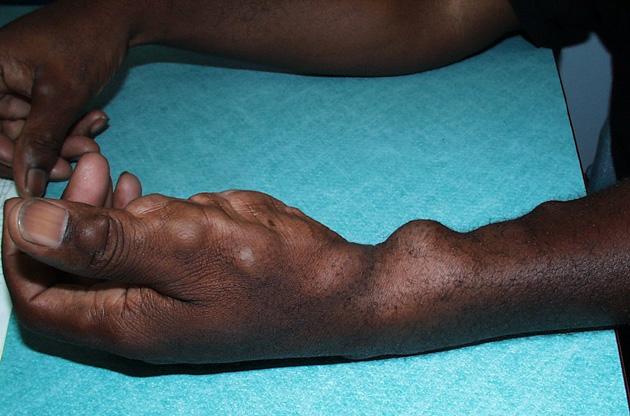
Maffucci syndrome is not recognized at birth. Lesions usually develop in early childhood, most commonly between the ages of 1 and 5 years. The severity of the disorder is variable. Some patients have a very benign course, while others develop serious complications.
The first sign of Maffucci syndrome is usually the presence of an enchondroma in the long bone (see Fig. Photo). Enchondromas distort and weaken the affected bones, so an initial presentation with a pathologic fracture is common. These cartilaginous tumors cause bone bulging, bending of the arms and legs, and often disproportionate (asymmetric) growth (different arm or leg lengths). The patient may be short in adulthood. Enchondromas affect only one side of the body in about 40 percent of patients.
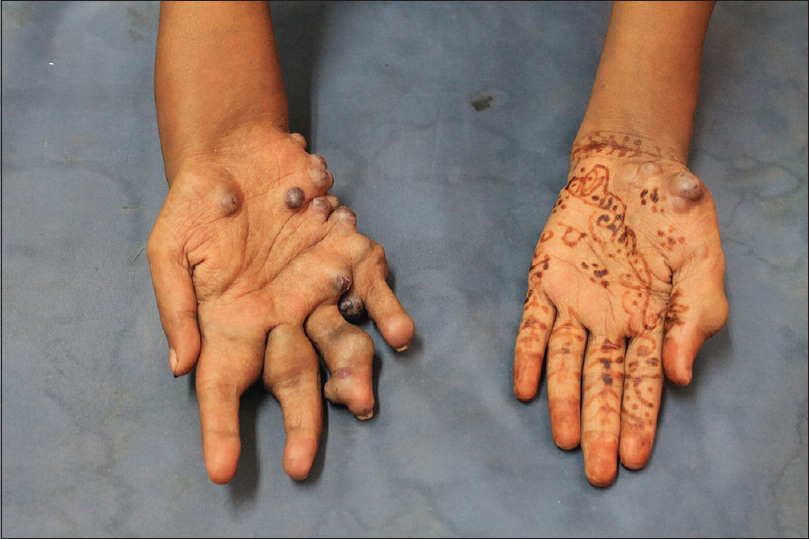
Vascular lesions on the skin also usually appear in early childhood (around 4-5 years of age) and often progress. These lesions do not necessarily occur near bones that have enchondromas. These vascular lesions begin as compressible, round, bluish patches. Over time, they become hard, nodular, warty, and often contain calcium stones (phlebolitis). The hand is the most common place; however, vascular lesions can also occur in internal structures such as the membranes that cover the brain and spinal cord (meninges), tongue, and oral mucosa.
These vascular lesions were formerly called "cavernous hemangiomas". Microscopic studies have shown that they consist of abnormally formed veins, so that the more modern term is "venous malformation". These ugly veins often contain a benign vascular tumor called "spindle cell hemangioma".
Patients with the syndrome are at risk of developing cancer, especially a cartilage tumor known as chondrosarcoma. The larger the enchondroma, the higher the risk of developing a malignant tumor. The frequency has been estimated to be between 15-40%; however, some researchers believe that chondrosarcoma in Maffucci syndrome is overestimated. Less commonly, other malignant, non-cellular neoplasms of the connective tissue can occur in patients with Maffucci syndrome.
Causes
In 2011, it was discovered that the cause of Maffucci syndrome is a change (mutation) in a gene known as IDH1 (rarely IDH2). The same mutations were found in concomitant Olyer's disease. Since the defect occurs after fertilization (the so-called somatic mutation), Maffucci syndrome is not considered hereditary, i.e. it cannot be passed on in the family. Cases of the disease occur by chance and there are no known pedigrees of the syndrome.
Affected populations
Maffucci syndrome occurs in all ethnic groups and affects both sexes equally.
Symptomatic disorders
The following disorders may appear similar to Maffucci syndrome; however, they can usually be differentiated by clinical research.
- Olier's disease Is a rare skeletal disease characterized by abnormal bone development and enchondromas in the absence of cutaneous vascular lesions that characterize Maffucci syndrome. Although Olier's disease is present at birth, it can only manifest in early childhood when skeletal deformities or abnormal growth of the limb occur. Olier's disease primarily affects the long bones and cartilage of the joints of the arms and legs, especially where the shaft and the head of the long bone (metaphysis) meet. The pelvis is also often affected, and less commonly the ribs, sternum (sternum), and skull. In this disease, enchondromas grow from cartilage in long bones in such a way that the outer layer (cortical bone) becomes thinner and more fragile. After puberty, these cartilaginous growths stabilize as the cartilage is replaced by bone. These enchondromas can undergo malignant degeneration, but much less frequently than with Maffucci syndrome. In many patients, somatic mutations are found in the isocitrate dehydrogenase gene, IDH1 or IDH2. The disorder is not inherited.
- Bladder nevus syndrome (SSFS) - bluish vascular lesions in Maffucci syndrome can be mistaken for SSFS, which characterized by multiple, mild, raised, blue, blue-black or purplish-red edema (venous malformations). Lesions occur in the skin and internal organs, especially in the gastrointestinal tract. They usually appear on the hands and soles of the feet, but can also occur anywhere on the body, including the face and trunk, and in liver, lungs, spleen, gallbladder, kidneys and skeletal muscles. These internal lesions can cause serious complications. Bleeding from the gastrointestinal tract usually leads to chronic anemiawhich may require a blood transfusion. It is known that the cause of the disease is a somatic mutation in the gene TIE 2 (TEK).
- Proteus syndromeIs an extremely rare condition that can easily be confused with Maffucci syndrome. It is characterized by cerebriform nevi of connective tissue ("moccasin feet"), epidermal nevi, lipomas and disproportionate, incessant and asymmetric growth of the skeleton. Patients with Proteus syndrome are generally normal at birth, with the exception of nevi. Patients can also have capillary and venous malformations. Enlarged veins put them at risk pulmonary embolismwhich can be fatal. The cause of the disease is a somatic activating mutation in the gene AKT1, arising in cells during the early embryonic period. The disease is not hereditary.
Diagnostics
The diagnosis of Maffucci syndrome is based on a detailed history, careful physical examination, and radiological evaluation. Surgical removal and microscopic examination of the skeletal injury (biopsy) confirms the presence of an enchondroma and distinguishes it from a chondrosarcoma.
Standard treatments
Treatment for Maffucci syndrome focuses on specific signs / symptoms in a specific affected person. No intervention is required for asymptomatic patients. Treatment requires the coordinated efforts of a team of specialists (interdisciplinary assistance). Verrucous (verrucous) vascular lesions can be injected with a drug that compresses and strengthens the area (sclerosing agent); however, prompt removal is often required. Enchondromas can be surgically removed (resected) if necessary. A specialist in hand surgery is required to correct skeletal abnormalities in the case of loss of function or re-fracture. The orthopedic surgeon solves the problem of leg length discrepancy, abnormal curvature of the spine (scoliosis) or other pathologies of the skeleton.
A patient with Maffucci syndrome should be monitored regularly due to the risk of malignant transformation of the enchondroma or the development of a tumor elsewhere. If cancer does not occur, patients with the syndrome have a normal life expectancy. Conservative treatment is recommended for patients with Ollier's disease. Surgery may be necessary for complications such as a pathological fracture, impaired growth, or malignant changes.
Forecast
Patients with Maffucci syndrome usually lead reasonably normal lives with a normal life expectancy, unless malignant transformation occurs.
Although skeletal malformations can sometimes be harmful, patients do fairly well in daily activities.
Lilia Khabibulina/ article author
Higher education (Cardiology). Cardiologist, therapist, functional diagnostics doctor. I am well versed in the diagnosis and treatment of diseases of the respiratory system, gastrointestinal tract and cardiovascular system. She graduated from the academy (full-time), she has a wide experience of work.
Specialty: Cardiologist, Therapist, Physician of functional diagnostics.
More about the Author.