Malignant hyperthermia: what is it, causes, symptoms, treatment, prognosis
Content
- What is malignant hyperthermia?
- Signs and symptoms
- Causes
- Affected populations
- Symptomatic disorders
- Diagnostics
- Standard treatments
- Forecast
What is malignant hyperthermia?
Malignant hyperthermia (MH) is an inherited skeletal muscle disorder that predisposes susceptible individuals to life-threatening adverse reactions (fulminant crisis MH) when exposed to potent volatile anesthetics (halothane, isoflurane, sevoflurane, desflurane, etc.) and skeletal muscle relaxant succinylcholine.
Anesthetic drugs trigger an uncontrolled release of calcium (Ca2 +) from the sarcoplasmic reticulum (SR) through the ryanodine receptor (RYR1), causing a rapid and sustained increase in the level of myoplasmic Ca2 +. High intracellular Ca2 + activates the Ca2 + pumps in the CP and the sarcolemma to recapture calcium in the CP or transport it to the extracellular space, respectively. The energy expenditure to restore cellular control of Ca2 + causes the need for ATP, which in turn produces heat. The integrity of the muscle membrane is impaired, which leads to hyperkalemia and rhabdomyolysis. Without immediate treatment, discontinuing the anesthetic and administering dantrolene, mortality can exceed 70%. In some people, a crisis of malignant hyperthermia in the absence of anesthetics can be triggered by stress, exercise and high ambient temperatures.
Signs and symptoms
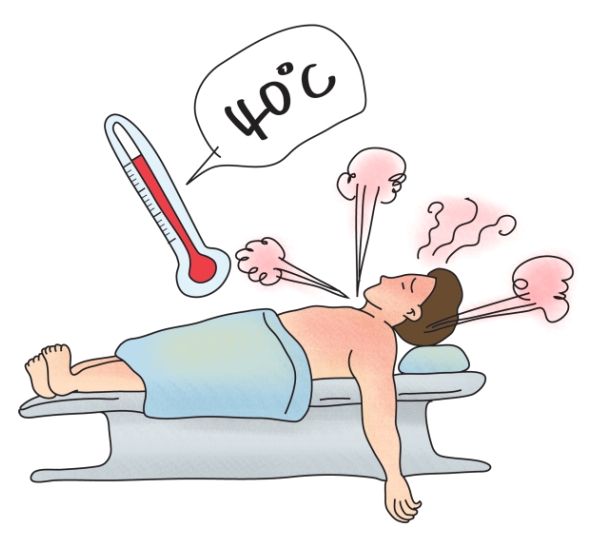
Malignant hyperthermia is characterized by hypermetabolism, which causes an accumulation of excess heat (hyperthermia), increased oxygen uptake and production of carbon dioxide, and hyperkalemia and acidosis with hyperlactemia. Skeletal muscle stiffness (stiffness) can be either localized in the masseter muscle or generalized. Muscle damage is reflected in increased serum creatine kinase, potassium, calcium and phosphate levels. Rhabdomyolysis with myoglobinuria and myoglobinemia are common. The time to onset after induction of general anesthesia can vary from minutes to hours, and patients may have previously been exposed to anesthetics without complications.
Causes
The crisis of malignant hyperthermia (MH) is inherited as an autosomal dominant trait with incomplete penetrance and variable expression. Dominant genetic disorders occur when only one copy of an abnormal gene is needed to cause a specific disorder. The abnormal gene can be inherited from either parent, or it can be the result of a new mutation (gene change) in the affected person. The risk of passing the abnormal gene from the affected parent to the offspring is 50% with every pregnancy. The risk is the same for men and women.
Molecular genetic studies in humans have identified the ryanodine receptor type 1 (RYR1) release channel gene on chromosome 19 (19q13.1) as the primary locus for MH. A number of studies conducted in different populations have reported that mutations in the RYR1 gene account for approximately 50% of MH cases, while 1% of MH cases were associated with the gene CACNA1Slocated on chromosome 1 (1q32) (encoding the a1 subunit of the voltage-regulated dihydropyridine receptor (DHPR)). Currently in the gene RYR1 more than 400 different variants of mutations have been identified (Leiden open variation database). Only 31 mutations have been functionally characterized and meet all the requirements for inclusion in the European MH study group (eng. European MH Group (EMHG)) causing malignant hyperthermia.
Affected populations
The incidence of MH during general anesthesia is estimated from 1/4200 (suspected MH) to 1/250000 (fulminant crisis of MH). Published reports likely underestimate the true incidence due to the difficulty in identifying moderate cases of MH. In the last decade, two independent studies have estimated the incidence of RYR1 variants in the general population from 1 in 2000 to 1 in 3000 people. More recent exomal studies suggest that the frequency of RYR1 variants may be higher.
Demographic data on the age and sex distribution of patients referred for the survey indicate that 68% of them are men and 32% are women. Acute MH is common worldwide and affects all ethnic groups, with an average age of 21-23 years.
Symptomatic disorders
Malignant hyperthermia is associated with other myopathies such as central core disease (BCS), multi-rod myopathy and nemaline myopathy, as well as severe rhabdomyolysis and heat disorder.
- MYOPATHIES ASSOCIATED WITH MUTATIONS IN THE RYR1 GENE: An increasing number of congenital myopathies are associated with highly penetrating dominant and recessive mutations in the gene RYR1. Congenital myopathies are a clinically and genetically heterogeneous group of inherited muscle disorders characterized by childhood onset. muscle weakness and histopathological features, including: central rods, nemaline bodies, and central nuclei. Recent studies show that RYR1 mutations were observed in> 50% of patients with congenital myopathies. These myopathies include nemaline myopathy, congenital fiber type imbalance, and cardiac myopathy, which include central rod disease and multi-rod myopathy. Although congenital myopathies are recessive disorders, most patients with central rod disease carry dominant mutations in the gene RYR1.
- THERMAL DISORDER, RABDOMYOLYSIS AND MH: A subset of people susceptible to malignant hyperthermia can develop symptoms associated with MH in combination with exercise and / or exposure to environmental heat. There are numerous reports of known MH susceptible patients who have developed fatal or near-fatal hypermetabolic crisis due to exercise and / or exposure to heat. It has long been known that MZ susceptible pigs will develop hypermetabolic crises when exposed to volatile anesthetics, exercise or heat. In addition, MH-susceptible patients are currently not being identified through exposure to volatiles. anesthetics, and through unexplained heat intolerance or exercise-induced rhabdomyolysis. A European study of 12 subjects with unexplained strenuous rhabdomyolysis found that 10 patients were susceptible to MH as a result of muscle contracture testing. Gene mutations were found in three out of 10 MH susceptible subjects RYR1. While there was once doubt, it is now readily admitted that some people have wakeful MH-like crises occur, and that exercise-induced rhabdomyolysis may be a frequent symptom.
Diagnostics
Many people with malignant hyperthermia otherwise do not have any problems. Thus, it is difficult to identify these individuals before they are given general anesthesia. A family history of the disorder is important, as is a history of any adverse metabolic reactions to anesthesia. A definitive diagnosis of MH susceptibility is made with the halothane-caffeine contracture test (HCCT) performed on a leg muscle biopsy. These tests are based on the differential contractile response of normal and MH muscles to halothane and caffeine. The test is invasive, requires a muscle biopsy, and can only be performed at specialized MH diagnostic centers.
Standard treatments
Successful treatment of an episode of malignant hyperthermia includes rapid withdrawal of the anesthetic, cooling, and intravenous administration of the muscle relaxant dantrolene. Dantrolene inhibits the calcium release channel in skeletal muscle without affecting neuromuscular transmission and is effective both for the prevention and treatment of fulminant MH crisis. The recommended starting dose is 2.4 mg / kg IV, with additional increments as needed for an acute episode.
In Russia, dantrolene is not used, since the drug is not registered by the healthcare services of the Russian Federation.
Forecast
If the MH crisis is treated early in the process, complete recovery can be expected. However, multiple organ failure and death can occur, and several deaths are recorded in the United States a year, in Russia there are much more. Prior to FDA approval for dantrolene USA in the late 1970s for use in the treatment of MH, mortality from acute MH reactions in the USA was higher 70%. Currently, mortality from acute MH is less than 5%. In Russia, the muscle relaxant dantrolene is not used, since it is not registered by the healthcare services of the Russian Federation.