Merkel's carcinoma: causes, symptoms, treatment, prognosis
Content
- What is Merkel carcinoma?
- Signs and symptoms
- Causes and risk factors
- Affected populations
- Related disorders
- Diagnostics
- Standard treatments
- Forecast
What is Merkel carcinoma?
Merkel cell carcinoma (KKM), also known as neuroendocrine carcinoma, is a rare form of skin cancer. This is an aggressive type of cancer that can spread (metastasize) to other areas of the body. The exact root cause of the disease is unknown, but there are several factors, including environmental and immunological, that contribute to the development of the disease. For many years, it was believed that this form of cancer arises from Merkel cells. These cells are found in the outermost layer of the skin called the epidermis. Merkel cells are located very close to nerve endings, which receive sensory sensations and can act as nerve receptors. Recent research suggests that CCM may not arise from Merkel cells. It is possible that this cancer arises from immature cells that eventually become Merkel cells (these are the precursors of Merkel cells).
Endocrine tissue is a specialized tissue containing hormone-secreting cells. These cells release several different hormones into the blood (endocrine) or local cells (paracrine, autocrine). These hormones have different functions in the body. Merkel carcinoma is characterized as a neuroendocrine carcinoma because it has the properties of nerves and endocrine (hormone-secreting) cells. There are also several other cancers that look similar under a microscope, but these tumors often behave very differently.
Signs and symptoms
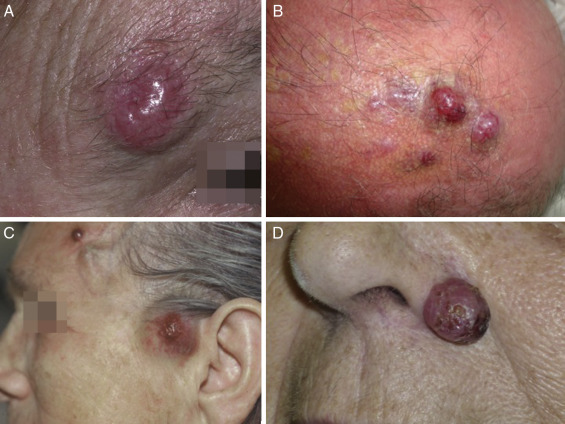
Merkel cell carcinoma most commonly affects areas of the skin that are exposed to the sun, including the head / neck and arms, but it can also develop in other areas of the body that are not usually exposed to exposure to the sun.
In most people, the first sign of Merkel carcinoma is a small bump (nodule) on the skin. This bulge is usually hard and skin-colored or reddish-purple. It also tends to grow rapidly. There are often no symptoms associated with the nodule. Sometimes the nodule may have a shiny surface or may be covered with small dilated vessels. Although rare in BMC, the abnormal nodule can rupture, forming an open, crusty wound.
In some cases, the lymph node (s) become enlarged (lymphadenopathy). This clinical sign (on palpation and / or imaging) indicates that the disease has spread to the patient's nearby (regional) lymph nodes.
Large BMC tumors are associated with a moderately higher risk of recurrence and lymph node spread. However, even small BMC tumors carry at least a 15% risk of spreading to nearby (regional) lymph nodes. Merkel cell carcinoma can also spread to other areas of the body, such as liver, bones, pancreas and other areas of the skin / body wall.
Causes and risk factors
Several risk factors have been identified for CCM. Risk factors include age over 50, fair skin, extensive sun exposure (ultraviolet radiation), or a weakened immune system. Persons with medical conditions such as HIV /AIDS, patients with liver, kidney or heart transplants, and autoimmune diseases, people taking immunosuppressive drugs that suppress the immune system, people with chronic lymphocytic leukemia (CLL) and some forms blood cancer (hematologic cancer) such as leukemia or lymphoma, usually have weak immunity. Despite the fact that such people are at increased risk of developing Merkel carcinoma, more than 90% of people with BMC have no known immune system problems.
Researchers have found that Merkel cell carcinoma is often associated (~ 80%) with a virus called Merkel cell polyomavirus. Merkel cell polyomavirus, MCPyV). It is now clear that most people become infected with MCPyV closer to adulthood, but it appears that the virus does not cause any symptoms, except in very rare situations in which it leads to KKM. In addition, some people develop Merkel carcinoma without the presence of Merkel cell polyomavirus (~ 20%), and such cases are usually associated with extensive exposure to UV radiation.
Affected populations
Since the Merkel cell carcinoma (MCC) was first described in 1972, more than 600 cases have been reported in the literature; more than 320 of these cases involved the head and neck.
Approximately 60% of BMC tumors occur in men. Over the past 15 years, the incidence has tripled, and it can lead to death in about one third of those affected. The registered annual incidence of BMC is 0.2-0.45 cases per 100,000 population. This rare cancer is 100 times less common than melanoma.
Related disorders
Symptoms of the following disorders may mimic those of Merkel carcinoma. Comparisons can be helpful in considering the cause of skin lesions.
There are many different conditions that need to be differentiated from Merkel carcinoma. These include:
- epidermoid cysts;
- squamous cell carcinoma;
- basal cell carcinoma;
- pyogenic granuloma;
- lipomas;
- tumors of the appendages;
- sebaceous cysts;
- melanoma;
- lymphoma;
- cutaneous Ewing's sarcoma.
Small cell under the microscope lungs' cancer it is often difficult to distinguish from primary Merkel carcinoma. Both cancers share similar neuroendocrine features. Therefore, it is necessary to carry out special staining in order to distinguish one form of cancer from another. This procedure is called immunostaining. During immunostaining, antibodies are applied to a tumor sample taken as a result of biopsy or surgical removal. Antibodies are used to test for certain proteins (markers), usually CCM tumors stain positive for low molecular weight cytokeratins (CAM 5.2 or AE1 / AE3), CK20 and neuro-specific enolase (NSE).
Diagnostics
The diagnosis of Merkel cell carcinoma is based on the identification of characteristic symptoms, a detailed history of the patient, a thorough clinical assessment, and various specialized tests.
- Clinical testing and examination.
The doctor may remove a small sample of the affected skin and examine it under a microscope (i.e., biopsy the tissue). The most common biopsies include an after-shave biopsy (a portion of the top of the abnormal tissue removed with a scalpel) or a punch biopsy (performed with one movement (blow) using a special tubular scalpel). The sample is then examined by a pathologist, who is a specialist trained in the study of tissues and cells, to understand the cause of the disease.
To control BMC, doctors usually do a sentinel lymph node biopsy (SLL) to determine if the cancer has spread to the draining lymph nodes. A sentinel lymph node biopsy is used to identify the first lymph nodes to which cancer may have spread. This method is used to identify the sentinel lymph node (draining lymph node). This procedure is performed in the operating room. During this procedure, the doctor injects a radioactive dye into the site of the primary lesion. The dye then travels and collects in the sentinel lymph node. Doctors will be able to see this through a special probe that can view the radioactive dye. The sentinel lymph node is then removed and carefully examined under a microscope for even a small number of tumor cells.
Imaging techniques, including computed tomography (CT), positron emission tomography (PET), and magnetic resonance imaging (MRI), are used to detect the spread of cancer.
Sometimes doctors recommend a combined PET / CT scan. This scan collects information about how much metabolic activity (glucose uptake as measured by PET) the cancer has at the same time as mapping of adjacent body structures (CT).
Standard treatments
The diagnosis and treatment of Merkel carcinoma requires the coordinated efforts of a team of medical specialists who are focused on the diagnosis and treatment of skin diseases (dermatologists); diagnosis and treatment of cancer (medical oncologists); surgical treatment of cancer (surgical oncologists); cancer treatment with radiation (radiation oncologists); cancer nurses; nutritionists; psychiatrists; and / or other healthcare professionals. Psychosocial support for the whole family is also often prescribed because of the rarity and relatively high risk of this cancer.
Specific therapeutic procedures and interventions can vary depending on many factors, such as the stage of the disease; the size of the tumor; localization of the tumor; the presence or absence of certain symptoms; the person's age and general health; and / or other factors such as immune health. Decisions regarding the use of specific drug regimens and / or other treatments must be made by doctors. and other members of the healthcare team in careful consultation with the patient based on the characteristics of his or her case; careful discussion of potential benefits and risks, including possible side effects and long-term consequences; patient preferences; and other relevant factors.
In general, for people with localized disease without lymph node involvement and without (distant) the spread of cancer, surgery is recommended to remove the primary cell carcinoma Merkel. Usually, the tumor is removed along with the healthy skin that surrounds it (wide local excision). If nearby lymph nodes are also affected, but the cancer has not spread (metastasized) further, then the affected lymph nodes are usually treated with surgery (and / or radiation therapy). Surgical removal of lymph nodes may be referred to as lymph node dissection or lymphadenectomy.
A specific type of surgery, called Mohs micrographic surgery, may be suitable for some people with Merkel carcinoma. With this approach, the surgeon uses a precise technique to remove the affected tissue, leaving as much normal tissue as possible. Research shows that radiation therapy should be given after Mohs surgery to better control BMC.
For some people, radiation therapy may be recommended after surgery. This is called adjuvant radiation and is given after initial therapy (in this case, surgery) to help reduce the risk of cancer coming back. Adjuvant radiation therapy refers to radiation therapy that is used to kill cancer cells remaining after surgery, removing all clinically detectable tumors (visible tumors). Radiation therapy uses X-rays or similar forms of radiation to directly kill cancer cells. Radiation therapy can also be used as primary therapy in people for whom surgical removal of cancer is not possible.
Sometimes doctors may recommend anti-cancer drugs (chemotherapy) as adjunctive therapy to surgery. Chemotherapy and radiation therapy can be used together as adjuvant therapy. There are concerns about the use of chemotherapy because some chemotherapy regimens can suppress the immune system.
Immunotherapy is recommended for most people with recurrent or metastatic disease. This type of treatment aims to increase the body's innate ability to fight cancer through the immune system. For example, avelumab is a type of immunotherapy called PD-L1 blockade that releases the “brakes” of the immune system that some cancers use to try to escape from immune cells.
Recent clinical trials of PD-1 or PD-L1 blockade drugs (eg, avelumab, pembrolizumab, and nivolumab) for progressive CCM showed a long-term response of approximately 60% for patients who had not previously received chemotherapy. The response rate is approximately 32% for patients who have previously received chemotherapy. Because these immunotherapy responses are very long lasting (often lasting for many years), compared to chemotherapy (usually lasting months), these results quickly led to a preference for immunotherapy over chemotherapy for KKM.
Forecast
Merkel carcinoma is uncommon, so it is difficult to assess the exact survival rate. The survival rate refers to what percentage of people with the same type and stage of cancer are still alive after a certain period of time after diagnosis.
According to the American Cancer Society, the overall five-year survival rate for BMC is about 60%. This means that about 60% of people diagnosed with BMC will still be alive 5 years after diagnosis.