Pfeiffer syndrome: what is it, causes, symptoms, treatment, prognosis
Content
- What is Pfeiffer Syndrome?
- Signs and symptoms
- Causes
- Affected populations
- Related disorders
- Diagnostics
- Standard treatments
- Forecast
What is Pfeiffer Syndrome?
Pfeiffer syndrome - a rare genetic disorder characterized by premature fusion of certain bones of the skull (craniosynostosis) and abnormally wide and inwardly deviated thumbs and toes. Most affected people also have midface differences (bulging eyes) and conductive hearing loss.
There are three forms of Pfeiffer syndrome, of which types II and III are the most serious. Pfeiffer syndrome is an autosomal dominant disorder associated with mutations in the genes for the fibroblast growth factor-2 receptor (FGFR2) and fibroblast growth factor receptor-1 (FGFR1).
Pfeiffer syndrome is now known to be a member of the group of conditions caused by mutations in genes FGFR, including Aper's syndrome (Aperta), Cruson syndrome, Beer-Stevenson syndrome, isolated coronary synostosis associated with FGFR2, Jackson-Weiss syndrome, Cruson syndrome with acanthosis nigricans and Müncke syndrome. (For more information on these states, see (See Related Disorders below.)
Signs and symptoms

Babies with type I Pfeiffer syndrome suffer from craniosynostosis, which makes the head appear short and tall (turribrachycephaly). Additional signs may include:
- high full forehead;
- underdevelopment of the middle part of the face (hypoplasia of the middle part of the face);
- wide-set eyes (hypertelorism);
- underdevelopment of the upper jaw (hypoplasia of the upper jaw) with a protruding lower jaw;
- dental pathology.
Intelligence in patients with type I disorder is usually normal.
Pfeiffer syndrome type II characterized by a more severe form of craniosynostosis, in which the skull looks like a cloverleaf (see. photo below) with more serious pathologies of the hands and feet and additional malformations of the limbs.
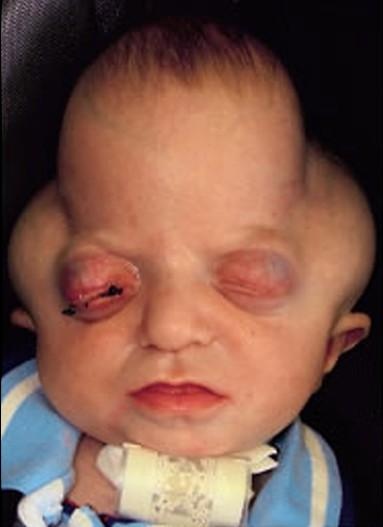
In infants with Pfeiffer syndrome type II, the premature closure of fibrous joints (cranial sutures) between several bones of the skull results in a "three-lobed" appearance of the skull. In addition, this form of craniosynostosis is often associated with hydrocephalus, a condition in which the normal flow of cerebrospinal fluid (CSF) changes, resulting in abnormal expansion (dilatation) of spaces in the brain (ventricles), causing accumulation of CSF within the skull and increased pressure on the brain. Characteristic craniofacial features associated with type II Pfeiffer syndrome may include:
- abnormally high wide forehead;
- severe bulging of the eyes (proptosis of the eyes);
- Unusually flat midface (midface hypoplasia)
- beak-shaped nose;
- ears shifted down.
Affected infants may also have abnormal fixation and immobility (ankylosis) of the elbow joints and / or, in some cases, various malformations of certain internal organs of the abdominal cavity (visceral anomalies). In addition, infants with Pfeiffer syndrome type II often experience mental impairment and neurological problems due to severe brain damage and / or hypoxia due to breathing problems. Without proper treatment, the physical disabilities associated with this disorder can lead to life-threatening complications in infancy.
Read also:Peutz-Jeghers Syndrome
People with Pfeiffer syndrome type III have symptoms and signs similar to those of type II Pfeiffer syndrome, with the exception of a cloverleaf deformity of the skull. Additional abnormalities associated with Pfeiffer syndrome type III include:
- shortened base of the skull;
- abnormal development of certain teeth at birth;
- severe protrusion of the eyes (proptosis) due to the abnormal shallow depth of the bony cavities that contain the eyeballs (orbits);
- various malformations of certain internal organs in the abdominal cavity (visceral anomalies).
As with type II, people with type III Pfeiffer syndrome often experience developmental disabilities and severe neurological problems, and can also develop potentially life-threatening complications at an early age without appropriate treatment.
Causes
Pfeiffer syndrome is an autosomal dominant genetic disorder. Dominant genetic disorders occur when only one copy of an abnormal (abnormal) gene is needed to cause a particular disease. The abnormal gene can be inherited from either parent, or it can be the result of a new mutation (gene change) in an affected person. Almost all cases of type II and type III Pfeiffer syndrome have arisen as a result of new mutations. Older paternal age is associated with an increased risk of new mutations in Pfeiffer syndrome. The risk of passing the abnormal gene from the affected parent to the offspring is 50% with every pregnancy. The risk is the same for men and women.
Pfeiffer syndrome type I is associated with mutations in FGFR1 and FGFR2. Type II and Type III diseases are associated with mutations in FGFR2.
Affected populations
The incidence of all types of Pfeiffer syndrome is approximately 1 / 100,000.
Related disorders
- Aper's syndrome (Aperta) Is a rare genetic disease that manifests itself at birth (congenital). The disease is characterized by characteristic malformations of the head, which lead to distinctive facial features. In addition, the arms and / or legs may be webbed (syndactyly) and, in some cases, mental retardation may also be present. In children born with Apert syndrome, the fibrous joints between the bones of the skull (sutures) close prematurely (craniosynostosis). The pressure of the continued growth of the brain distorts the various bones of the skull and face. The skull takes on characteristic shapes. Often the head looks improperly pointed at the top (acrocephaly). Deformation of the skull plates causes changes in the facial bones, resulting in characteristic facial abnormalities such as wide-set eyes (hypertelorism), abnormal protrusion of the eyes (bulging), underdevelopment of the mid-facial regions (hypoplasia of the midface) and / or narrow sky. Hand and foot malformations can include unusually wide thumbs and toes, short fingers, and / or partial or complete fusion (syndactyly) of certain fingers and toes. Most often, there is a complete fusion of bones between the second and fourth fingers and the presence of one common nail. Aper's syndrome is an autosomal dominant genetic disorder associated with mutations in FGFR2.
- Cruson syndrome - a rare genetic disorder that can appear at birth or in infancy. The disease is characterized by characteristic malformations of the skull and facial area. Such anomalies can vary greatly in range and severity from case to case, including among members of the same family. However, in most babies with Cruson syndrome, the fibrous joints between some of the bones of the skull (cranial sutures) close prematurely (craniosynostosis). In addition, facial abnormalities usually include unusual bulging or bulging of the eyeballs (proptosis) due to shallow eye cavities (orbits); deviation of one of the eyes outward (diverging strabismus or exotropia); wide-set eyes (hypertelorism); and a small underdeveloped upper jaw (hypoplasia of the upper jaw), with protrusion of the lower jaw (relative prognathism of the lower jaw). Having normal-looking arms and legs distinguishes Cruson syndrome from Pfeiffer syndrome. Cruson syndrome is an autosomal dominant genetic disorder associated with mutations in FGFR2.
- Cruson's syndrome with acanthosis nigricans - a rare genetic disorder characterized by the signs and symptoms of Crouzon syndrome combined with thick, dark areas in the folds of the skin (acanthosis black). The condition is inherited in an autosomal dominant manner and is associated with specific mutations in FGFR3.
- Jackson-Weiss Syndrome - an extremely rare genetic disease characterized by craniosynostosis; an unusually flat midface (midface hypoplasia); abnormally wide big toes; and / or fusion (syndactyly) of the second and third toes. The range and severity of symptoms and signs can vary greatly from case to case, including among affected family members (s). Jackson-Weiss syndrome is an autosomal dominant genetic disorder associated with mutations in FGFR2.
- Beer-Stevenson syndrome Is an extremely rare genetic disorder characterized by craniosynostosis, certain skin abnormalities, and mental retardation. Genital and anal abnormalities may also be present. Beer-Stevenson syndrome is an autosomal dominant genetic disorder associated with mutations in a gene FGFR2.
- Müncke syndrome Is a rare genetic disorder characterized by premature fusion of the skull bones at the crown from ear to ear (coronary craniosynostosis). Other symptoms may be similar to those of other diseases caused by mutations FGFR. Müncke syndrome is an autosomal dominant genetic disorder associated with a specific single mutation in FGFR3. Some people with this specific mutation FGFR3 have no symptoms of the disease.
- Isolated coronary synostosis associated with FGFR2, is an autosomal dominant genetic disorder characterized by premature fusion bones of the skull along the top of the head from ear to ear (coronary craniosynostosis) and the absence of other serious anomalies. Many children also suffer from hypertelorism. The condition is inherited in an autosomal dominant manner and is associated with specific mutations in FGFR2.
Diagnostics
The diagnosis of Pfeiffer syndrome is clinical. If the diagnosis is uncertain, molecular genetic testing is available for FGFR1 and FGFR2.
Standard treatments
Treatment for Pfeiffer Syndrome focuses on the specific symptoms that each person experiences. Treatment may require a coordinated team of specialists. Pediatricians; surgeons; doctors who diagnose and treat diseases of the ears, nose and throat (otolaryngologists); neurologists; hearing assessors and treatments (audiologists); and / or other health care providers may require systematic and comprehensive treatment planning for the affected child.
Read also:Malignant hyperthermia
Specific treatments for Pfeiffer syndrome are symptomatic and supportive. Because craniosynostosis and, in some cases, associated hydrocephalus can lead to an abnormal increase in pressure in the skull (intracranial pressure) and in the brain, early surgery may be recommended to correct craniosynostosis and, in the case of hydrocephalus, the introduction of a tube (shunt) to drain excess cerebrospinal fluid (CSF) from the brain to another part of the body where the cerebrospinal fluid can be absorbed. Early corrective and reconstructive surgery may also be performed on infants with Pfeiffer syndrome to help correct certain associated craniofacial abnormalities (eg, midface hypoplasia, facial asymmetry, nasal anomalies, eye proptosis due to shallow orbits). The results of such craniofacial surgery may vary.
Respiratory problems can also occur, especially in very young children. This causes low oxygen levels, which, if not recognized and treated, can lead to brain damage.
In addition, in some cases, reconstructive surgery may be done to help correct the defects. development of the ear, and / or special hearing aids can be used to improve the conductive hearing loss.
Some people with Pfeiffer syndrome may also have surgery to correct syndactyly and / or other skeletal malformations and improve function and mobility. Physical therapy and additional orthopedic and supportive measures can also be used to further improve the victim's mobility. Surgical procedures performed to correct certain craniofacial, audiological, digital, and / or skeletal anomalies associated with the disease will depend on the severity and location of the anatomical anomalies and their associated symptoms.
Early intervention can be important in order for children with the disease to reach their potential. Special services that may be helpful to affected children include special social support, physical therapy, and other medical, social and / or professional services.
Read also:Dubovitsa syndrome
Genetic counseling is recommended for patients and their families. In addition, a thorough clinical examination may be important in the family members of the diagnosed individuals for identifying any symptoms and physical characteristics that could potentially be associated with the syndrome Pfeiffer.
Forecast
Most people with type I Pfeiffer syndrome have a normal life expectancy. People with types II and III have severe illness and may develop complications that shorten their life span.