Waardenburg syndrome: what is it, symptoms, treatment, prognosis
Content
- What is Waardenburg Syndrome?
- Signs and symptoms
- Causes
- Inheritance type
- Affected populations
- Symptomatic disorders
- Diagnostics
- Standard treatments
- Forecast
What is Waardenburg Syndrome?
Waardenburg syndrome Is a genetic disorder that can manifest itself at birth (congenital). The range and severity of associated symptoms and signs can vary greatly from case to case. However, primary signs often include characteristic facial abnormalities; unusually reduced coloration (pigmentation) of hair, skin and / or iris of both eyes; and / or congenital deafness. More specifically, some patients may have an unusually wide bridge of the nose due to lateral (lateral) displacement of the inner corners of the eyes (telecant). In addition, pigmentation abnormalities can include a white strand of hair growing over the forehead; premature graying or whitening of hair; differences in the color of two irises or in different parts of the same iris (iris heterochromia); and / or patchy, abnormally light (depigmented) areas of the skin (leukoderma). Some people may also have hearing impairment due to abnormalities in the inner ear (sensorineural hearing loss).
Researchers have described various types of Waardenburg syndrome (hereinafter abbr. SV) based on associated symptoms and specific genetic data. For example, type I Waardenburg syndrome (CB1) is usually associated with lateral displacement of the inner corner of the eye (i.e., telescopic), but type II (CB2) is not associated with this feature. In addition, CB1 and CB2 are known to be caused by changes (mutations) in different genes. Another form, known as type III (CB3), in which characteristic facial features, eye (eyepiece), and hearing disorders may be associated with characteristic malformations of the arms and hands (upper extremities). A fourth form, known as CB4 or Waardenburg-Hirschsprung disease, may have primary signs of SV plus Hirschsprung's disease. The latter is a digestive (gastrointestinal) disorder in which there are no groups of specialized bodies of nerve cells in the smooth (involuntary) muscle wall of the thick intestines.
In most cases, Waardenburg syndrome is transmitted in an autosomal dominant manner. A number of different disease genes have been identified that can cause Waardenburg syndrome in certain individuals or families (relatives).
Signs and symptoms
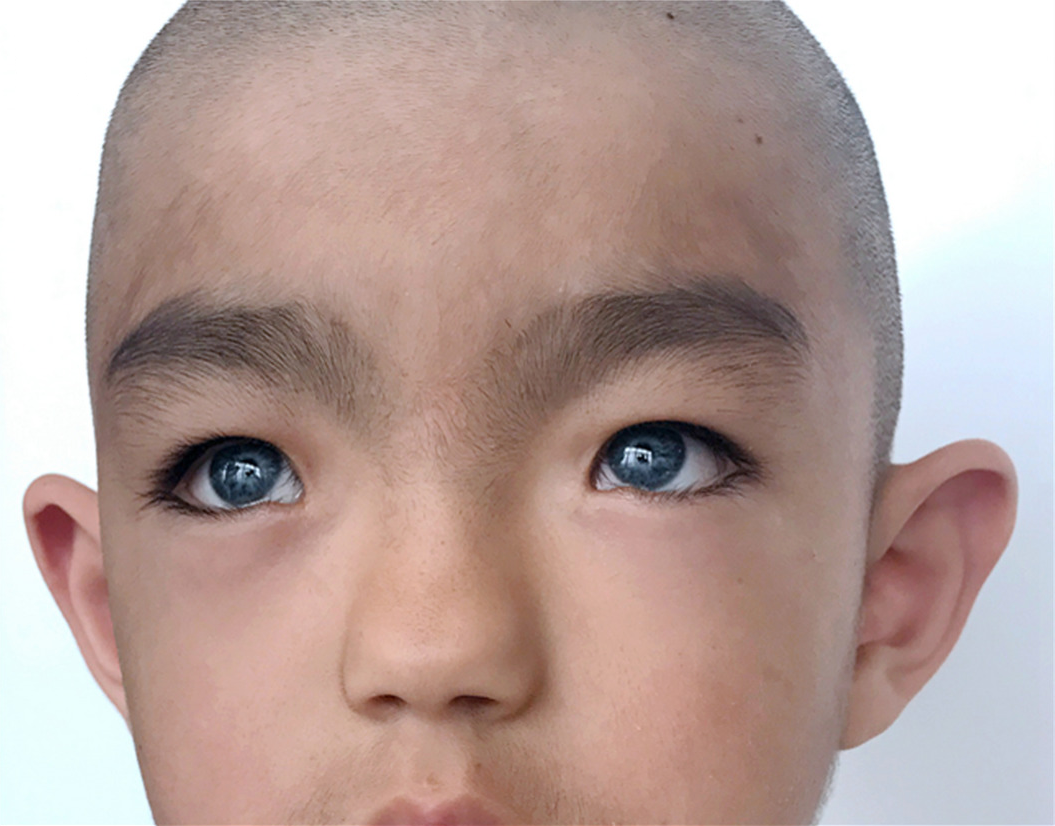
The primary signs of Waardenburg syndrome may include:
- characteristic facial anomalies (see. Photo);
- pigmentation disorders (hypopigmentation) of hair, skin and / or iris or iris of both eyes (partial albinism);
- congenital hearing loss.
However, as previously mentioned, the associated symptoms and signs can be very different, including among affected family members (s). For example, while some patients may have only one characteristic, others may have multiple disease-related abnormalities.
In some patients with Waardenburg syndrome (SV), there is an abnormal displacement of the lateral (lateral) inner corners of the eyes, formed by the junction of the upper and lower eyelids (telecant). In addition, the condition may be associated with unusually low tear duct openings and an increased susceptibility to infections of the lacrimal sacs (dacryocystitis). (Each inner corner of the palpebral fissure opens into a small space that contains an opening for the tear duct.) patients may have an abnormally wide, high bridge of the nose and underdeveloped nasal "wings" (hypoplasia of the nasal wings), which leads to narrow nostrils. In addition, in some cases, the eyebrows may be unusually thick and / or grow together (sinofreeze). In rare cases, affected people also have wide-set eyes (ocular hypertelorism). As mentioned earlier, researchers have described different forms of the disease based on certain symptoms and specific genetic data. Type II CB differs from Type I CB by the absence of a TV channel.
Additional facial abnormalities may be present in some patients with SV. They can include:
- an unusually rounded tip of the nose that may be slightly upturned;
- abnormal "smoothness" of the vertical groove of the upper lip (groove);
- full lips;
- slight protrusion of the lower jaw (prognathism of the lower jaw).
There have also been several reports in which the disease was associated with a cleft palate (heiloschisis) and / or an abnormal groove on the upper lip (cleft lip).
Waardenburg syndrome is often associated with pigmentation disorders due to a deficiency of the melanin pigment. Some with this condition have graying of the scalp and eyelashes (poliosis) at birth, which tends to disappear with age. Eyebrows, eyelashes, and scalp hair can turn gray or white prematurely (starting in early childhood, adolescence, or early adulthood). In addition, some patients have irregularly shaped skin areas devoid of pigmentation (leucoderma or vitiligo), especially on the face and hands. The disorder can also be associated with underdevelopment (hypoplasia) of the connective tissue fibers that make up most of the stained area of both eyes (iris). As a result, patients may have unusually pale blue eyes or differences in iris pigmentation or in different regions of the same iris (iris heterochromia). For example, the iris of one eye may be blue and the other iris a different color, or one or both of the irises may appear unusually "speckled". Some reports suggest that iris heterochromia may be more common in type 2 Waardenburg syndrome, while while the presence of graying hair on the scalp and depigmented areas of the skin is more common in people with Waardenburg syndrome 1 type.
Read also:Hypophosphatasia
Some people with FD also suffer from congenital deafness. This hearing impairment appears to be the result of an abnormality or absence of the organ of Corti, a structure within the hollow spiral passage of the inner ear (cochlea). The organ of Corti contains tiny hair cells that convert sound vibrations into nerve impulses, which are then transmitted through the auditory nerve (vestibular cochlear nerve) to the brain. Anomalies in the organ of Corti can interfere with the transmission of these nerve impulses, resulting in impairment of hearing (called sensorineural hearing loss or cochlear hearing loss). In most patients with the disorder, congenital sensorineural deafness affects both ears (bilateral). However, in rare cases, only one side (unilateral) may be affected.
In some cases, characteristic features of the face, eyes and hearing can occur in conjunction with bilateral malformations of the arms and hands (upper limbs). This form of the disorder, which is described as a severe manifestation of CB1, is sometimes referred to as the syndrome Waardenburg type 3 (CB3), Klein-Waardenburg syndrome or Waardenburg syndrome with upper anomalies limbs. Bilateral defects may include:
- underdevelopment (hypoplasia) and abnormal shortening of the upper limbs;
- Abnormal flexion of certain finger joints in fixed positions (flexion contractures)
- fusion of the bones of the wrist;
- and / or webbing or fusion (syndactyly) of certain fingers.
In some cases, other skeletal abnormalities may be present, such as congenital high shoulder stance (Sprengel deformity).
A fourth form of Waardenburg's syndrome has also been described, in which the main features of SV are associated with Hirschsprung's disease. This form of the disorder may be called CB4, Waardenburg-Schach syndrome, or Waardenburg-Hirschsprung syndrome. Hirschsprung's disease (also known as aganglionic megacolon) is a gastrointestinal disorder characterized by the absence of certain bodies of nerve cells (ganglia) in the smooth muscle wall in colon area. As a result, there is an absence or violation of involuntary rhythmic contractions that propel food along the gastrointestinal tract (peristalsis). Associated symptoms and signs may include:
- abnormal accumulation of feces in the colon;
- expansion of the colon over the affected segment (megacolon);
- bloating (flatulence);
- vomiting;
- lack of appetite (anorexia);
- an inability to grow and gain weight at the expected rate;
- and / or other deviations.
Rare cases of CB4 have been reported in which patients also had neurological symptoms due to abnormalities in the brain and spinal cord (central nervous system). In such cases, additional indications included:
- restriction of growth;
- abnormally decreased muscle tone (hypotension);
- contractures and deformities of the limbs (arthrogryposis);
- and / or other deviations.
Causes
Gene mutations EDN3, EDNRB, MITF, PAX3, SNAI2 and SOX10 can cause Waardenburg syndrome. These genes are involved in the formation and development of several types of cells, including pigment-producing cells called melanocytes. Melanocytes produce a pigment called melanin, which contributes to the color of the skin, hair, and eyes and plays an essential role in the normal function of the inner ear. Mutations in any of these genes disrupt the normal development of melanocytes, resulting in abnormal pigmentation of the skin, hair, eyes, and hearing problems.
Read also:Sore throat
Types I and III of Waardenburg syndrome are caused by mutations in the gene PAX3. Gene mutations MITF or SNAI2 can cause type II Waardenburg syndrome.
Mutations in genes SOX10, EDN3 or EDNRB can cause type IV Waardenburg syndrome. Besides the development of melanocytes, these genes are important for the development of nerve cells in the colon. Mutations in one of these genes lead to hearing loss, pigmentation changes, and intestinal problems associated with Hirschsprung's disease.
In some cases, the genetic cause of Waardenburg syndrome has not been established.
Inheritance type
Waardenburg syndrome is usually inherited in an autosomal dominant manner, which means that one copy of the altered gene in each cell is enough for the disorder to occur. In most cases, the affected person has one parent with the condition. A small percentage of cases are the result of new mutations in a gene; such cases occur in people who have no family history of the disease.
In some cases of Waardenburg syndrome type II and IV, an autosomal recessive inheritance pattern is found, which means that both copies of the gene in each cell have mutations. Most often, the parents of a patient with an autosomal recessive condition carry one copy of the mutated gene, but do not show signs and symptoms of the disease.
Affected populations
Waardenburg Syndrome (SV) is named after the researcher (Petrus J. Waardenburg), who first accurately described the disorder in 1951. Since then, at least 1,400 cases have been reported in the medical literature. Available data indicate that the disease may have an incidence of about 1 in 40,000 births and is responsible for 2 to 5 percent of congenital deafness. The disease affects men and women relatively equally.
Symptomatic disorders
Symptoms of the following disorders may be similar to those of Waardenburg syndrome. Comparisons can be useful for differential diagnosis.
There are a number of disorders that may have certain traits similar to those seen in SV. For example, according to researchers, such disorders may include:
- family cases of partial albinism and deafness;
- familial cases of vitiligo and congenital sensorineural / sensorineural hearing loss;
- a condition known as Vogt-Koyanagi-Harada syndrome.
The latter may be characterized by inflammatory eye diseases; vitiligo; graying of eyebrows, eyelashes and scalp hair (poliosis); hair loss (alopecia); a condition in which certain sounds can cause discomfort (disacusion); and / or other symptoms and signs.
In addition, some congenital abnormalities can also be associated with lateral displacement of the inner corner of the eye (i.e., telescopic); wide-set eyes (ocular hypertelorism); narrow nostrils; unusually thick eyebrows that can grow together (sinofreeze); hearing impairment; malformations of the upper limbs; digestive disorders; and / or other functions potentially associated with Waardenburg syndrome. However, such disorders are often characterized by additional, distinctive symptoms, physical signs, or other characteristics that can help distinguish them from SV.
Diagnostics
Waardenburg syndrome (SV) can be diagnosed at birth or early childhood (or, in some cases, later in life) based on a thorough clinical assessment, identification of characteristic physical signs, a complete history of the patient and his family, as well as various specialized research. For example, in patients with suspected CO, the diagnostic evaluation may include the use of a caliper for measuring the distance between the inner corners of the eyes, the outer corners of the eyes and the pupils (interpupillary distance). (A caliper is an instrument with two articulated, movable, curved arms that is used to measure thickness or diameter.) the combination of these measurements can sometimes be useful to confirm the presence or absence of lateral displacement of the inner corner of the eye, which may indicate the presence of SV 1 type.
Additional diagnostic tests can be performed to help detect or characterize certain abnormalities potentially associated with the disease. Such examinations may include examination with an illuminated microscope to visualize the internal structures of the eye (examination with a slit lamp); specialized auditory research; and / or advanced imaging techniques such as for assessing inner ear anomalies, skeletal defects (eg, seen in type 3 SV), Hirschsprung's disease (eg, seen in type 4 disorder), and etc.. For example, researchers point out that computed tomography (CT) scans can help characterize inner ear defects that are responsible for congenital sensorineural deafness. (Computed tomography uses a computer and X-rays to create a film showing cross-sectional images of internal structures.) In some cases diagnostic evaluation may also include removal (biopsy) and microscopic examination of certain tissue samples, such as a rectal biopsy, to confirm disease Hirschsprung. In some cases, additional diagnostic tests may also be recommended.
Read also:Hers disease
Standard treatments
Treatment for Waardenburg syndrome is aimed at eliminating specific symptoms that appear in each person. Such treatment may require a coordinated effort by a team of health professionals, such as skin doctors (dermatologists); ophthalmologists (ophthalmologists); hearing specialists; doctors engaged in the diagnosis and treatment of diseases of the skeleton, joints, muscles and related tissues (orthopedists); doctors specializing in diseases of the digestive tract (gastroenterologists); speech therapists; physiotherapists; and / or other healthcare professionals.
Early recognition of sensorineural hearing loss can play an important role in ensuring prompt intervention and appropriate supportive care. In some cases, doctors may recommend treatment with a cochlear implant - a device in in which electrodes implanted in the inner ear stimulate the auditory nerve to send impulses to brain. In addition, early special education may be recommended to aid in the development of speech and specific techniques. (for example, sign language, lip reading, use of communication tools, etc.) that can facilitate communication.
Since patients with pigmented skin abnormalities may be predisposed to sunburn and the risk of developing skin cancer, doctors may recommend avoid direct sunlight, use sunscreen with a high sun protection factor (SPF), wear sunglasses and protective coatings against sun. (such as hats, long sleeves, trousers, etc.) and other appropriate measures. Patients with reduced iris pigmentation, lateral displacement of the inner corners of the eyes and / or other comorbid ocular abnormalities, ophthalmologists may also recommend certain supportive measures. These may include the use of specially tinted glasses or contact lenses (for example, to reduce possible sensitivity to light (photophobia)), measures to prevent or treat infection, or other preventive or therapeutic measures.
In people with upper limb abnormalities, treatment may include physical therapy and various orthopedic techniques, possibly including surgery. In addition, surgery may sometimes be recommended to treat other abnormalities that may be associated with the disease. The specific surgical procedures performed will depend on the severity and location of the anatomical abnormalities, associated symptoms, and other factors.
For example, for patients with Hirschsprung's disease, treatment may require removal of the affected intestine and surgical “reconnection” of healthy intestinal tract. In some cases, before surgical correction of the condition, treatment may require the creation of an artificial outlet for the colon through an opening in the abdominal wall (for example, a temporary colostomy).
Additional support services that some victims may find helpful include special education and / or other medical, social, or professional services. Genetic counseling will also benefit those affected and their families. Another treatment for Waardenburg syndrome is symptomatic and supportive.
Forecast
Waardenburg syndrome should not affect life expectancy. Usually, the disease is not accompanied by any other complications other than hearing loss, pigmentation disorders, or Hirschsprung's disease, which affects the colon. The physical characteristics caused by this disease will remain with the person for life.