
Operation to remove hemorrhoids: reviews, how it goes, preparation
Hemorrhoids is a disease of veins and blood vessels located in the rectum and anus of a person. All people of the planet are susceptible to diseases, but few seek medical help on time. As a result, the disease reaches its final stages, and conservative treatment is unable to solve the patient's problem. An operation is prescribed without fail.
Content
- 1 Need for surgery
- 2 Cases of contraindications for surgery
-
3 Preparing for surgery
- 3.1 What preparatory activities are carried out in the clinic
- 3.2 How the patient prepares for surgery
-
4 Surgical methods
- 4.1 Milligan-Morgan hemorrhoidectomy
- 4.2 Longo's hemorrhoidectomy
- 4.3 Hemorrhoid laser treatment
- 5 Reviews
Need for surgery
The third and fourth stages of the disease are direct indications for surgical removal of hemorrhoids. The patient's condition is grave. If conservative and minimally invasive methods of treatment are not justified, the disease progresses rapidly, surgical intervention is required. Let's describe the reasons for the need.
At internal hemorrhoids:
- Large nodes, falling out of the rectal lumen;
- Heavy bleeding;
- The patient experiences unbearable pain when walking, in a resting position;
- The functions of the sphincter of the rectum are weakened - uncontrolled excretion of feces;
- Threat of thrombosis, pinching of hemorrhoids, cracks in the rectum;
- There is a great risk of developing an inflammatory process, joining an infection.
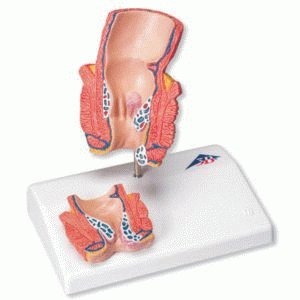
Inflammation of the venous walls of the rectum
With external hemorrhoids:
- Severe swelling of the tissues around the anus;
- Painful sensations are strong;
- Large hemorrhoids interfere with movement. It is impossible to lock in a sitting position;
- The tissue around the anal canal is cracking;
- The risk of thrombosis, pinching of the hemorrhoid increases;
- Increased likelihood of developing skin diseases due to aggressive mucous secretions;
- The threat of infection and inflammation of the subcutaneous fat increases.
With combined hemorrhoids, symptoms occur that are characteristic of external and internal hemorrhoids.
A mandatory indication for surgery is rectal prolapse with hemorrhoids, complications - paraproctitis and others.
Cases of contraindications for surgery
A number of contraindications for surgery for hemorrhoids:
- Hemorrhoids are not operated in the stage of exacerbation of bowel disease;
- Do not perform an operation to remove hemorrhoids in case of poor blood clotting, diseases of the circulatory system;
- It is impossible to prescribe surgical treatment of hemorrhoids in case of renal, hepatic and pulmonary insufficiency;
- It is unacceptable to carry out surgery using general anesthesia for pathologies of the cardiovascular system, respiratory diseases;
- Diabetes mellitus is a contraindication for surgery due to poor blood clotting;
- Operation to remove hemorrhoids is contraindicated if the patient has malignant tumors;
- The operation to remove hemorrhoids is not performed with a weakened immune system.
Surgical treatment of pregnant women is not recommended. After childbirth, the problem often returns. The effects of anesthesia have a negative effect on the fetus.
They try to prescribe treatment for the elderly using conservative methods - after 50 years, tissues are hardly restored. If the operation cannot be avoided, a thorough examination of the patient and preparation for the operation is recommended.
Preparing for surgery
The patient is carefully prepared for the upcoming surgery.
What preparatory activities are carried out in the clinic
- Selection of the appropriate treatment method. The doctor is determined with the method of surgical intervention, depending on the severity of the disease, the localization of hemorrhoids, the presence of complications. For this, the patient is examined, familiarized with the anamnesis, and complaints are discussed.
- Medical examination. In order to identify possible contraindications and risks, laboratory tests are carried out (blood and urine tests), electrocardiography, fluorography, digital examination of the rectum, anoscopy, colonoscopy, ultrasound of the abdominal organs cavity.
- Preparing for anesthesia. The anesthesiologist records information about the constant intake of medications by the patient, the presence of allergic reactions to medications, and makes the necessary tests. Makes a decision - under what anesthesia the operation will take place. Informs the patient about the preparation the day before the operation - food and drinking regimen, enema. Removable dentures and jewelry should be removed from the oral cavity.

How the patient prepares for surgery
The patient begins preparing for the operation a couple of weeks before the operation.
- The diet is being followed. In order to prevent complications after surgery, the patient normalizes bowel function and prevents the formation of constipation. Foods that cause bloating, diarrhea, constipation, and foods that irritate the stomach and intestines are excluded from the diet.
- Before the operation, measures are taken to eliminate inflammation in the anus. Swelling, inflammation, or ulcers are minimized with medication.
- Visit your dentist before surgery. Heal sore and loose teeth, as they will create problems with general anesthesia.
- In the evening before the operation, hygiene procedures are required. In the evening, take a shower and do a cleansing enema - the intestines are empty on the day of the operation.
- Food and drinking regime. The last meal before the operation is carried out at least 12 hours in advance. On the morning of the operation, in case of general anesthesia, you must not drink water either.
Surgical methods
Depending on the localization of the hemorrhoidal cones, the size, the presence of bleeding, the stage of the course of the disease, methods of getting rid of the patient from hemorrhoids are prescribed.
The primary goal of surgery is to remove the inflamed hemorrhoids.
Known radical and minimally invasive methods of surgical treatment. Removal of hemorrhoids by radical surgery is carried out at the third or fourth stages of the disease. Elimination of the affected areas occurs by cutting and excision.
Milligan-Morgan hemorrhoidectomy
A radical method for the treatment of hemorrhoids. Treatment is carried out in two ways:
- Open - when the operating wound is not sutured, but heals on its own. The operation takes place in a hospital setting.
- Closed - sutures are applied to the operated areas of the mucous membrane. The patient is operated on on an outpatient basis.
Open hemorrhoidectomy is used in cases complicated by cracks in the rectum or the development of paraproctitis. The procedure involves cutting or excising the inflamed nodes and surrounding mucosa. Sometimes the Prax method is used, when the nodes themselves are cut out without the mucous membrane.
The advantages of the method include:
- Milligan-Morgan surgery removes internal, external hemorrhoids;
- The operation gives a result, the problem does not return for a long time;
- Complications after surgery are rare.
The disadvantages include:
- Surgical treatment takes several hours and takes place under general anesthesia;
- Pain during the postoperative period;
- Long term healing and rehabilitation period.
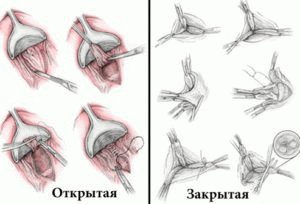
Open hemorrhoidectomy
Longo's hemorrhoidectomy
The method of transanal resection is used - the Longo method.
Surgical intervention consists in cutting off part of the mucous membranes of the rectum above the dentate line - above the hemorrhoidal cones. The nodes are not excised, they are pulled up, they are sutured with medical braces. As a result of the cessation of blood flow, the cones "dry out". Subsequently, they are overgrown with connective tissue, the intestine acquires a natural anatomical appearance.
The advantages of the method:
- Operate the patient using local anesthesia;
- Blood loss during surgery is minimal;
- The procedure lasts up to 15-20 minutes;
- Painless postoperative period;
- The operation gives a stable result, complications are rare.
Flaws:
- The Longo method is applicable only to the treatment of internal hemorrhoids.
- The operation is costly.
Hemorrhoid laser treatment
If at stages 1-2, conservative treatment does not bring a tangible effect, an operation is required, hemorrhoids are removed using minimally invasive methods.
Laser coagulation is an effective method of treating hemorrhoids. Effective with internal and external hemorrhoids.

Laser removal of hemorrhoids
The technique is based on the use of the following properties of a laser beam:
- Work in the infrared range;
- Ultra-precise focusing;
- The use of heat radiation.
Internal nodes are cauterized with a laser beam, external ones are cut off. During treatment, the doctor adjusts the depth and power of the beam.
The method is effective in the treatment of thrombosed hemorrhoids, in the presence of profuse bleeding from internal nodes and anal fissures. Laser coagulation is prescribed even for inflammation and fistulous canals.
The advantages of the method:
- With the help of laser coagulation, hemorrhoids of any localization are removed;
- Cracks, ulcers and inflammations are eliminated;
- The procedure is highly accurate and non-traumatic for the surrounding tissues;
- Laser coagulation is painless and bloodless;
- The patient recovers quickly from such an operation;
- Removal of large nodes at 3 and 4 stages of the course of the disease using a combined technique.
Few disadvantages:
- Treatment cost;
- Insufficient performance on stages of advanced hemorrhoids.
The laser coagulation procedure requires preliminary preparation from the patient.
Reviews
A person decides to have an operation when other methods have been tried, and pain and discomfort make life unbearable. We have to decide on radical measures, in the overwhelming majority of cases, patients get rid of the problem for years - hemorrhoids no longer torment.
The operation is performed using the Milligan-Morgan method. The difficult stage is the postoperative period. The operation is painless. Eliminates neglected internal, external and combined hemorrhoids of 3-4 degrees. It hurts in the first two to three weeks of rehabilitation. Men complain of urination disorder at first. It is necessary to solve the problem, since in advanced cases there is no other alternative.
The Longo method effectively eliminates the problem, the recovery period is short. External hemorrhoids are not treated with this method.
Laser coagulation solves the health problem and affects the aesthetic side. In women after childbirth and pregnancy, external nodes are of an unsightly appearance. Laser coagulation is designed to treat hemorrhoids, regardless of where the nodes are located, but in advanced stages it is not effective enough. Feedback on the method of treatment is positive - everything happens painlessly, in 15 minutes. No anesthesia and no hospital room. At 3-4 stages, hemorrhoids are best treated with other methods.


