
Types of hemorrhoids: classification and differences in treatment methods
Hemorrhoids is a disease caused by insufficiency of the venous network in the rectal area. There is stagnation of blood in the choroid plexus and stretching of its walls with the development of varicose veins. The resulting hemorrhoids become inflamed and cause great anxiety to the patient.

Content
-
1 Types of hemorrhoids
- 1.1 Classification by etiological factors
- 1.2 Localization of the pathological process
- 1.3 The nature of the course of the disease
- 2 Clinical stages of the disease
- 3 Treatment of acute hemorrhoids
- 4 Conservative treatment of the initial stages of chronic hemorrhoids
-
5 Surgical treatments
- 5.1 Ligation operation
- 5.2 Desarterization
Types of hemorrhoids
Hemorrhoids are classified according to a number of criteria. The clinical form, types, treatment options for the disease, and the prognosis for the future depend on this. Highlighted a table, including the types of hemorrhoids, treatment methods.
Classification by etiological factors
Due to the occurrence of the disease, it is divided into:
- Congenital.
- Acquired.
Acquired disease is subdivided into:
- primary - when hemorrhoids develops as an independent nosological unit;
- secondary - acts as a complication of other diseases.
Localization of the pathological process
Depending on the localization of hemorrhoids, it is customary to distinguish between variants of the disease:
- Subcutaneous or external.
- Submucous or internal - developing in the lumen of the rectum.
Depending on the form, localization of the pathological process, treatment will differ.
The nature of the course of the disease
In the course of the course, the disease is divided into acute or chronic. In the latter case, it proceeds without pronounced symptoms.
Acute hemorrhoids differ in varieties:
- Acute thrombosis of hemorrhoidal veins without inflammation. Moderate swelling and pain in the anus develops. The nodes are slightly enlarged. Nodules in the form of dense cones are determined by palpation.
- Thrombosis of hemorrhoidal formations with the development of an inflammatory process. The patient is worried about acute severe pain. Increased with light load, going to the toilet. The perineal area is inflamed. Soft tissues swell, begin to hurt a lot.
- Thrombosis with paraproctitis or proctitis. The inflammatory process captures the area around the anus. When examining the anus, falling out cyanotic-purple nodes, greatly increased in size, are found. Palpation is impossible - the patient experiences acute excruciating pain.
Acute types of hemorrhoids require urgent treatment. Otherwise, the disease leads to a number of serious complications.
Clinical stages of the disease
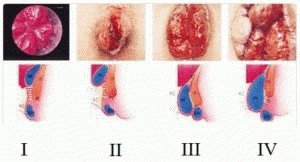
The clinical significance belongs to the classification of the disease according to the degree of development. Treatment methods depend on the stage of the pathological process. The chronic course of the disease will include 4 stages of the development of the pathological process.
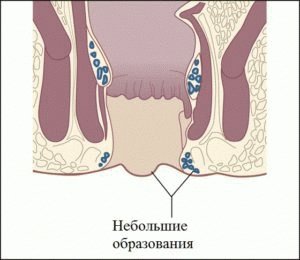
- First stage. Small hemorrhoids. Localized around the anus. The nodes do not cause any disturbance to the patient. Unsharp pains are recorded during the act of defecation. Occasionally, impurities of blood are found in the feces. Subjectively, the patient feels a burning sensation in the anus. The rectal mucosa and the skin around the anus are swollen. Symptoms are not pronounced, the patient does not experience subjective discomfort.
Hemorrhoids 1 degree
- At the second stage, there is an increase in hemorrhoids in size. The enlarged nodes fall into the rectal lumen. Often occurs during bowel movements. After the end of bowel movements, the nodes spontaneously return inside. Periodically, the patient feels pain in the perineal region. Sometimes discomfort develops with the accumulation of feces in the rectum, the appearance of the urge to defecate. Patients are looking for ways to eliminate pain, trying to apply alternative treatment to alleviate the condition. They resort to the use of ointments, sprays to eliminate pain, itching and burning. It relieves inflammation and discomfort with ice compresses.
- At the third stage, hemorrhoids reach significant sizes and are already constantly localized outside the anus. After the act of defecation, the patient is forced to set them with his hands. Hemorrhoids are often pinched. Causes severe pain and discomfort. At the third stage, it is impossible to do without surgical intervention.
- The fourth stage is severe, it poses a threat to the life and health of the patient. The knot falls out with light exertion, coughing, sneezing. Bleeding is fixed. Deep anal fissures develop. Treatment is exclusively surgical. An additional measure is conservative treatment. The disease is accompanied by iron deficiency anemia.
Classification by the degree of the disease is often used in practice - the choice of the method of therapy depends on it.
Treatment of acute hemorrhoids
Acute form of hemorrhoids requires complex treatment. In addition to local drugs, anti-inflammatory treatment is prescribed, drugs that improve the rheological properties of blood.
Local measures - rectal suppositories, topical ointments. They differ in anti-inflammatory and local anesthetic effect. The suppository contains a direct-acting anticoagulant - heparin. Inside, antibiotics of a wide spectrum of action, anti-inflammatory drugs, antiplatelet agents are prescribed.
To reduce pain and swelling, relieve an acute inflammatory process, the suppositories and ointments contain corticosteroid drugs - hydrocortisone.
When the hemorrhoid is pinched, the doctor alternately prescribes compresses of contrasting temperature to the anal area to relax the sphincter muscles. Pain and swelling decrease, and a gradual reduction of the prolapsed node into the rectum occurs.
For oral administration, pain relievers are prescribed from the group of non-steroidal anti-inflammatory drugs - Nise or Movalis.
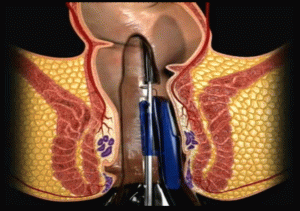
Outside, dressings with Levomekol ointment are applied. To prevent the development of thrombosis, Detralex is taken. If a blood clot has formed, poses an immediate threat to health and life, they resort to surgery - thrombectomy. The node is opened, a blood clot is removed. Healing takes place without suturing.
Hemorrhoid thrombectomy
Conservative treatment of the initial stages of chronic hemorrhoids
Conservative treatment is effective in the initial stages of the disease. Aimed at eliminating the inflammatory process, relieving painful sensations, swelling. A mandatory component of treatment is strict adherence to a special gentle diet. Mild laxatives are prescribed. To strengthen the tone of the vascular walls, special preparations are recommended - Phlebodia, Detralex.
Local treatment involves the use of anti-inflammatory drugs, pain relievers - special ointments, suppositories. Improves local blood flow and circulation.
With the development of bleeding, hemostatic agents are prescribed. In case of hemorrhoids, it is recommended to avoid lifting loads weighing more than 2 kilograms. Control stools, avoid constipation, diarrhea. To improve vascular tone and blood circulation in the small pelvis, do therapeutic exercises, give moderate physical activity.
Surgical treatments
Surgical treatment is prescribed when chronic hemorrhoids in the third or fourth stages. Conservative treatment does not bring the desired result. The application is resumed in the postoperative period to accelerate healing, relieve swelling, and inflammation.
In stages 2-4, an operation is prescribed to remove the inflamed and bleeding nodes - hemorrhoidectomy. A complete surgical removal of the venous plexus in the rectum is performed. This will protect against the development of relapses of the disease.
Surgical treatment of hemorrhoids carried out in a planned manner. An exception is bleeding from a hemorrhoidal bridle with the development of severe anemia. The patient is offered a range of treatment methods to choose from. The final decision remains with the patient. The doctor gives a detailed description, explanations regarding the methods of performing the surgical intervention. The physician presents to the patient the prognosis during the operation and in case of refusal.
The doctor makes the final decision on the method of treatment after examining the patient. Medicine presents types of surgical treatment with varying degrees of trauma.
Ligation operation
Ligation is a surgical intervention for hemorrhoids. A special suture loop is applied to the hemorrhoid. Varicose veins can be removed quickly. Surgery does not injure the adjacent soft tissue. Recovery is fast. Treatment is not applicable for every form of the disease.
Desarterization
The method of treating the disease is considered effective and safe. Under the control of an ultrasound sensor, the affected vessels of the anal region are sutured. Treatment is used for external forms of the disease.


