
Which doctor to go to with hemorrhoids: detailed information on treatment
Many people have heard about hemorrhoids, even more people have come across it personally. A disease that interferes with normal life has become a real scourge of our time due to sedentary and sedentary work. Not everyone goes to a specialist with such a problem, hoping that the signs of hemorrhoids will go away on their own. However, in vain, because you need qualified help from a specialist proctologist.

Which doctor to go to with hemorrhoids
Content
-
1 What is hemorrhoids
- 1.1 The most common causes of acquired hemorrhoids
- 2 Which doctor should I seek help from?
-
3 Treatment
- 3.1 Methods for removing nodes
- 3.2 Video - Hemorrhoids. How to treat and how to diagnose
What is hemorrhoids
Hemorrhoids are a disease associated with varicose veins that form small balls or nodules in the rectum.

Haemorrhoids
The disease undergoes several stages.
- Symptoms are almost invisible at first. You may experience a slight burning sensation after a bowel movement, but it is often attributed to a fissure in the anus caused by constipation. At this stage, the nodules are still in the intestinal submucosa.
- Further, the nodules increase and begin to be injured during the passage of dense feces. As a result, small blotches of blood appear in the feces. The burning sensation intensifies, a transparent exudate is released.
- When the nodes increase in size several times, they can begin to extend beyond the anus, but at the same time then retract back. The sensations are extremely painful, it is difficult for a person to sit and walk. Defecation is painful and bleeding occurs.
- At the last stage, the nodes are so enlarged that they completely fall out, while they can have a color from brown-blue to black. At this stage, most likely, you cannot do without surgical intervention. After all, hemorrhoids bring very severe pain, and constant bleeding aggravates the patient's situation.

Stages of development of a proctological disease
Based on the stage of the disease, hemorrhoids are called internal or external.

Internal and external hemorrhoids
Women are more prone to pathology, since they have more provoking factors for its occurrence: menstruation, pregnancy, childbirth.

Pregnancy and childbirth can contribute to the formation of hemorrhoids
The most common causes of acquired hemorrhoids
- Sedentary lifestyle.
- Poor diet leading to constipation.
- Insufficient fluid intake.
- Predisposition to varicose veins.
- Excess weight.
- Lifting heavy loads abruptly or frequently.
- Injury to the rectum.
- The development of a tumor in the small pelvis.
- Intestinal infections.

The causes of hemorrhoids
Interesting fact! The first mention of hemorrhoids was found in the writings of Hippocrates and the ancient Egyptians.
Which doctor should I seek help from?
There is nothing to be ashamed about in the treatment of hemorrhoids. This is the same disease as everyone else, and it is necessary to prevent its development so that you do not have to resort to surgical manipulations.
The diagnosis and treatment of hemorrhoids is carried out by a proctologist or coloproctologist.

A proctologist (coloproctologist) is a doctor who diagnoses, prevents, and treats diseases of the perineum, as well as the colon, rectum and colon, including polyps, anal fissures and hemorrhoids
Women (especially pregnant women) can also visit a gynecologist, who will give his instructions for concurrent treatment.
Before visiting a proctologist, if the disease is in its initial stage, it is advisable to do a cleansing enema. In other cases, it is undesirable to do such a procedure, since you can worsen your condition.

Cleansing enema
The doctor begins the appointment with the collection of anamnesis. You must be prepared to answer the following questions:
- How often hemorrhoids appear (or is this the first case).
- Is there a tendency to varicose veins.
- Does anyone in the family have varicose veins?
- What is the lifestyle, are there any bad habits.
- How rational is the food.
- Have any medical (or other) manipulations in the rectum been carried out recently, because of which it could be injured?
- What concomitant diseases are there.

An appointment with a proctologist begins with taking an anamnesis
Then, the doctor manually examines the rectum using a digital examination. For convenience, the patient climbs into a special proctology chair. The specialist, wearing a sterile glove, inserts the index finger into the anus and probes the intestinal wall.
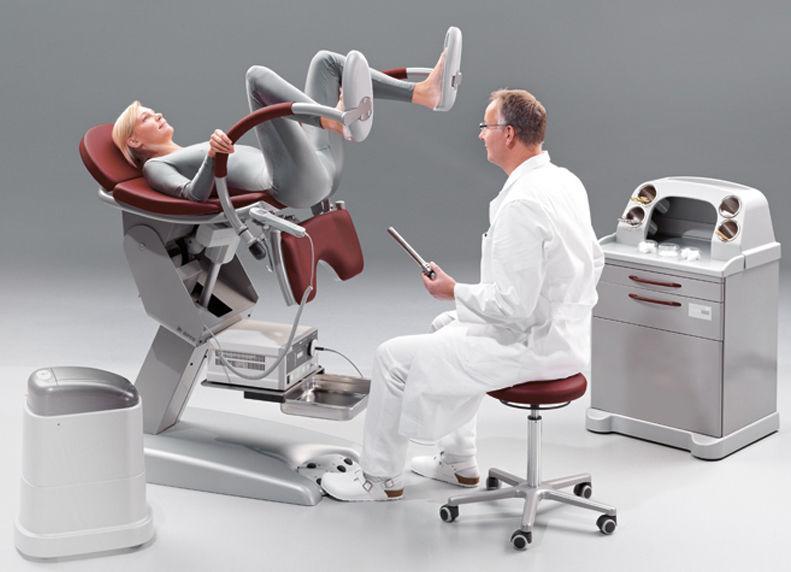
Proctology examination chair
Thus, he can reveal the approximate number of nodes, their size, location. During the examination, the doctor will ask questions about the pain of the procedure, since he will press on one or another part of the intestine.

Conducting a digital rectal examination
In addition to digital examination, additional methods may be required to compile a complete clinical picture.
- anoscopy - is a procedure with which it is possible to examine the anus to a depth of 10 cm. A special tube is inserted into the rectum, which is illuminated, the doctor can visually assess the condition of the hemorrhoids;

Anoscopy of the rectum
- sigmoidoscopy is a method of studying the walls of the rectum using a special rectoscope probe, thanks to which you can visually assess the state of the mucous membrane at a depth of 25 cm;

Rectoromanoscopy (rectoscopy), apparatus
- irrigoscopy - the study of the walls of the rectum using an X-ray, after the introduction of a contrast agent.

X-ray examination
Such studies are not always necessary, the doctor relies on the general picture and sometimes, a simple visual examination and finger examination are sufficient.
In addition, it is necessary to pass laboratory tests of blood, feces and urine, to exclude other latent diseases that can provoke pain in the rectum and bleeding.
After the diagnosis is made, a treatment regimen is prescribed.
Treatment
The doctor may prescribe complex therapy for hemorrhoids, the use of minimally invasive methods or surgery. Everything will depend on several factors.
- Hemorrhoids grade (1 to 4).
- The form of the disease (internal or external hemorrhoids).
- The age of the patient.
- The presence of concomitant diseases.
- Type of hemorrhoids (acute or chronic).
Based on this, a specialist may prescribe the following drug therapy:
- Glucocorticosteroids are drugs based on synthetic hormones that effectively suppress inflammation. Means based on prednisolone and cortisol have proven themselves well: Proctosedil, Ultraproct.

"Proctosedil"
- The drugs are antispasmodics. They are used in the form of ointments and suppositories, for example, "Olestezin", "Nigepan".
- Anticoagulants are drugs that reduce blood clotting and, as a result, prevent the development of stagnant phenomena: "Hepatrombin G", "Heparoid Zentiva".

"Hepatrombin G"
- Venotonics - means that normalize venous outflow: "Procto-glivenol", "Troxevasin".

"Procto-glivenol"
- Hemostatics - drugs necessary for severe bleeding, used to accelerate blood clotting: "Relief-Advance".

"Relief-Advance"
- Immunomodulating drugs that stimulate and maintain local immunity in the rectum, making the treatment faster. The "Posterisan" product, which contains inactivated particles of Escherichia coli, has proven itself well. With the help of it, tissue regeneration is accelerated, inflammation and pain are eliminated.

"Posterisan"
If hemorrhoids are at stage 1, homeopathic remedies can also be used, for example:
- "Fleming's ointment" is an anti-inflammatory and tonic agent for the walls of blood vessels, containing an extract from horse chestnut, extracts of calendula and witch hazel, as well as zinc compounds;

Fleming's Ointment
- "Bezornil", a product containing zinc compounds, borneol, musk, amber and pearls. The drug helps to accelerate the regeneration of damaged tissues, fights bacteria and has an anti-inflammatory effect.

"Bezornil"
In parallel, suppositories and ointments can be prescribed drugs in the form of tablets to enhance the effect.
Attention! Pregnant women are prescribed ointments that do not contain hormones.
If drug therapy does not help, minimally invasive intervention is required.
Methods for removing nodes
| Name | Description |
|---|---|
 Cryodestruction |
A procedure in which hemorrhoids are treated with ultra-low temperature liquid nitrogen. In a matter of seconds, tissue death occurs. Healing proceeds quickly, only a small crust remains on the treated area. |
 Infrared irradiation |
The method by which there is a quick and painless destruction of the tissues of the node. In its place, only a trace remains, as from a slight burn, which instantly becomes covered with a crust, and that, in turn, comes out soon in a natural way. |
 Ring ligation |
A procedure in which special medical latex rings are applied to the knots. They squeeze the leg of the node, which stops the blood supply. As a result, the knot dries up and falls off on its own. |
 Sclerotherapy |
A method based on the introduction of special sclerosant substances into the tissue of hemorrhoidal cones. They destroy the phospholipid membrane of cells, causing their breakdown. |
If hemorrhoids have passed into stage 3 or 4, surgical intervention is necessary, in which the nodes will be excised.

Surgical treatment of hemorrhoids
Do not postpone the treatment of an intimate problem. Elimination of hemorrhoids in the early stages is much easier and more painless than in the subsequent stages, so a visit to the proctologist should be done as early as possible.


