
The first signs of dysbiosis: we identify the disease in the early stages
Doctors say that there is no direct parallel between the clinical picture and the stages. The first signs of dysbiosis are difficult to identify on your own. The adult has no warning symptoms. No wonder doctors say that 90% of the population of Russia are latent carriers of the disease. If children have weight loss as a result of dysbiosis, it is extremely difficult to determine the imbalance in men and women. The authors of monographs operate to determine the severity of the test results, but the diagnosis is not made due to the presence of headaches or dry skin of the face.
The manifestations of dysbiosis in humans are different, depending on the part of the flora that caused it. This prevents the pathology from being recognized if there is a latent (latent) period. A large proportion of patients complain of diarrhea. There is a painful, liquid stool, with an unpleasant odor, blood impurities. Periodically, signs of intestinal dysbiosis intersect with hemorrhoids. Patients are frightened, but worse if the doctor is similarly misled.

Content
- 1 Definition
-
2 Intestinal microflora
- 2.1 Protective functions of microflora
- 2.2 Natural barriers
- 2.3 Microflora composition
-
2.4 Representatives of the obligate microflora
- 2.4.1 Bifidobacteria and lactobacilli
- 2.4.2 Propionobacteria
- 2.4.3 Esherichia
-
2.5 Optional flora
- 2.5.1 Bacteroids
- 2.5.2 Staphylococci
- 2.5.3 Streptococci
- 2.5.4 Bacilli
- 2.5.5 Yeast
-
3 Bacteriological signs
- 3.1 First degree (mild form)
- 3.2 Second degree (moderate form)
- 3.3 Third degree (severe)
-
4 Clinical signs
- 4.1 Dyspepsia of the gastrointestinal tract
- 4.2 Intestinal absorption disorders
- 4.3 Anorectal Syndrome
- 4.4 Vitamin deficiency
Definition
Dysbacteriosis is an imbalance in the intestinal microflora. As a result, digestion suffers: a feature of the disease is the frequent accompaniment of diarrhea due to a violation of water-salt metabolism. The body is unable to retain electrolyte. The course of the disease is characterized by severe dehydration. Sometimes diarrhea cannot be relieved by an extreme measure - a daily hunger strike.
The identified disease needs a comprehensive solution. The doctor and the patient have to solve a number of problems:
- Destruction of pathogenic flora.
- Absorption of toxins, elimination from the body.
- Creation of normal conditions in the intestine.
- Breeding on the created basis of the necessary microflora.
Intestinal dysbiosis symptoms in women and men are similar due to the same pathogens. We emphasize: pathogens displace the normal microflora, settling in the vacant place. This condition is called dysbiosis, which can develop into dysentery, cholera and other intestinal diseases.
In the later stages, the pathogenic flora enters the bloodstream, appearing in unconventional places of localization. For example, it passes from the large intestine into the mouth, causing a symptom of an unpleasant, fatal odor. Elena Malysheva attributes a similar phenomenon to the lake. We add that troubles with the nasopharynx are completely provoked by malfunctions at the level of the lower intestine.
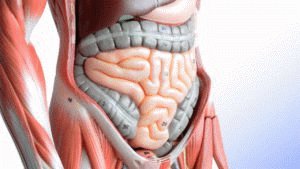
Intestinal microflora
Let's touch on the issue of the presence of microflora in the body. The world around us is filled with bacteria. If different types of microorganisms could enter the intestines with comfortable conditions for reproduction (acceptable temperature, nutrient medium, abundance of moisture), this would lead the body to disaster, destroying person.
Protective functions of microflora
Therefore, the mucous membrane has protective measures against invasion. This includes the production of interferon, immunoglobulins to suppress excess activity. Local microflora plays an equally important role. During its existence, humanity has formed a set of strains for any mucous membrane, the coexistence with which protects against external threats. Regulation takes place in a similar way:
- A microbe that has occupied a certain territory does not allow other types of microorganisms. For example, Fleming was surprised to see how the mold that produces penicillin kills all the pathogenic flora in the area. Something similar happens in the intestines. Bacteria living in the organ form metabolites that regulate environmental conditions in a manner unsuitable for the development of a harmful population.
- Bacteria take up space, prevent external invasion.
Inside a person there is a friendly community that does not favor strangers. However, periodically pathogenic flora infiltrates. When a pathogenic bacterium, getting inside the intestine, due to the weakening of local defense begins to multiply, this is the beginning of the end. Normal microflora gradually dies, giving way to pathogenic.
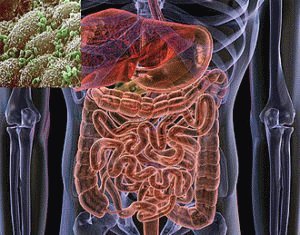
Natural barriers
There is a serious barrier on the way of invasion - a stomach with magic juice - a weak solution of hydrochloric acid. Low pH-factor kills some bacteria, gram-positive (most of the normal microflora) and gram-negative. This explains the scarcity of the population of the stomach.
The digestive juice kills the pathogenic and beneficial flora. Above we talked about gram-positive and gram-negative bacteria. Although the former dominate, the species cannot be said to be safe. This, for example, includes Clostridia - causative agents of botulism, gas gangrene and other serious diseases.
Barrier systems are characteristic of the human body. For example, the brain is shielded from the body by the blood-brain barrier. For this reason, it is impossible to unequivocally consider a person who resists alcohol to be a teetotaler with a strong will.

Microflora composition
Signs of dysbiosis in adults are identified by changes in the intestinal flora. For the most part, we are talking about the large intestine due to the features listed above. The population density gradually increases with movement towards the anus. The maximum number of inhabitants is concentrated in the large intestine. Bifidobacteria dominate - anaerobic flora. Traditionally, it is customary to divide populations into three categories:
- Obligate microflora is considered a full-fledged population. It prevents the penetration of pathogenic strains from the outside, performs a number of useful functions: synthesizes vitamins, ferments proteins and fiber, and forms immunity. The concentration of the population reaches hundreds of billions of units, accounting for 90% of the local population.
- The optional flora is represented by a conditionally pathogenic part. For example, Staphylococcus aureus, which is much more common in the upper respiratory tract, is practically indestructible. Easily causes joint damage.
- Transient microflora does not linger for a long time under normal conditions. It becomes the cause of the disease or dissolves without a trace.
Pathogenic flora is not included in the classification. For the time being, it is suppressed by normal microflora and immunity. Constantly ready to cause the corresponding disease.
Representatives of the obligate microflora
The long conversation about microflora is not accidental. If a person knows about the functions of typical representatives of the biota, he knows about intestinal dysbiosis. The clinical picture is a failure of the function of the obligate part of the populations: vitamin deficiency, weakened immunity. A knowledgeable person will be able to identify dysbiosis by external signs.
Bifidobacteria and lactobacilli
vita brevis ars longa
The specified share of anaerobes is 90 - 98% of the total number. In children, at the stage of microflora formation, Lactobacillus brevis and Bifidobacterium bifidum dominate. The former are one of a number of reasons for beer fermentation and are part of kefirs. The latter are found in human milk. There is nothing surprising in the ingress of microorganisms into the intestines of the child. Both species are found in the vagina at a concentration of 1 million. units.
Lactobacilli are relatively few. An order of magnitude less than bifidobacteria. There are 44 species of lactobacilli, their habitat is wider, they are found even in the stomach, in low concentration. Lactobacilli are predominantly involved in maintaining the desired pH level, playing the role of an important prerequisite for suppressing foreign microflora.
Diseases caused by bifidobacteria are unknown.
Propionobacteria
As part of the anaerobic obligate microflora, organisms maintain a pH level within 5.5, suppressing the growth of pathogenic flora. With excess reproduction, they easily cause acne formation - propionobacteria are to blame for acne vulgaris in adolescents.
Esherichia
Aerobic gram-negative bacteria - Escherichia coli, present in the colon and distal small intestine. Detection in other areas indicates the development of severe or pre-severe dysbiosis. They penetrate into the oral cavity, duodenum, stomach and gallbladder. Most of them are full-fledged strains, 5-10% have weak enzymatic properties.
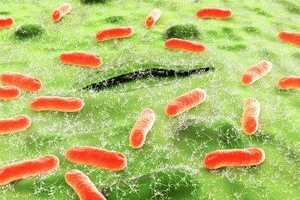
Escherichiosis of the intestine
Hemolyzing (blood-destroying) colonies are considered pathogenic; they are not observed in a healthy state in humans. This state is explained by antagonism on the part of bifidobacteria and lactobacilli. When spreading outside the habitat, E. coli causes inflammation, leading to sepsis.
Optional flora
Why there is an optional part of the flora is difficult to say. For example, a representative - Staphylococcus aureus - lives in the nasopharynx of the vast majority of the population.
Bacteroids
The complex of gram-negative rods is represented by the mentioned microorganisms. With age, the number increases up to 100 billion. units per 1 g of feces. And although representatives break down bile acids, they enter the metabolic chain of fat processing, with favorable conditions, they easily cause inflammation, starting with the oral cavity and ending wounds.
Staphylococci
Pathogenic flora present in the body. A small number is not destroyed by the immune system.
Streptococci
Children who are bottle-fed have 1-2 orders of magnitude more than the indicated cocci. Most of them are harmless, prevent the invasion of pathogenic flora, and help develop immunity. However, pathogenic strains cause a number of diseases, such as sore throats.
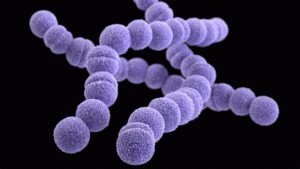
Streptococcus bacteria
Bacilli
Aerobic and anaerobic strains are present. In breastfed babies, it is almost completely absent. Clostridia belong to the class of bacilli. Peaceful representatives break down proteins, stimulate the mechanical functions of smooth muscles. Pathogenic strains cause dangerous diseases, leading to botulism (to which immunity is not developed). Easily brought to diarrhea, the contents of the intestines begin to rot.
Yeast
The yeast in the intestine is the smallest. Excessive reproduction causes all sorts of inflammatory processes, from the oral cavity to the urethra.
Bacteriological signs
In modern practice, feces are sown. According to the results of the study, a diagnosis of intestinal dysbiosis is made. According to the criterion, intestinal bacteriosis is divided into three degrees of severity, the indicator is the density of the population of microorganisms.
The degrees are very different for people younger and older than 60. Quantitative differences reach the same order of magnitude.
First degree (mild form)
- Up to 60 years: the density of bifidobacteria decreases to 100 million. units, lactobacilli - up to 1 mln. Increased or decreased content of Escherichia coli - from 1 mln. up to 10 billion
- After 60 years: the level of bifidobacteria is within 10 million, lactobacilli - up to 100 thousand. Escherichia coli - the same.
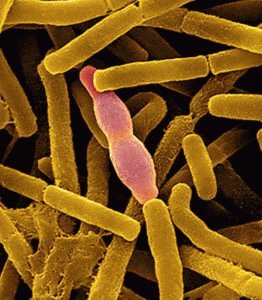
Colibacillus
Second degree (moderate form)
- Up to 60 years: the population density of bifidobacteria falls to 10 million. and below, lactobacilli - up to 100 thousand. Appear hemolytic Escherichia coli in a concentration of up to 10 mln. An increased content of conditionally pathogenic flora (up to 100 thous. units).
- Over 60: the density of bifidobacteria drops to 1 million, lactobacilli - to 10 thousand. With Escherichia coli and conditionally pathogenic flora - the same is true.
Third degree (severe)
The signs observed at the previous stage remain, but the amount of conditionally pathogenic flora increases sharply, up to 10 million. units. In the presence of pathogenic flora, a diagnosis of a different disease is already being made, intestinal dysbiosis is considered as a concomitant phenomenon.
Clinical signs
Before considering the bacterial picture, it will be logical to give a general idea of what clinical signs are concomitant. The performance is formed from the functions of an obligate flora that forms immunity, produces vitamins, ferments proteins and complex carbohydrates. All of the above is violated. Immunity decreases, vitamin deficiency develops (group B, K and PP), the body is poisoned with toxins. A similar picture is superimposed on the specific action of the pathogenic flora:
- Reduced mucosal resistance (to colonization).
- Disorder of the motor function of the intestine, its blood circulation.
- Decreased detoxification function.
- Weakening of immunity.

Dyspepsia of the gastrointestinal tract
Dyspepsia is understood as a complex of non-dangerous symptoms associated with a disorder of the digestive system: bloating abdomen, flatulence, pain on palpation along the path of the colon (form of the Greek Omega), heartburn, belching, vomiting and nausea. Diarrhea is observed, feces are liquid, sometimes foaming, smelly or with a sour odor. Traces of blood, blue mucus may be present. Bloating is sometimes observed separately in the right and left hypochondrium.
The dominance of Proteus provokes frequent, loose stools (6-8 times daily). The feces are frothy, greenish in color, with an unpleasant odor. Pseudomonas aeruginosa forms the appearance of feces, according to the name. The excrement is full of mucus. Staphylococcus aureus presents a complex of symptoms that is similar to Proteus; instead of an unpleasant odor, streaks of blood may be present. The color of the stool is greenish.
Intestinal absorption disorders
Carbohydrates are poorly absorbed, diarrhea is constantly pursuing. Against this background, there is a complex of deficiency of vitamins of group B, K, PP. Calcium absorption is impaired:
- Anemia of fingers, lips.
- Apathy.
- Depression.
Anorectal Syndrome
It is expressed as a consequence of the excessive use of antibiotics. Already in the latent period, there are manifestations:
- Migraine.
- General poor health.
Later added:
- Elevated temperature.
- Itching, burning around the anus.
- Discharge mucous and bloody.
- False urge to defecate.
- Dull pains.
Vitamin deficiency
It is necessary to separate the phenomenon from the violation of absorption, in this case, the violation of the formation of vitamins in the gastrointestinal tract is implied. B vitamins stimulate smooth muscles, their absence leads to constipation. The tone of the intestinal walls is reduced, blood circulation is impaired. Anemia develops. Lack of vitamin K leads to a decrease in blood clotting.
Intestinal dysbiosis causes vitamin B2 deficiency. Stomatitis develops, lips crack, less often hair falls out, nails change. People with a lack of thiamine do not sleep well, are nervous, and they develop neuritis. A low intake of PP causes depression. Tongue and pharynx are bright red, saliva is constantly flowing.
There is a lack of fat-soluble vitamins. Intestinal dysbiosis in acute form causes severe disturbances that occur less frequently.