
Catarrhal colitis of the intestine: symptoms and treatment of the disease
For further consideration of the concept of catarrhal colitis of the intestine, you need to know what the human intestine is.
Intestine (translated from lat. Intestinum) - the department of the digestive system, next to the stomach, is responsible for the final digestion of incoming food, the absorption of nutrients and the elimination of residues. In humans, it begins with the stomach and ends with the anus for excretion of feces.
Catarrhal colitis is the initial stage of the inflammatory process of the mucous membrane of the colon walls. This is one of the most common bowel diseases.
The incubation period of the disease lasts 1-3 days. If at this moment no action was taken, then the ailment only aggravates and progresses to subsequent stages: fibrinous stage, then chronic stage of colitis - and smoothly turns into ulcerative.
With the diagnosis "catarrhal colitis", the mucous membrane of the small intestine becomes inflamed, reddening of the walls occurs, narrowing of the lumen of the large intestine. Bleeding ulcers appear on the affected area, then tissue necrosis.
Depending on the distribution and volume of the affected areas of the intestine with this disease, the following stages are distinguished:
- Colon inflammation - 15-20%.
- Left-sided intestinal inflammation - 25-30%.
- General rectosigmoiditis - 50-55%.
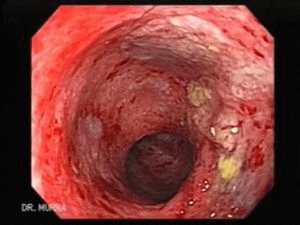
Colitis in the intestines
Content
- 1 Colitis types
- 2 The causes of the onset of the disease
- 3 Symptoms of the disease
-
4 Diagnostics and treatment
- 4.1 Diagnostic steps
- 4.2 Treatment methods
- 5 Nutrition and disease prevention
Colitis types
The disease is divided into two forms of development:
- Acute colitis
- Chronic focal colitis.
The acute form develops as a result of all sorts of infections and bacteria entering the intestines. This happens more often in the summer, when there is a wide variety of vegetables and fruits and people eat them dirty.
The symptoms of the disease are clearly expressed, appear very quickly and are of the following character: aching pain, spastic, twitching and cutting sensations. If treatment is postponed until a later date, then subsequent complications are possible: peritonitis, bleeding.
In case of untimely treatment, colitis becomes chronic.
Chronic focal colitis is more sluggish with intermittent exacerbations.
Long-term inflammation of the intestinal tissues leads to the fact that they become thin and stop functioning properly or die off altogether.
Chronic focal colitis is of three types:
- Spastic - an overestimated tone of the intestinal walls, leading to spasms.
- Distal - forms hypertonicity of the sigmoid and descending divisions.
- Hypertensive - during endoscopy, a very narrow uneven lumen and hypertonicity of the entire colon are revealed. The main symptom of this type of disease is delayed excretion of feces with the presence of purulent mucus. In most cases, this type of colitis is observed in people who have had intestinal infections or dysbiosis before the disease.
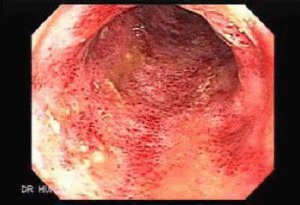
Chronic colitis
The causes of the onset of the disease
The variety of causes of the disease is as follows:
- The presence of parasites, viruses, infections, bacteria in humans. They penetrate when drinking water and food of questionable quality is consumed.
- Deficiency of vitamins, minerals and trace elements in the body.
- Unbalanced diet.
- Stress.
- Uncontrolled intake of medication not prescribed by a doctor.
- Other diseases of internal organs.
- Weak immunity.
- Exposure to poisons and toxins.
- The presence of allergies.
Symptoms of the disease
These include:
- Headache.
- Increased body temperature.
- Belching followed by bitterness in the mouth.
- Loose stools (constipation): purulent, slimy, or bloody.
- Sharp pains in the abdominal region during palpation.
- Bloating.
- Vomiting, dizziness, irritability, fatigue, drowsiness.
- Lack of appetite.
- Dehydration of the body.

Diagnostics and treatment
If at least one symptom or cause indicating an ailment appears, you must immediately contact a specialist for examination and treatment.
Diagnostic steps
- Patient interview.
- General examination and palpation of the abdomen.
- Collection of material (blood, urine, feces) for laboratory research.
- Colonoscopy, irrigoscopy, endoscopy.
With the help of instrumental intervention, it is possible to take intestinal tissue for biopsy.
Based on the test results, the doctor may prescribe outpatient or inpatient treatment, depending on the degree of the disease. If catarrhal colitis is detected in the early stages of its development, it is necessary to give the patient a gastric lavage and an enema.
Treatment methods
- Medication.
- People's.
With drug treatment of the disease, the patient must constantly be under the supervision of the attending physician. Taking medications for treatment is most effective. This method is aimed at eliminating severe attacks of pain and the causes of the disease. More effective in the treatment of the disease can be called drugs such as "No-shpa", "Ftalazol", "Duspalatlin", "Suprilol", "Loperamide" and many others.

The traditional method includes home treatment using medicinal herbs and infusions. Recovery is more active, and the disease is cured almost completely. Ready-made herbal preparations can be purchased at pharmacies. But it is not recommended to self-medicate, as this leads to an exacerbation of the disease or a disastrous result. Before you need to consult a specialist.
Commonly used home treatment options are:
- Infusions of chamomile, sage, viburnum. You need to drink warm in small sips.
- Onion juice. Drink for constipation.
- Potato juice.
- Infusion of steamed flax seed. This remedy is effective for constipation.
- Linseed oil.
Nutrition and disease prevention
The basis of nutrition for catarrhal colitis is diet. It is compiled for each patient individually, depending on the neglect of the inflammatory process, and in what condition the large intestine is. The patient needs to draw up a detailed list of foods that contribute to the deterioration of his condition in order to exclude them from the diet.
These product categories include:
- Fatty, sour, spicy and salty foods.
- Conservation.
- Spices.
- Raw fruits and vegetables.
- Dairy and fermented milk products.
- Alcoholic and carbonated drinks.
- Bakery and flour products.
In the early stages of the disease, it is recommended to consume a lot of liquid - 2-3 liters per day, since the disease is often accompanied by diarrhea and dehydration occurs.
The diet should consist of light chicken or vegetable broth, low-fat and light soups, cereals, jelly, low-fat fish. It is preferable to cook food by steaming, oven or in a slow cooker. Eat more often, at least 6 times. Food portions should be small so as not to overload the stomach. As the state of health improves, they begin to introduce into the diet the usual food in a reasonable amount.
Alas, it is impossible to foresee the appearance of the disease in advance, but for prevention it is necessary to follow simple precautions, such as:
- Hygiene.
- Nutrition balanced with vitamins and minerals.
- Compliance with the diet.
- Sports activities.
- Give up partially or completely the use of alcohol and tobacco.
- Undergo medical examinations and medical examinations every year.
Catarrhal colitis can be the basis for the development of chronic intestinal diseases and at the first manifestations it is better not to start it, diagnose it in a timely manner and start treatment. It is necessary to follow the recommendations of specialists and be treated correctly in order to achieve the result.
Be healthy!