Analysis for allergy
 Due to the constant increase in the population of the Earth, the number of allergic reactions, allergy tests are quite in demand. A reliable and traditional method of diagnosing allergy are allergic tests, which include intradermal tests, scarification tests( scratch method) and prik-tests( prick method).
Allergic probes are used for the diagnosis of such diseases as respiratory allergoses( pneumonia, bronchitis, tracheitis, laryngitis, sinusitis, rhinitis), atopic dermatitis, drug allergy, eczema on the hands, food allergy, bronchial asthma and pollinosis. The purpose of conducting allergoproobs is to identify provoking allergens that can affect the development of the symptoms of the disease. Contraindications for allergic tests: severe general condition of the patient;long-term therapy with hormonal( corticosteroid) drugs;exacerbation of any chronic or current allergic disease;acute infectious process.
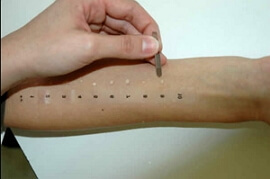
All allergy tests can not be performed immediately, because a general clinical examination is performed before the allergy test, which includes a general blood and / or urine test, pediatrician( children) examination, and a biochemical blood test. A standard set of allergens for allergic tests is as follows: skin( epidermis) of animals, food, wool, down, pollen of plants, house dust, etc. The standard place for carrying out skin tests is the inner surface of the forearm, about three centimeters from the wrist. In the event that the patient has an allergic skin disease, the samples are taken on unaffected areas.
How is the allergy test performed? Allergen is injected intradermally, or a drop of the allergen chosen from the standard kit is applied to the site of the sterile scraicket or scratch. If there is an allergy to the chosen allergen, after a certain time, redness or swelling of the skin appears on the injection site. Usually the result is evaluated under bright light after one or two days. If the diameter of the papule exceeds 2 mm, the sample is considered positive. During one study, about fifteen to twenty samples are allowed.
Allergic tests in children are allowed only after reaching the age of five, since it is up to this age that they develop immunity, which can adequately respond to the analysis of allergy tests. If the samples are taken at an earlier age, complications can develop, including serious aggravation of allergic reactions and chronic diseases. Carrying out allergic test at an early age is replaced with a special blood test.
Where to take tests for allergies? I also want to note that skin tests should be performed under the obligatory constant supervision of an allergist in special allergological rooms or institutions, since there is a high probability of developing a serious negative reaction.
And, on the contrary, in contrast to allergic tests, immunological tests are completely safe, which consists in carrying out blood samples for specific antigens to a certain allergen and samples for common immunoglobulins.
The analysis of blood for allergies is probably the most common type of tests performed to diagnose this condition. Analyzes of blood for allergies allow you to identify in the blood substances called antibodies. The most common type of blood test is an enzyme immunoassay, which helps to measure the level of antibodies in the blood, to which the body gives an allergic reaction. Often, the level of antibodies is elevated in people with bronchial asthma or allergies. To obtain detailed and more detailed information, testing methods such as immunological and allergic sorbent tests are shown. The analysis of blood for allergy is used in the following cases:
• If the patient has any difficulty in correctly interpreting the results of the scarification test, a dermatological disease( eczema, urticaria, etc.)
• If the patient for valid reasons can not stop taking detrimental or blocking reactionson the allergen of tricyclic antidepressants and antihistamines
• If the patient has a serious allergic reaction, for example, anaphylactic shock
• If the patient has positive skin tests for many
productsAllergy Analysis in Children .To prevent the development of severe allergic effects in children, the analysis of allergy in children is shown. To begin with, this analysis can be done at home. In case of suspected allergies to foods, one should alternately exclude from the diet constantly consumed products, carefully following the current state of the baby. However, in order to more accurately determine the allergen-provoking allergic reaction, allergies should be tested in a laboratory. In addition to the blood test, it is possible to carry out skin tests.
In conclusion, I want to summarize all of the above. In the case of the slightest suspicion of allergy, you need to do a long time without making an allergy test. You should know that sometimes you can cure allergies without the use of medications, and just correct your lifestyle. The cheapest and easy method of identifying allergies are skin tests for allergies. However, they practically do not work, if a possible allergic reaction to food is required. In such cases, a blood test for allergy is performed, which is a good alternative to skin tests, since it does not cause the development of an allergic reaction. In addition, blood tests are shown to people who previously had anaphylactic shock. Also, if a person has any kind of allergy confirmed, before carrying out any kind of surgery, it must be checked for the presence of such an allergic reaction as an allergy to latex. In this situation, the most attractive is the blood test. In the case of latex allergy, surgeons and attendants should not use medical latex gloves during surgery.