Pancreatic cyst: symptoms and treatment
Cysts in the human body can pose a serious danger, since they can degenerate into malignant tumors.
Education is formed at any age, development in children is not an exception.
Pancreatic cyst is a pathology in which cavity structures appear in the organ, they are filled with pancreatic secretions and other components.
Pancreatic cells in this state die, being replaced by fibrous tissues.

Content:
- 1 The reason for the development
- 2 Cyst classification
- 3 The main symptoms
- 4 Disease stages and complications
- 5 Diagnostics
- 6 Treatment
- 7 Food
- 8 Forecasts
- 9 Useful video
The reason for the development
The pancreas plays an important role in the entire digestive process. At the expense of the organ, chemical substances are broken down, as well as their rapid assimilation in the body.
The structure of the organ is such that a cyst can develop in it, but its appearance is not normal and is caused by various reasons.
All of them are divided into primary (congenital defects of the pancreas) and secondary (acquired during life).
The mechanism of appearance lies in the fact that the organ is destroyed on its own, destroying healthy tissue.
Due to this negative effect, an accumulation of dead tissue appears, after which the body tries to limit healthy cells from the dead, creating a capsule.
After a while, it is filled with a secret and other contents, which is a cyst.
The main reasons for the development of a pancreatic cyst are:
- Birth defects are caused by blockages in the ducts.
- Gallstone disease, with stones.
- Pancreatitis in any form and any kind.
- Pancreatic necrosis.
- Mechanical damage to the organ.
- Endocrine diseases such as diabetes or obesity.
- Infection of an organ with parasites and other pathogenic bacteria.
Education can affect different parts of the organ, therefore, it is necessary to identify the reasons that result in the development of a cyst of the head of the pancreas:
- Congenital malformations.
- Alcohol and cigarette abuse.
- Improper nutrition, when a person's diet contains a lot of fried, fatty or spicy foods. In this case, a deposition of cholesterol appears, the plaques of which accumulate on the walls of the gland canals.
A congenital cyst of the pancreatic head is rarely diagnosed due to its small size.
It does not cause pressure on other internal organs, does not manifest itself visually. The cyst of the head of the pancreas proceeds as follows:
- Neutrophils and lymphocytes enter the site of injury, after which isolation from the parenchyma occurs.
- The connective tissues grow, a granule appears.
- In the middle of the focus of tissue development, the immune system kills, and voids appear.
- When the cyst is connected to the ducts, it is filled with secretion, dead tissues and an inflammatory process occurs.
In 90% of all situations, the development of a cyst causes pancreatitis, trauma and calculi in the ducts of the gland.
Cyst classification
To understand the symptoms and treatment of a cyst, it is customary to classify the disease. There are the following types:
- Congenital cyst - when a problem appears from birth, even during the intrauterine formation of the fetus. A congenital cyst does not grow over the years, and only epithelial cells are contained inside.
- A pseudocyst is a neoplasm that can develop over the years of life as a result of inflammation of the pancreas, as well as other described reasons.
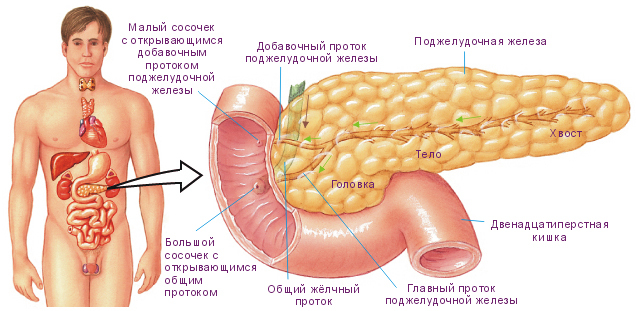
Formations can be in different parts of the affected organ. Therefore, there is a cyst of the tail of the pancreas, head and body.
According to statistics, the head is least susceptible to formations, the development of pathology occurs only in 15% of people.
The rest of the patients will have a cyst of the tail of the pancreas or organ body.
Most of the diseases appear due to the inflammatory process, the development of pancreatitis of any type and form, only 10% of cases are caused by organ trauma.
After an acute course of pancreatitis, a pancreatic cyst appears in different ways. In medicine, it is customary to distinguish the following course:
- Acute - the cyst develops very quickly, but there are no clear walls. For the cavity, ducts, fiber and parinchematous tissues are used.
- Subacute - appears as a result of an acute cyst, in other words, it is a chronic form of the pathological process, and the formation itself appears from fibrous tissues or granules.
- An abscess is an inflammation with purulent contents, a serous substance appears in the cyst cavity.
A pancreatic cyst may not have complications, but in some situations it causes fistulas, accumulation of blood, pus, and other problems.
The main symptoms
The symptomatology of the pathological process does not always manifest itself, it all depends on the size and location of the formation.
If the pancreas is affected by only one cyst up to 5 cm, then there will be no symptom, since there is no pressure on other organs and channels, the nerve endings are not compressed.
In the presence of diseased formations, patients develop pronounced signs, among which the most important will be pain syndrome.
The strength and other features of pain depend on the degree of damage:
- With the development of a false type of pathology as a result of pancreatitis, the symptoms are sharp and strong, affecting the lower back, left side.
- With purulent inflammation or rupture of the cyst, a rise in temperature begins, the sudden appearance of pain, which cannot be tolerated.
- If the formation compresses the solar plexus, then the patient will have burning sensations radiating to the back.
As for the main symptoms by which the development of a cyst can be determined, they will be as follows:
- Pain under the right or left rib. In some cases, the symptom appears in the navel area. The symptom has a different strength and nature of manifestation, it can radiate to other parts of the body. Without treatment, the symptoms only get worse.
- You can use palpation to determine the compaction of the walls of the abdomen.
- The patient's appetite decreases, nausea and vomiting develop.
- If the cyst enlarges, the internal organs may be compressed, which leads to stagnation of bile and causes jaundice. The work of the digestive system is also disrupted.
- In patients, the color of urine and feces changes.
- With additional infection of the organ, weakness in the body and a feverish state appear.
As a rule, without treatment, the cyst on the pancreas gradually grows, after which it ruptures.
The entire contents of the bladder enter the abdominal cavity, bleeding, severe pain, sweating and fainting develop.
The pancreatic cyst must be quickly treated, which avoids complications and serious consequences, in addition, pathology can cause death.
Disease stages and complications
A cyst in the pancreas develops in several main stages. In medicine, it is customary to distinguish 4 main stages:
- The first stage develops up to one and a half months after the development of acute pancreatitis. At this time, the first symptoms of the disease may develop, an initial cavity develops in the gland. The pathological process appears in about 15% of patients after acute pancreatitis.
- The second stage appears in about 2-3 months. At this time, the formation of capsules begins, the walls become loose and can easily rupture.
- Stage 3 appears up to six months. This time is characterized by the end of the development of the capsule, the cyst acquires dense fibrous walls.
- The last stage develops up to a year. The pancreatic cyst is already fully formed, has the ability to move, due to which it easily moves away from other tissues.
The main danger of the pathological process is that the cyst can degenerate into malignant tumors.
Its cavities can be both benign and cancerous. If cancer of the gland is developed, then treatment is almost impossible, the course of the disease is very rapid, and extensive metastases appear, which affect many internal organs and healthy tissues.
A benign cyst is also considered dangerous, since it can rupture, after which peritonitis appears.
The appearance of fistulas is another serious consequence of a cyst. With the development of these, the risk of infection, damage by pathogenic bacteria and other infections increases.
With a large size of education, squeezing of the channels of the organ, vessels, and also internal organs begins, which leads to the following:
- Obstructive jaundice appears, with a cyst of the head of the pancreas.
- Swelling of the legs in case of pressure on the portal vein.
- When the urinary tract is squeezed, incontinence of varying severity can develop.
- In some cases, intestinal obstruction develops. This problem appears very rarely, only in the presence of very sick cysts.
Determining the treatment, excluding the development of complications is possible only with qualified diagnosis.
Each person with the development of characteristic symptoms should immediately consult a doctor in order to stop the disease at the very beginning of development. In this case, the prognosis will be favorable, the treatment will be short and cheap.
Diagnostics
To identify a pancreatic cyst, patients need to consult a gastroenterologist. During the first examination, complaints and main symptoms are collected.
After that, the doctor will conduct a visual assessment of the condition, palpation, which allows you to assess the protrusion of the walls and their boundaries.
After that, the doctor prescribes several additional examination methods:
- Delivery and analysis of blood and urine is carried out.
- Ultrasound makes it possible to see the cyst, its place of formation and size. In addition, the technique allows you to determine the number of cavities, possible complications.
- MRI is done to visually assess the cyst, clarify the exact dimensions, and also assess the connection of the cyst with the organ channels.
- Scintigraphy - the technique is used as an adjunct to clarify the localization of the formation in the organ cavity.
- Endoscopic retrograde cholangiopancretography is a very accurate method that is used for a detailed study of the cavities, structure, and also the interaction of the tumor with the gland channels. The technique is rarely used, since there is a likelihood of infection during the course.
- Radiographs are used to outline the boundaries.
If the doctor cannot establish the shape and structure of the tumor, then biological material must be taken, which makes it possible to exclude or confirm the malignant origin of the tumor.
Timely determination does not allow the development of cancer of the affected organ.
Treatment
The main method of treating cysts is surgical. If the lesions are significant, multiple, then the use of medications will not give the desired results.
With a single and small cyst, up to 5 cm, the operation is not performed, however, the formation should not cause sharp symptoms and disturbances from other organs.
A malignant cyst is removed surgically, even if the size is minimal.
In medicine, 3 methods are used for surgical treatment:
- Resection, which means full pressure of the damaged parts.
- Laparoscopy.
- Drainage of the cyst.
In the first case, the operation consists in the complete removal of the cyst body, as well as the part of the gland that was adjacent to the tumor.
The site of the operation depends on the size of the formations, as well as the condition of the inner walls of the pancreas.
If drainage is used, it can be internal or external. Internal drainage is carried out at the junction of the tumor body and stomach, 12 or small intestine.
The technique is considered safe for humans and improves well-being. Due to this method, pain disappears, the contents of the cyst are removed, the likelihood of repeated development of the cyst is reduced to a minimum.
External drainage is used in cases where the patient has complications of the disease:
- Pus appears inside the cyst.
- The walls of the tumor are not yet formed and can easily rupture.
- In the cavity of formation there is the development of a large number of new vessels.
- The general condition of the patient is extremely serious.
External drainage can cause unwanted results, including:
- The appearance of fistulas.
- Cyst growth.
- The emergence of new tumors.
- Blood poisoning rarely occurs.
Drainage can only be performed with a benign tumor.
The last method of treatment is laparoscopy, a minimally invasive technique that does not require large incisions on the body.
When using this method, patients recover quickly, rehabilitation is short.
The method is used only to remove single, but bulky cysts. In problem areas, a puncture is made with a needle, after which the contents of the cyst are sucked out.
Treatment with medicines allows you to correct the general condition, can affect the development of the underlying pathology, which caused the appearance of a cyst.
If a person has pancreatitis, then it is imperative to take enzymes, which normalizes the digestive system, eliminates high loads from the pancreas.
Antispasmodics or analgesics can be used to relieve pain and spasms. It is imperative to monitor the rate of blood sugar.
Food
The essence of dietary nutrition with cyst damage is to eliminate any load on the pancreas.
The correct diet makes it possible to exclude the re-development of tumors, and also normalizes the release of enzymes. The basic principles are as follows:
- Fractional meals are used, you need to eat in small portions, often, the interval between meals should not be more than 3 hours. When hunger appears and it is impossible to eat normally, you need to have a snack with permitted foods.
- All products and dishes should be crushed, grinded.
- The main methods of heat treatment: cooking steamed, boiled, stewing and baking.
- Fatty and fried foods are completely excluded.
- The use of sweets and muffins is decreasing.
- The main food should be protein, with 70% - animal products.
- Fatty meats and fish, mushrooms in any form and legumes are completely excluded.
- It is very useful to use low-fat dairy products, poultry without skin, boiled eggs and plant products that are heat treated.
- From drinks it is recommended to use fresh juices, diluted with water, homemade compotes, jelly.
- Fresh bread should be replaced with breadcrumbs or plain biscuits.
- Soups are made on the basis of cereals, vegetables, using meat or fish broth. The broth itself is used only 2 or 3, dressing of the first courses of 1 tbsp is allowed. sour cream or butter.
- Alcohol, coffee, soda and grape juices should be removed from the menu.
- Preservation, pickles, smoked, pickled foods are removed from the diet.
- Spices and herbs are prohibited.
- From plant products, you can not use those that contain essential oils, oxalic acid.
The diet is used throughout life, and if you deviate from the basic rules, it may worsen.
Forecasts
The prognosis of the life and health of the patient directly depends on the main causes, the course of the disease and the correct treatment.
The disease is relatively safe, but in many people a complication begins after a cyst, which leads to undesirable, disastrous consequences.
After removal of the cyst, the likelihood of recurrence is not excluded, new tumors may appear.
If the doctor's recommendations happen, constantly use medications, proper nutrition, and also undergoes a routine examination, the chances of favorable results increase significantly.
People can live normally after treatment, and this does not affect the quality of life. In order to prevent and normalize the patient's condition, you need:
- Observe the basic rules of nutrition.
- Give up alcohol and smoking completely.
- Timely diagnose any diseases of the gastrointestinal tract, as well as malfunctions of the digestive system.
A pancreatic cyst does not develop very often, but if the problem has already appeared, immediate treatment should be provided.
Otherwise, there is a likelihood of a significant deterioration in health, the risks of death increase.
Modern medicine has many methods that allow the patient to live with a cyst for a long time, without significant changes.