Dysphagia: types, causes, symptoms, treatment and degrees
Dysphagia - Difficulty swallowing. According to the international classification of diseases, the ICD-10 code is R13. Swallowing food or saliva occurs reflexively and consists of several phases:
- Oral - carries out the movement of food or liquid behind the palate. It is provided by the work of the brain.
- Pharyngeal - occurs involuntarily and rapidly due to the reflex. Thanks to her, food immediately continues its path to digestion, moving towards the esophagus.
- Esophageal - provides movement along the esophagus. It is carried out due to the unconditioned reflex.
Content
- 1 Types of dysphagia
- 2 Symptoms
- 3 Causes
- 4 Treatment and first aid
- 5 Folk remedies
Types of dysphagia
Dysphagia can have different stages, depending on the location of the problem. The varieties are defined:
- Oropharyngeal (oropharyngeal) - difficulty in the passage of food and fluid into the esophagus. It is caused by a disorder in the work of the muscles of the pharynx.
- Pharyngeal-esophageal - a violation of the rapid entry of food into the esophagus.
- Dysphagia of the esophagus (esophageal) - develops with difficulty swallowing slowly, making it difficult for food to pass.
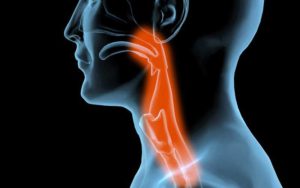
It is difficult for a person to swallow
There are 4 stages of impaired swallowing, when:
- Swallowing obstructions are present exclusively with certain harsh foods.
- Without obstacles, only a watery or puree-like consistency passes into the esophagus, it is impossible to swallow a solid lump.
- Paradoxical dysphagia sometimes occurs. Its paradox lies in the fact that solid food passes better than liquid food (another name for the Lichtenstern symptom). Only liquid is not available for swallowing.
- A person cannot swallow in principle.
Symptoms
With this unpleasant and often dangerous disease, noticeable signs appear - it becomes painful to swallow, breathe, obsessive sensation of a foreign body in the throat, and choking on food. Often, patients complain of gag reflexes when swallowed, bad breath, a sharp weight loss, frequent heartburn, and dehydration.
For diagnosis, the patient is asked to try to swallow food or water while observing the swallowing reflex. In addition, in-depth studies are carried out:
- Ultrasound of the thyroid gland.
- EGD of internal organs (fibroesophagogastroduodenoscopy).
- MRI.
- X-ray.
- Otolaryngologist consultation.
Causes
The factors that caused dysphagia determine the true and functional (on a nervous basis) form that occurs if the upper gastrointestinal tract is affected. Most often, the violation is caused by the pathology of the esophagus, but this is not the only source of difficulty.
The classification of the causes of the disorder depends on the type of dysphagia.
Oropharyngeal arises as a result of the following diseases:
- Parkinson's disease;
- cerebral hemorrhage;
- sclerosis;
- paralysis;
- polio;
- weakness, muscle dystrophy (dysarthria and dysphonia are possible).
The causes of esophageal dysphagia:
- achalasia;
- esophageal spasms;
- oncology that has affected the stomach or esophagus;
- compression of the esophagus by neighboring organs (due to tumors, aortic aneurysm, an increase in the size of the heart, with cervical osteochondrosis);
- alkaline burns;
- scars caused by inflammation;
- solids in the esophagus (tablets, large pieces of food, bones).
As a result of iron deficiency anemia, sideropenic dysphagia can occur. It usually occurs when a person's age reaches retirement, since older people are in a horizontal position most of the time. With dysphagia of valsalva, swallowing is difficult due to a fracture of the hyoid bone. With osteochondrosis, food dysphagia may occur.
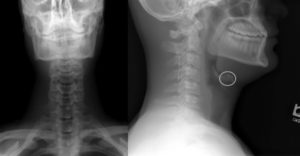
Hyoid bone fracture
In addition, the circumstances causing the disease are:
- severe allergies, accompanied by severe edema;
- swelling of the nasopharynx;
- angina;
- fear, holding down the cervical spine, a sensation of the so-called "lump in the throat" (neurogenic history);
- neurological pathology, if the nervous system is affected by progressive diseases.
True dysphagia disrupts the process of swallowing, prevents the passage of food from the mouth to the esophagus. Causes tongue stiffness syndrome, unable to form a lump for swallowing. Everything that needed to be swallowed goes into the nasopharynx and larynx. Subsequently, a reflex spasm and coughing occurs, which can lead to suffocation.
The functional one is manifested by painful sensations with impaired swallowing function. As a rule, it manifests itself exclusively with one type of food - spicy, salty, hard, liquid. The contents of the swallowed do not pass into the larynx and other respiratory organs. The swallowing reflex may be delayed.
Acute difficulty swallowing due to inflammatory diseases of the pharynx is often caused by paratonsillitis or an abscess in the pharyngeal region. Paratonsillitis is a complication of tonsillitis that appears when the infection spreads. An abscess is a purulent formation.
With a disease of the esophagus, you can swallow painlessly, but in the abdomen, more precisely, in the upper part, there is an acute pain after eating. Often there is an unpleasant aftertaste and involuntary ejection of food from the stomach into the mouth. Unpleasant sensations in the stomach become pronounced when bending and at night, especially if the last meal happened less than 2-3 hours before bedtime. There is a hoarseness of the voice, salivation, possibly choking. The ailment occurs only when eating food of a solid structure, reduces pain with drinking water.
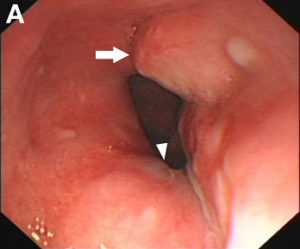
Esophageal dysphagia
In children, similar causes of the disease are more common:
- Cerebral palsy. The disease causes a breakdown in the functioning of the child's nervous system.
- Athetosis is uncontrollable tics.
- Many other diseases such as sclerosis, brain tumor, polio. Advanced inflammatory disease.
- Hereditary predisposition.
- Serious illness or deficiency of vitamins and minerals in the mother's body during pregnancy.
- Enlargement of the thyroid gland, lack of iodine.
- Surgery of the oropharynx and adjacent organs that have disrupted the functioning of the system.
- Tumors.
Treatment and first aid
Difficulty swallowing sometimes results from a medical condition. Dysphagia should be treated with topical agents that relieve its symptoms. To normalize the work of the esophagus, antispasmodics are used. A lightweight diet is shown; local anesthetics should be used before meals.
With esophagospasm, the situation will be improved by physiotherapy - electrophoresis on the region of the cervical nodes.
When providing emergency assistance, in the case of a true one, it is required first to clear the airways of foreign objects in order to avoid suffocation. Subsequent therapy of this type of complication is carried out in a hospital under the supervision of a physician. In exceptional cases, the intake of food and water through a tube is required.
To provide first aid for food dysphagia, heartburn medications that reduce acidity are needed. Subsequently, treatment for esophagitis is required.

In the case of esophageal dysphagia, maintenance of dietary rules is required. It is necessary to eat at least 4 times a day in small portions, exclude dry and solid foods from the diet. Avoid hasty snacks, chew food thoroughly. Eliminate bending forward for a couple of hours after eating, do not overeat before going to bed. The menu can only consist of simple, fast-digesting foods. Fried, salty, fatty, smoked, fast food, carbonated drinks, alcohol and drinks containing caffeine are contraindicated. It is better to eat more fermented milk products.
Stroke dysphagia often complicates treatment procedures. After an attack, the swallowing reflex can be restored only after 2-3 weeks. During this period, you need to be especially careful about caring for the patient after a stroke and follow the rules:
- Before treatment or attempts to feed, you need to ask the patient to cough up and swallow saliva, then give him a spoonful of water. If the liquid flows freely, you need to feed through a tube.
- Give food and water in small portions.
- For feeding, choose food of a coarse structure. Serve flavorful and mouth-watering meals.
- Feeding should be done while sitting.
- Drinks should be served only before or after meals.
- Avoid throwing back the head and hurrying the patient while eating.
If the inability to swallow is due to neuralgia, speech therapist classes will help to overcome the disease. Treatment includes speech therapy and massage. The reproduction of habitual movements helps to restore the swallowing reflex - coughing, yawning, gargling, whistling, snoring, and swallowing porridge.
In acute inflammatory diseases of the pharynx, local warmth and rinsing the oropharynx with disinfectant solutions are considered emergency care. Antibiotic injections directly into the affected tissue, taking antipyretic drugs. If an abscess has developed on the tissue affected by the infection, then you need to go to the hospital for its autopsy. Such a system of methods will relieve acute symptoms. With prolonged inflammation of the pharynx, hospitalization in the otolaryngology department or surgery is recommended.
Folk remedies
Self-treatment with folk remedies is unacceptable, since diagnosis is required before therapy, and often there is a need for surgery. If the first sign of dysphagia appears, you need to see a doctor. Any intervention is appropriate only with the agreement of the doctor. Sometimes natural remedies can help relieve pain and soreness.
If you have difficulty swallowing due to nasal congestion, drip aloe or beet juice into your nose to make breathing easier. You can put cotton swabs soaked in propolis tincture in your nose for 10 minutes.
Inflammations of the oral cavity and pharynx are removed by rinsing with an aqueous solution with the addition of propolis or with soda, salt and iodine. You can take one sip daily of a decoction of crushed orange peels and mint.
Gargling with sage or furacilin has a good healing effect.
In the case of dysphagia of the esophagus with inflammation, an infusion of oregano decoction, taken 3 times a day before meals, can stop the pathology and heal wounds. If the cause of the ailment is neurology, tincture of red hawthorn in boiling water will help. You need to take three times a day before meals. The rest of the causes of the disease require the appointment of a treatment system, determined exclusively by the doctor.