
Diarrhea after antibiotics - how to treat: first aid and effective remedies!
An upset stomach with diarrhea can happen to anyone for a variety of reasons. No one is immune from this, especially with improper or unhealthy diet, high probability ingestion of infection and other aggravating factors that a modern person faces constantly. Another thing is the manifestation of diarrhea as a consequence of a serious illness. In this case, it will not be episodic and easily passing, but a persistent symptom, signaling that not everything is in order in the body. But there is also a third type of diarrhea that occurs after taking antibiotics. Why is it formed, what is it fraught with, and how to treat such an anomaly.

Diarrhea after antibiotics - how to treat
Content
- 1 "Itself" will not work
-
2 What to do first
- 2.1 Gastric lavage
- 2.2 Fight dehydration
- 3 Taking medication
-
4 Diet regimen
- 4.1 Video - Antibiotic-associated diarrhea. Diagnostics and treatment
- 4.2 Video - How to restore the intestines after taking antibiotics. Pain after taking antibiotics
"Itself" will not work
First of all, it should be noted that in our society, going to a doctor with complaints of diarrhea is not a common phenomenon. Most citizens hope that the unpleasant phenomenon will go away "by itself." And in cases with household food poisoning, this is the case. But when antibiotics get down to business, destroying the intestinal microflora at an accelerated pace, the body must be helped to defeat the diarrhea caused by this process.

The effect of antibiotics on the microflora of the gastrointestinal tract
By the way. Even if diarrheal symptoms go away on their own, it does not leave a trace. They leave behind at least irritated mucous membranes, toxins and dehydration.

Causes and mechanism of development of antibiotic-associated diarrhea
It is clear that diarrhea is not a disease, but only a symptom. This is how the body makes the brain pay attention to the fact that something is wrong with it. In the case of drug-induced diarrhea, formed by taking antibiotics, it is a symptom of intoxication of the body and destruction of microflora. The degree of destruction is proportional to the strength and intensity of the manifestation of the symptom.

The thing is that when antibiotics are taken orally in the form of capsules or tablets, not only pathogenic bacteria are destroyed, but also useful ones that are responsible for the normal functioning of the intestine.
By the way. It is not easy to believe in this medical fact, but poisoning with medicines that have antibiotic properties occurs with almost the same frequency as household food poisoning. That is, for every three cases of diarrhea, one of them is medication. This is by no means because incompetent doctors are giving patients “bad” pills that do harm instead of treatment.

Antibiotics as a Cause of Diarrhea
Everything is much more complicated. Most patients prescribe medicines for themselves, because they do not like going to the doctor, not only because of diarrhea. "On its own" should go away if a person caught the flu or a cold, got cold or pulled his back, or felt pain in a carious tooth. As long as the pain can be tolerated, he will do it, helping himself with pain relievers and antibiotics, picked up on the Internet or recommended by a neighbor, while violating the dosage and exceeding the recommended terms of admission.

With an increase in temperature and general weakness, a doctor's call is necessary
Important! If diarrhea occurs due to medication taken by an unauthorized doctor, stop taking it and go to the clinic for medical help. If the diarrhea is severe, dehydration is rapid, everything is accompanied by vomiting and fever, call a doctor at home.
In fairness, it must be said that diarrhea occurs after officially prescribed antibiotics. As a side effect, it, like nausea and many others, is prescribed in the drug's instructions. In this case, the doctor decides to continue or stop taking the medicine. Various options are possible - from replacing the antibiotic to continuing to take it, if it is impossible to replace it, and the risk from not taking it outweighs the harm caused to the body by diarrhea.

Side effects of antibiotics
What to do first
It is very important, without waiting for the development of symptoms, at the very first signs of drug-induced diarrhea, to rid the body of the source that caused it. Medications taken are not immediately removed from the body, therefore it is necessary to stop using antibiotic agent as early as possible - its effect will persist for several more hours, worsening diarrhea.

Stop taking antibiotics first
The fight against any form of this pathology begins with the cleansing of the body of toxins. In order not to wait until the effect of the taken antibiotics aggravates the situation, you can wash your stomach at home.
By the way. Medicines taken orally enter the stomach first through the esophagus. There they dissolve and are absorbed through the gastric walls into the bloodstream, which carries the drug to the site of exposure. Part of the working agent remains in the stomach and is excreted through the intestines. Thus, the drug has an effect on the entire body, and not only on the pathological point, the state of which is intended to normalize.

Antibiotic action
Gastric lavage
To cleanse the body of residual medicinal substances in case of severe poisoning by them, the stomach is washed. It is quite possible to do it yourself as follows.
- Take five liters of water.
- Bring to room temperature.
- Dissolve salt or baking soda in full in the amount of two tablespoons.
- Begin to take a solution of half a liter every five minutes.
- If after the first dose of vomiting does not occur, induce it by applying pressure on the root of the tongue.

How to induce vomiting
Advice. Many sources recommend using potassium permanganate. It is better not to do this, since the substance is difficult to dose (very little is needed for the full volume so that its color remains light pink). In addition, particles of a substance not completely dissolved can burn the mucous membrane.
It is necessary to repeat the reception until the liquid that is poured out of the body in the form of vomit becomes transparent and clean.

It is better not to use a solution of potassium permanganate.
Fight dehydration
The second step in eliminating drug-induced diarrhea is eliminating dehydration caused by it. Yes, there are medicines to stop diarrhea and normalize stools, but before you start taking them (again, it is better to do this as directed by a doctor), you need to take care of the restoration of water-salt balance.

Drink plenty of fluids
Advice. If any diarrhea, including that caused by antibiotics, persists for more than three days and the temperature is kept and vomiting does not stop or the feeling of nausea remains, go to the doctor necessarily.
First you need to drink. Just water or herbal tea, or fruit drink, compote. You will need a lot of liquid, about ¾ glass every 20 minutes. Dehydration with diarrhea is a much more serious problem than it seems, and it comes on sooner than most people think. The first signs may appear as early as four hours after the onset of diarrhea.

Personal hygiene items must be individual
Taking medication
The next step is to take enterosorbents. To solve the problem that has arisen from drugs with other drugs will seem absurd to some. But enterosorbents are a group that is able to absorb, bind and remove toxins left in the gastrointestinal tract by antibiotics. This is followed by probiotics and fermented preparations that will restore the environment. In parallel, you can use auxiliary folk methods.
Table. Drugs for the treatment of diarrhea after antibiotics.
| Group of drugs | Name of drugs | Action |
|---|---|---|
 Enterosorbents |
· Activated carbon; · Enterosgel; · "Polysorb"; · "Smecta"; · "Lingin"; · "Neosmectin". |
This group of drugs in the composition contains components that are capable of attaching toxins to themselves, deactivating and removing them from the body through defecation. Substances of similar action are found in food: bran, vegetables, algae, fruits. |
 Probiotics |
· "Linex"; · "Bifidumbacterin"; · "Khilak-Forte"; · "Lactobacterin". |
They are needed to reanimate the intestinal mucosa and normalize its activity. These are microflora restorers, which can also be either tabletted or natural. For example, probiotics are found in fermented milk products. But it is better to take probiotic preparations after diarrhea from antibiotics, for a speedy and effective effect. |
 Enzymes |
· "Loperamide"; · "Phtazol"; · "Enterobene"; · "Imodium". |
Medicines from this group contain enzymes that inhibit peristalsis, normalizing the consistency and frequency of stool waste. They need to be taken exclusively for medical purposes. |
 Folk remedies |
· wormwood; · Walnut partitions; · Alder bark; Sage; · Linden blossom; St. John's wort; · Oak bark; · Potentilla. |
Herbal remedies are used in the form of teas and decoctions. |
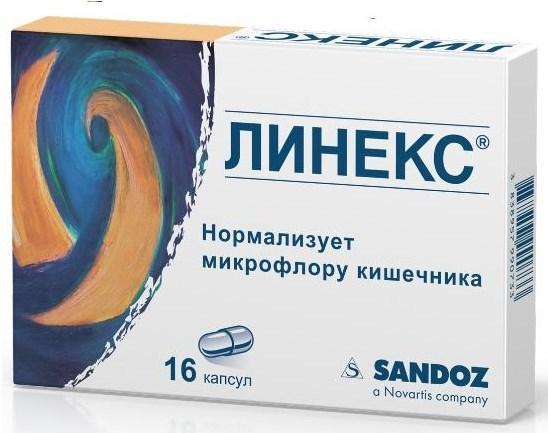
"Linex"
Diet regimen
The third "whale" in the fight against drug diarrhea is diet. Without its observance, it is impossible to get rid of pathology without consequences for the body. You will need a complete change in diet and adherence to a special diet for at least a few weeks.

Viscous liquid cereals - semolina and mashed buckwheat, steam omelet, rice broth soups
Important! If antibiotic intoxication is severe, it is equivalent to chemical poisoning. Symptoms include frequent profuse diarrhea and vomiting. And it is forbidden to sit down at this time at all, even if the stomach is already empty, and the feeling of hunger is unbearable.
The first day of diarrhea, you can only drink fluids, since the body must be completely cleansed of toxins. On the second day, you can enter a modified diet. The portions are minimal. All products are prepared only in the following ways of culinary processing:
- cooking;
- extinguishing;
- baking;
- steam method.

Fluid intake should be increased to 3 liters per day
What you can eat on the second and subsequent days of diarrhea treatment:
- raw bananas;
- baked apples or boiled and mashed apples;
- natural yogurt;
- boiled poultry and beef;
- cereal porridge on the water;
- boiled eggs;
- boiled fish;
- vegetables in soups or steamed, excluding beets;
- crackers.

Yogurt is good for your gut flora
At the same time, the use of an increased amount of liquids continues, to the range of which jelly is added.
Advice. Do not neglect salt and never go on a salt-free diet. Salt is needed at this stage to retain fluid in the body, eliminating dehydration.

Salt is not worth giving up
And a very important list of what should not be consumed until the final recovery from drug diarrhea.
- Milk and all derivatives from the product, except for sour milk.
- Any nuts and legumes.
- Bread products, especially freshly baked.
- By-products.
- Dried fruits.
- Confectionery products.
- All sweets.
- Coffee drinks.

Coffee drinks
- Smoked products.
- Soda and analogues.
- Raw vegetables and fruits (excluding bananas).
- Canned food.
- Mushrooms.
- Spices and other foods that have a pungent (sour) taste that are irritating.
- Alcohol.
The diet cannot be stopped after the diarrhea stops - it continues for another two weeks, then the usual foods are introduced one at a time.

Follow your diet for 2 weeks
Antibiotic diarrhea is not easy to treat, especially if you do it yourself without going to your doctor. If it is not completely cured, the pathology will take on a chronic form, and the tendency to diarrhea and indigestion will remain forever.


