
Green diarrhea in an adult
Normal functioning of the gastrointestinal tract is necessary for the full functioning of various body systems. There are several signs of indigestion: abdominal pain, flatulence, and diarrhea.
Diarrhea or diarrhea often occurs in both children and adults. Often, the feces with this disorder acquire a pathological color and contain impurities that should not normally be present in feces. Liquid green stools should especially alert the patient, as it indicates the development of various infectious diseases, dysbiosis or internal bleeding. To avoid the development of complications, it is necessary to pay attention to the presence of concomitant symptoms and seek medical help in a timely manner.

Green diarrhea in an adult
Content
- 1 Features of pathology
-
2 Green diarrhea in an adult
- 2.1 Dysbacteriosis
- 2.2 Enteritis
- 2.3 Intestinal bleeding
- 2.4 Video - Blood from the anus: what is the reason?
- 2.5 Pancreatitis
- 2.6 Poisoning
- 2.7 Video - What your chair is talking about
- 3 Indications for contacting a specialist
Features of pathology
Diarrhea or diarrhea is called loose stools. A similar violation occurs as a result of neurogenic disorders, diseases of the gastrointestinal tract, or the consumption of large quantities of foods that have a laxative effect. The most important thing in stopping diarrhea should be given to the diagnosis and treatment of the underlying disease that caused frequent bowel movements.
Attention! Long-term diarrhea poses a serious health hazard to the patient. Together with loose stools, a large amount of fluid and nutrients leaves the body. In the absence of therapy, such a violation can lead to dehydration and, as a result, dysfunction of the heart system.
Normally, during the day, the amount of feces excreted by an adult is approximately 150-250 grams, depending on the specifics of the diet. If the patient has an accelerated metabolism, bowel movements may become more frequent, but the amount of stool remains within the normal range. Diarrhea is diagnosed if the amount of fluid in the discharge begins to exceed 60-65% of the total mass.

Bristol Stool Scale
Stool characteristics in normal and pathological conditions
| Symptom | Norm | Pathology |
|---|---|---|
| Bowel frequency | 1-2 times during the day | 3-4 or more times a day |
| Stool consistency | Gruel | Creamy, liquid, flakes |
| Stool color | Light brown to dark brown | White, yellow, grayish, black, beige, green |
| The nature of the feces | Homogeneous | Heterogeneous, flakey, frothy, with food particles |
Experts identify two types of diarrhea:
- Sharp. It usually lasts for several days, up to a maximum of 2 weeks. Usually develops against the background of intestinal infections.
- Chronic. A similar pathology is diagnosed if stool disorders are noted for 14-15 days in a row or more. In this case, diarrhea is usually caused by motor dysfunctions in the digestive tract. Also, the chronic form of the disease is determined in patients with polyfecal matter: a condition in which, due to malabsorption, an increase in the volume of feces of more than 350 grams per day is noted.

Symptoms and signs of diarrhea
Diarrhea usually presents with the following symptoms:
- frequent loose stools, with various pathologies, the frequency of bowel movements can exceed 20 times during the day;
- abdominal pain of a spastic nature, tenesmus;
Attention! Tenesmus is a painful urge to defecate. Manifested by cutting, pulling or burning pains in the rectum.
- nausea due to severe spasms of the smooth muscles of the intestine;
- discoloration of feces, with diarrhea, feces can be whitish, yellowish, green, etc. flowers;
- weakness, fatigue, decreased blood pressure.
In the presence of infection, stool disorders are accompanied by hyperthermia and general symptoms of intoxication of the body: cephalalgia, vomiting, dizziness, and a sharp deterioration in well-being.

Causes of diarrhea
Green diarrhea in an adult
Normally, the color of feces varies from light to dark brown due to the high content of bile pigments. With diarrhea, feces may turn a beige color due to inadequate treatment of the chyme and increased fluid content in feces.
In a healthy person, feces can acquire a greenish tint in the following cases:
- eating a large number of green leafy crops: broccoli, lettuce, parsley, cilantro, etc.;
- excess in the human body of undigested calcium and iron;
- excessively rapid passage of food masses through the intestines, may occur as a result of taking laxatives;
- taking medications that can cause faeces to turn greenish or provoke dysbiosis;
- excessive secretion of bile as a result of the use of choleretic drugs;
- eating food with a high content of food colors: jelly, caramel, lemonade, etc.

Signs of travelers' diarrhea
If the green liquid stool persists for more than a day or is accompanied by any alarming symptoms, you need to seek help from a specialist. Such a condition may indicate the development of a number of pathological processes in the patient's body.
Dysbacteriosis
Dysbiosis or dysbiosis is a pathological condition that develops as a result of a violation of the microflora of the gastrointestinal tract. Dysfunction of the digestive system in this case is due to a change in the ratio of the species composition of intestinal bacteria.
In patients with dysbiosis, the number of beneficial bifidobacteria and lactobacilli required for the normal process of food digestion is sharply reduced. At the same time, the content of pathogenic microorganisms is growing steadily. A similar disease develops under the influence of various factors, including due to the intake of antibacterial drugs, immunosuppressants, under the influence of negative environmental factors.

Causes contributing to the occurrence of diarrhea
The disease is accompanied by the following clinical picture:
- Painful sensations in the abdomen, most often localized in the lower half of the abdominal cavity. The patient may complain of stabbing, cramping, or bursting pain. Unpleasant sensations can migrate as a result of the movement of feces in the intestinal lumen.
- Dyspeptic symptoms. Due to the lack of beneficial microorganisms, the process of intestinal digestion is disrupted. Chyme is not digested, ferments and rotts. As a result, the patient develops flatulence, rumbling and seething in the abdomen, rotten belching, diarrhea. Feces with flatulence are usually light yellow or greenish in color.
- Malabsorption syndrome. This condition is manifested by impaired absorption of various nutrients in the intestine, which ultimately leads to the development of anemia, impaired ionic balance, calcium deficiency, etc.
- Allergic reactions to various foods. Urticaria, bronchospasm, edema, stool disturbances and nausea occur. These disorders are especially common in young children.
Attention! Often, dysbiosis develops as a result of taking antibacterial or cytostatic drugs. To avoid the development of complications, such medicines should be used only in accordance with the recommendations of a doctor.
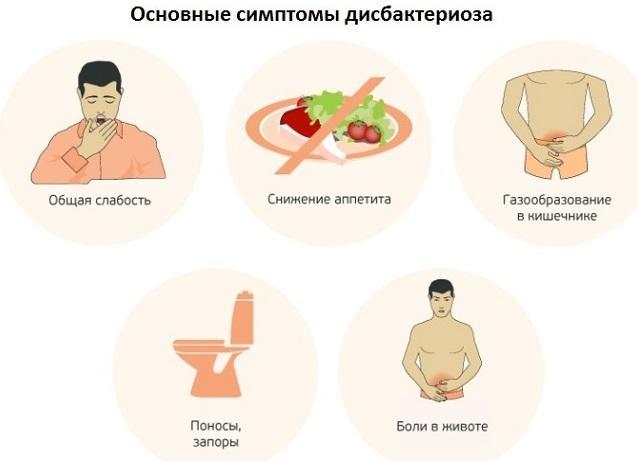
Intestinal dysbiosis symptoms
Therapy for dysbiosis involves adherence to a diet high in nutrients, amino acids, vitamins and trace elements. To restore the balance of the intestinal microflora, the patient is prescribed probiotics and prebiotics: Duphalac, Linex, Lactobacterin etc. Help normalize motor function Duspatalin, Trimedat, Meteospazmil, Imudon. To remove toxins and decay products of pathogenic bacteria from the patient's body, it is necessary to take sorbents: activated carbon, Polypefan, Pepidol.

Release form of the drug Duphalac
Enteritis
Enteritis is an inflammatory process that affects the small intestine. As a result of this pathology, a violation of its main functions occurs and dystrophic-degenerative processes develop. The disease is accompanied by a sharp deterioration in the patient's well-being. In the absence of timely therapy, the disease leads to dystrophic-degenerative changes in the mucous and submucous layer of the small intestine.

Description of the disease Enteritis
Attention! Enteritis can be both acute and chronic. The acute form of pathology is usually characterized by more pronounced symptoms and develops against the background of a bacterial or viral intestinal infection.
The disease manifests itself in a number of characteristic signs:
- Diarrhea. Enteritis is accompanied by a violation of the stool, while the number of bowel movements can reach 10-15 times during the day. Stools copious, watery, greenish or greenish-yellow in color.
- Nausea and vomiting. Attacks are noted on average 5-6 times during the first days from the onset of the disease. In this case, after vomiting, the patient's condition improves for some time.
- Bowel pain. The pain syndrome is sharp, piercing or spastic in nature.
- Hyperthermia. An increase in temperature in adult patients usually persists for 1-2 days from the moment the first clinical symptoms of pathology appear. Depending on the severity of the infection, subfebrile or febrile fever is determined.
- Symptoms of general intoxication: weakness, lethargy, drowsiness. A whitish coating appears on the tongue and, less often, on the inner surface of the patient's cheeks. The patient's skin is dry and pale, indicating dehydration.

Chronic enteritis
Disease therapy includes the use of antibacterial drugs: Lincomycin, Doxycycline, Metacyclin. To restore the intestinal microflora, the patient is prescribed Bificol, Colibacterin, Lactobacterin etc. To compensate for the protein deficiency, infusions are performed Minocrivina, Polyamine, Amikina etc.
Intestinal bleeding
One of the reasons why patients may be worried about frequent greenish bowel movements is the development of intestinal bleeding. Usually, such a symptom is one of the manifestations of various pathologies of the gastrointestinal tract. Depending on the form of bleeding, the color of feces can vary from intense black to brownish green. Greenish diarrhea usually occurs in patients as a result of a violation of the integrity of the wall of the small intestine.
In most cases, the pathology is accompanied by the following disorders of well-being:
- weakness, lethargy;
- nausea, vomiting;
- pallor of the skin, blueness of the nails;
- diarrhea, stool with blood inclusions;
- bouts of cold sweats;
- rapid but weak pulse;
- low blood pressure;
- discomfort in the abdomen.

Intestinal bleeding symptoms
The presence of a pathological process can be diagnosed using instrumental research methods: sigmoidoscopy, irrigoscopy, radiography, etc. Depending on the severity of the disorder, the patient is prescribed medication or surgical treatment.
Attention! In the absence of therapy, dysfunction of the digestive system progresses, gradually leading to the development of severe blood loss. The color of the feces becomes darker, scarlet streaks and blood clots gradually appear in the feces.
With the conservative treatment of intestinal bleeding, the patient is prescribed the following drugs:
- hemostatics: Aprotinin, Terliprissin, aminocaproic acid;
- blood replacement therapy: erythrocyte, platelet mass, cryoprecipitate etc.;
- with ulcerative bleeding Famotidine, Pantoprazole.
If therapy does not bring the desired result, the patient undergoes resection of the affected area and, if necessary, followed by the formation of an anastomosis.
Video - Blood from the anus: what is the reason?
Pancreatitis
Disruptions in the production of enzymes necessary for the normal process of digestion are reflected in the state of the gastrointestinal tract. The patient has indigestion, abdominal pain, flatulence, nausea. As a result of a malfunction of the pancreas, bile stagnation occurs or it is thrown into the stomach. In the course of this disorder, the patient may experience such a characteristic symptom of pancreatitis as green-gray frequent stools.
In addition, with pancreatitis, the following clinical picture is observed:
- Paroxysmal pain that is localized in the right hypochondrium. May be cutting, dull, or aching. With an exacerbation of the disease, the pain syndrome becomes shingles, extremely intense.
- Skin discoloration. The skin becomes grayish or yellowish.
- Nausea and hiccups. Often, patients experience sour or rotten eructations.
- Vomiting of bile, followed by short-term relief.
- After a short period after a meal, the patient develops symptoms of dyspepsia: bloating, excessive gas formation, a feeling of heaviness.

Pancreatitis
To diagnose pancreatitis, resort to the following measures:
- physical examination;
- clinical analysis of feces and blood;
- coprogram - a comprehensive study that allows you to determine the digestive ability of the digestive system;
- ultrasound examination of the pancreas and excretory ducts.
If the patient has calculi in the pancreas, he is shown surgery to remove the affected organ. Otherwise, conservative treatment is carried out, which involves adherence to a diet and the use of the following drugs:
- analgesics: Analgin, Baralgin, Spazmalgon;
- anti-enzymatic agents for relieving edema: Aprotinin, Contrikal;
- to stabilize the level of enzymes after the removal of the inflammatory process, it is prescribed Creon, Pancreatin, Mezim etc.
With the timely implementation of therapeutic measures, in most cases it is possible to prevent the development of complications such as diabetes, dysfunction of the adrenal cortex, etc.

Causes of green diarrhea
Poisoning
The feces can acquire a greenish tint if the patient is poisoned. Food or alimentary poisoning is a pathological process that occurs in the body as a result of the consumption of products containing toxins, pathogenic microorganisms or viruses. With improper preparation or storage of various dishes, the amount of harmful microflora in them increases dramatically. After entering the patient's body, the bacteria begin to multiply actively, which leads to general intoxication of the person.
Attention! Despite the fact that poisoning in most cases is the result of ingestion of the patient pathogenic microorganisms, the disease is not contagious and does not pose a danger to others.
Poisoning is manifested by the following symptoms:
- cephalalgia and dizziness;
- cutting or cramping abdominal pain;
- nausea, profuse vomiting, relieving;
- diarrhea, the color of feces can range from an earthy gray to green or yellowish;
- flatulence, bloating;
- myalgia, muscle weakness;
- pallor of the skin;
- lethargy, a sharp deterioration in health.

Important early signs of poisoning
Therapy for poisoning is aimed at removing toxins from the patient's body and normalizing the digestive system. If necessary, the patient is given a gastric lavage or a cleansing enema is given. In addition, treatment for this disorder includes the following:
- taking activated carbon or other adsorbents;
- drinking enough clean cool water or warm, weak sweet tea to prevent dehydration;
- providing the patient with complete rest;
- during the acute period of poisoning, refusal to eat any food.
Video - What your chair is talking about
Indications for contacting a specialist
There are a number of symptoms accompanying diarrhea, in the event of which the patient is indicated for urgent hospitalization:
- hyperthermia;
- severe abdominal pain;
- vomit;
- the appearance of streaks or blood clots in the feces;
- repeated diarrhea that persists for more than a day.
In some cases, green diarrhea can be caused by eating large amounts of certain foods, acclimatization and other factors that do not pose a health hazard person. If the patient begins to be bothered by any alarming symptoms, he should urgently seek help from a specialist.


